

What This Calculator Does
The Calorie Surplus Calculator works out how many extra calories you need each day to gain a target amount of weight within a set time frame. It uses the widely cited rule that roughly 3,500 calories equals one pound of body weight, then adds that surplus to your maintenance calories (Total Daily Energy Expenditure, or TDEE) to give a clear daily intake target.
How to Use It
Enter your maintenance calories (TDEE) — the amount you burn per day at your current weight and activity level. Enter the amount of weight you want to gain in pounds, and the number of days you want to reach that goal. The calculator returns your required daily surplus, your total target intake, and an estimated weekly gain rate.
The Formula Explained
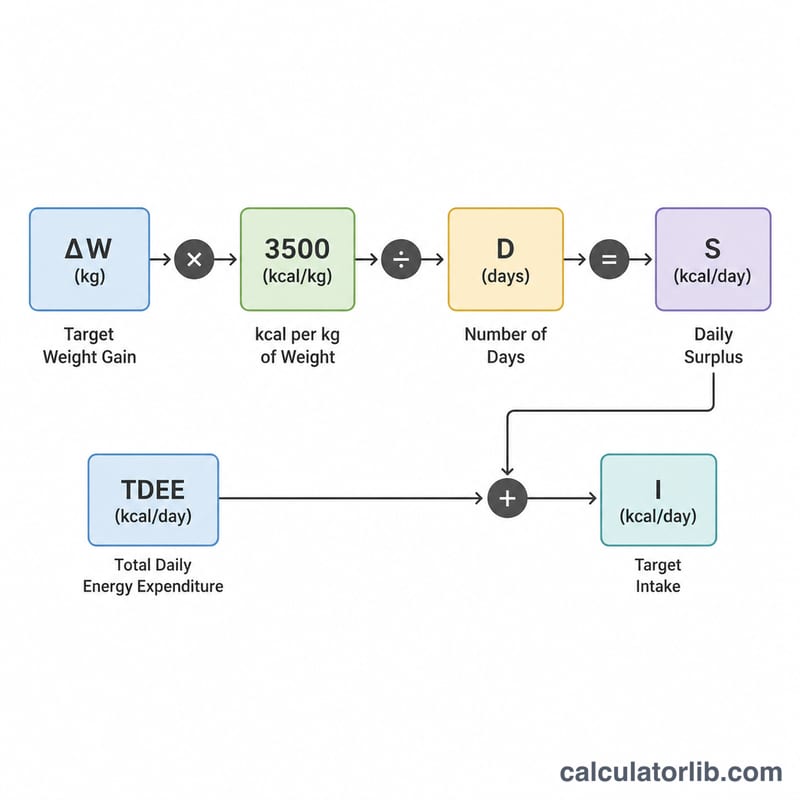
First the total extra energy is found: pounds to gain \(\times\) 3,500 kcal. Dividing by the number of days gives the daily surplus. Adding that to your TDEE gives the target daily calories. For sustainable, lean gains many coaches suggest a surplus of about 250–500 kcal per day; very large surpluses tend to add more fat than muscle.
$$\text{Target} = \text{TDEE} + \frac{\text{Gain (lb)} \times 3500}{\text{Days}}$$ $$\text{where}\quad \left\{ \begin{aligned} \text{Daily Surplus} &= \dfrac{\text{Gain (lb)} \times 3500}{\text{Days}} \\ \text{Weekly Gain} &= \dfrac{\text{Gain (lb)}}{\text{Days}} \times 7 \end{aligned} \right.$$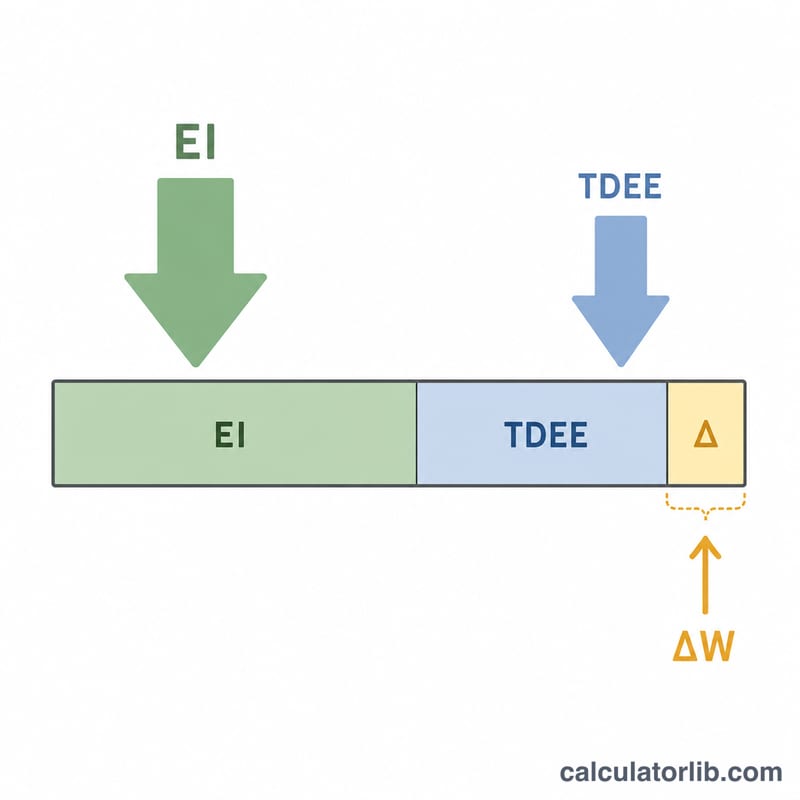
Worked Example
Suppose your TDEE is 2,500 kcal/day and you want to gain 10 lb in 60 days. Total energy = \(10 \times 3500 = 35{,}000\) kcal. Daily surplus = \(35{,}000 \div 60 \approx 583\) kcal. Target intake = \(2{,}500 + 583 \approx 3{,}083\) kcal/day, gaining about 1.17 lb per week.
Surplus Scenarios Compared
The table below assumes a fixed maintenance level of TDEE = 2,500 kcal/day and varies the total weight to gain (5, 10, 15 lb) and the time frame (30, 60, 90 days). The daily surplus is computed as \(\frac{\text{Gain (lb)} \times 3500}{\text{Days}}\), the target intake adds that surplus to TDEE, and the weekly gain rate is \(\frac{\text{Gain}}{\text{Days}} \times 7\). Scenarios whose surplus falls within the lean 250–500 kcal/day range are flagged as sustainable for minimizing fat gain.
| Gain | Days | Daily surplus (kcal) | Target intake (kcal) | Weekly gain (lb) | Lean range? |
|---|---|---|---|---|---|
| 5 lb | 30 | 583 | 3,083 | 1.17 | No — aggressive |
| 5 lb | 60 | 292 | 2,792 | 0.58 | Yes |
| 5 lb | 90 | 194 | 2,694 | 0.39 | Below — modest |
| 10 lb | 30 | 1,167 | 3,667 | 2.33 | No — very aggressive |
| 10 lb | 60 | 583 | 3,083 | 1.17 | No — aggressive |
| 10 lb | 90 | 389 | 2,889 | 0.78 | Yes |
| 15 lb | 30 | 1,750 | 4,250 | 3.50 | No — very aggressive |
| 15 lb | 60 | 875 | 3,375 | 1.75 | No — aggressive |
| 15 lb | 90 | 583 | 3,083 | 1.17 | No — aggressive |
Notice that the same total gain becomes far more sustainable as the time frame lengthens: spreading 10 lb over 90 days drops the surplus into the lean range, whereas 30 days forces an aggressive surplus likely to add substantial fat. You can verify a TDEE of 2,500 kcal with a TDEE calculator before plugging it in here.
Recommended Surplus & Gain Rates
For most people aiming to add muscle while limiting fat, a controlled "lean bulk" works best. The ranges below summarize widely used guidelines.
| Approach | Daily surplus | Typical weekly gain | Best for |
|---|---|---|---|
| Lean / minimal-fat | 250–500 kcal | ~0.25–0.5 lb | Intermediate & advanced lifters, body-composition focus |
| Moderate | 500–700 kcal | ~0.5–1 lb | Beginners & "hardgainers" wanting faster scale movement |
| Aggressive | 700+ kcal | 1+ lb | Short-term mass goals; expect more fat gain |
Recommended weekly gain rates by experience:
- Beginners: roughly 0.25–0.5 lb per week — newer lifters can build muscle quickly without a huge surplus.
- Intermediate: about 0.25 lb per week, often equal to a modest 250 kcal surplus.
- Faster bulk: up to ~1 lb per week, accepting that a larger share of the gain will be fat.
The core tradeoff: the body can only build muscle so fast, so any calories beyond what muscle growth requires are stored as fat. A larger surplus speeds up the scale but lowers the muscle-to-fat ratio of what you gain. This is general information, not personalized nutrition or medical advice; consult a qualified professional for individual guidance.
Interpreting Your Result
Your daily surplus number tells you how much to eat above maintenance; the target intake is the actual figure to hit each day. How you read it depends on the size of the surplus:
- Modest surplus (250–500 kcal): favors a higher muscle-to-fat ratio. Scale gains are slower, but more of the added weight is likely lean tissue, especially when paired with resistance training and adequate protein.
- Large surplus (700+ kcal): drives faster weight gain, but muscle protein synthesis has a ceiling — the excess is stored as fat. This may suit hardgainers or short bulks, but expect a longer cut afterward.
Why weekly gain rate matters: watching pounds-per-week is the most practical way to confirm your surplus is working. If you are gaining far faster than your target rate, the surplus is too high and you are likely adding excess fat; if the scale is flat over 2–3 weeks, your real TDEE is higher than estimated and you should increase intake.
Recalculate periodically: TDEE is not fixed. As you gain weight, your body burns more calories at rest and during activity, so the surplus that once produced a gain becomes mere maintenance. Re-estimate your TDEE every 5–10 lb of gain (or every 4–6 weeks) and re-run the calculation so your target intake keeps pace.
Key Terms Explained
- TDEE (Total Daily Energy Expenditure) / Maintenance Calories
- The total number of calories you burn in a day, including basal metabolism, digestion, daily movement and exercise. Eating exactly this amount keeps your weight stable, which is why it is also called maintenance calories.
- Calorie Surplus
- The number of calories eaten above TDEE each day. A consistent surplus is what causes the body to store energy and gain weight; \(\text{Surplus} = \text{Intake} - \text{TDEE}\).
- Target Intake
- The daily calorie goal that produces your desired gain by the target date — your TDEE plus the required surplus: \(\text{Target} = \text{TDEE} + \frac{\text{Gain (lb)} \times 3500}{\text{Days}}\).
- Weekly Gain Rate
- How fast you are gaining, expressed in pounds per week: \(\frac{\text{Gain (lb)}}{\text{Days}} \times 7\). It is the easiest real-world metric to track against your plan.
- 3,500 kcal-per-pound Rule
- A common estimate that one pound of body weight corresponds to roughly 3,500 calories. It is a useful planning approximation; real results vary with the muscle-to-fat composition of the gain and with metabolic adaptation.
FAQ
Is the 3,500-calorie rule exact? No — it is an estimate. Real weight change depends on body composition, water, and metabolic adaptation, but it is a solid planning guideline.
What surplus is best for muscle gain? A modest 250–500 kcal/day surplus paired with resistance training favors muscle over fat.
Should I recalculate over time? Yes. As you gain weight your TDEE rises, so update it every few weeks to stay on track.