
What the Equilateral Triangle Calculator Does
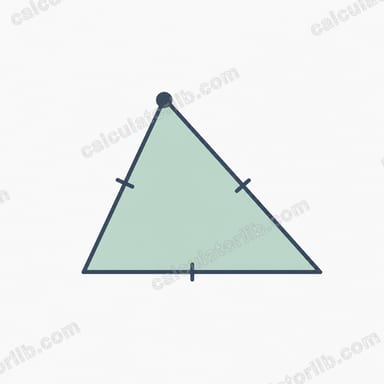
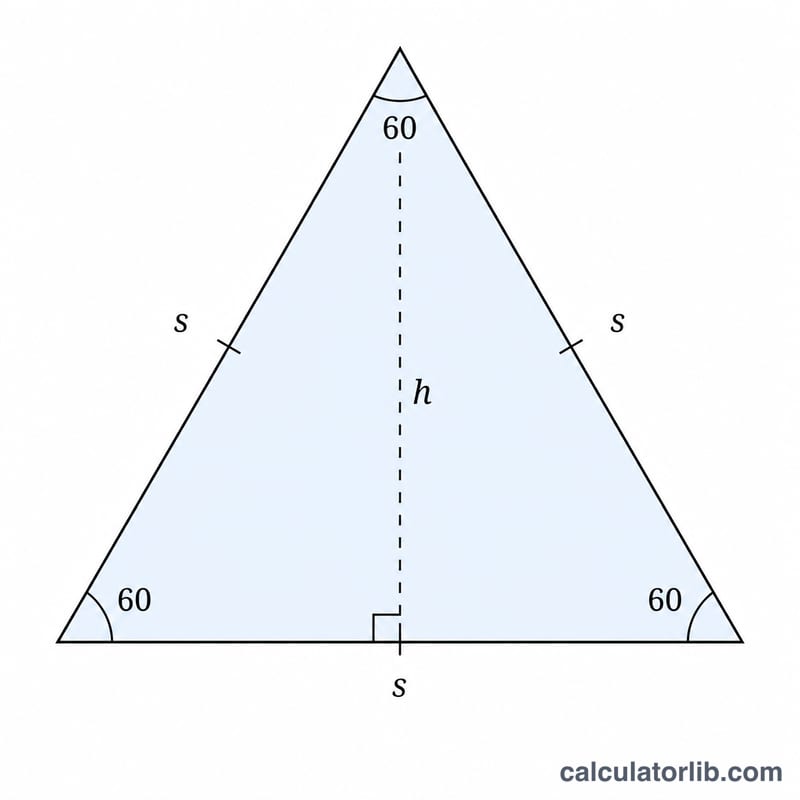
An equilateral triangle is a triangle in which all three sides are equal in length and every internal angle measures exactly 60°. Because of this perfect symmetry, knowing just one measurement — the side length — is enough to derive every other property. This calculator takes that single side length and instantly returns the area, perimeter, height, inradius, and circumradius.
How to Use It
The tool keeps things simple with just two inputs:
- Side Length — enter the length of one side of the triangle (any unit you like, e.g. cm, m, inches).
- Solve for — choose which value you want highlighted as the main result: Area, Perimeter, Height, Inradius, or Circumradius.
Whichever option you select, the calculator computes all five properties at once and presents your chosen value with its appropriate unit (square units for area, units for the rest).
The Formulas Explained
For a side length s, the calculator applies these standard equilateral-triangle relationships:
- Area: A = (√3 / 4) × s²
- Perimeter: P = 3s
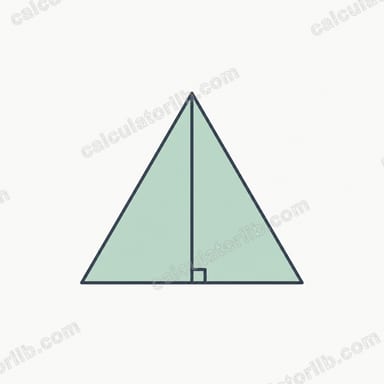
- Height: h = (√3 / 2) × s
- Inradius (radius of inscribed circle): r = s / (2√3)
- Circumradius (radius of circumscribed circle): R = s / √3
The √3 factor appears throughout because the height of an equilateral triangle splits it into two 30-60-90 right triangles.
Worked Example
Suppose you enter a side length of 6 and solve for area:
- Area = (√3 / 4) × 6² = 0.4330 × 36 ≈ 15.59 square units
- Perimeter = 3 × 6 = 18 units
- Height = (√3 / 2) × 6 ≈ 5.196 units
- Inradius = 6 / (2√3) ≈ 1.732 units
- Circumradius = 6 / √3 ≈ 3.464 units
Notice the circumradius is exactly twice the inradius — another consequence of the triangle's symmetry.
Frequently Asked Questions
Can I work backwards from the area or height? This calculator starts from the side length. If you only know the area or height, rearrange the formula first — for example, s = √(4A / √3) from the area equation — then enter that side length.
What units does it use? The tool is unit-agnostic. Whatever unit you enter for the side, the perimeter, height, and radii share that unit, while the area is in square units.
Why is the height shorter than the side? Because the height runs from a vertex to the midpoint of the opposite side, it equals about 0.866 (√3/2) of the side length — always shorter than the side itself.