
What is the Atoms to Moles Calculator?
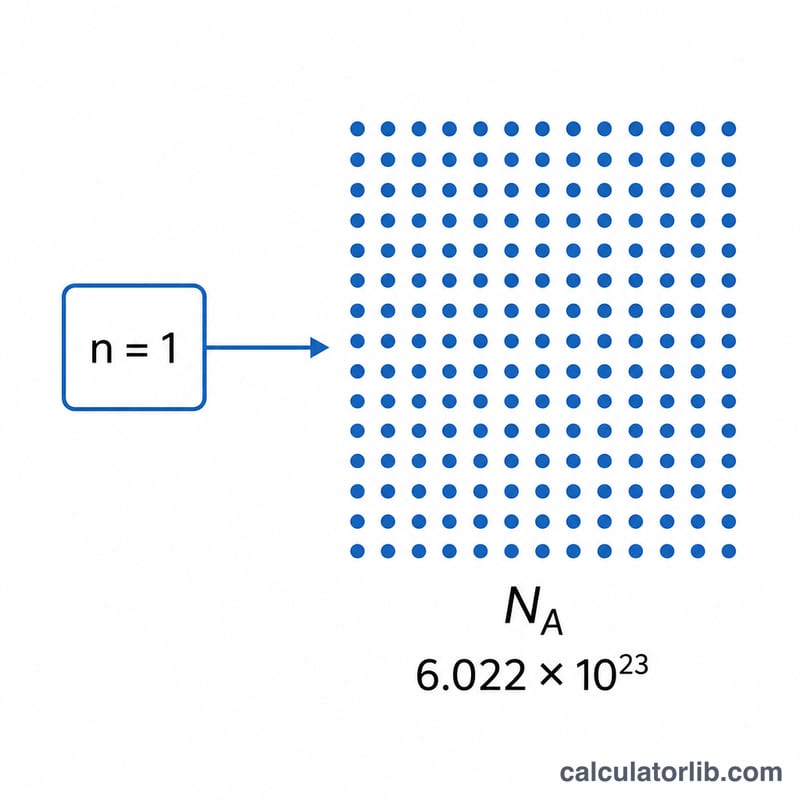
This calculator converts a raw count of particles — atoms, molecules, ions or formula units — into an amount of substance measured in moles. Because individual particles are far too numerous to count directly, chemists group them into moles using Avogadro's number, \(N_A = 6.022 \times 10^{23}\) particles per mole. Enter how many particles you have and the tool returns the equivalent number of moles.
How to Use It
Type the number of particles into the input box. You can use scientific notation such as 6.022e23 or 1.5e24, or a plain number. The calculator divides your value by Avogadro's number and displays the result in moles. This works equally for atoms and molecules — a "particle" is simply one countable unit of whatever you are measuring.
The Formula Explained
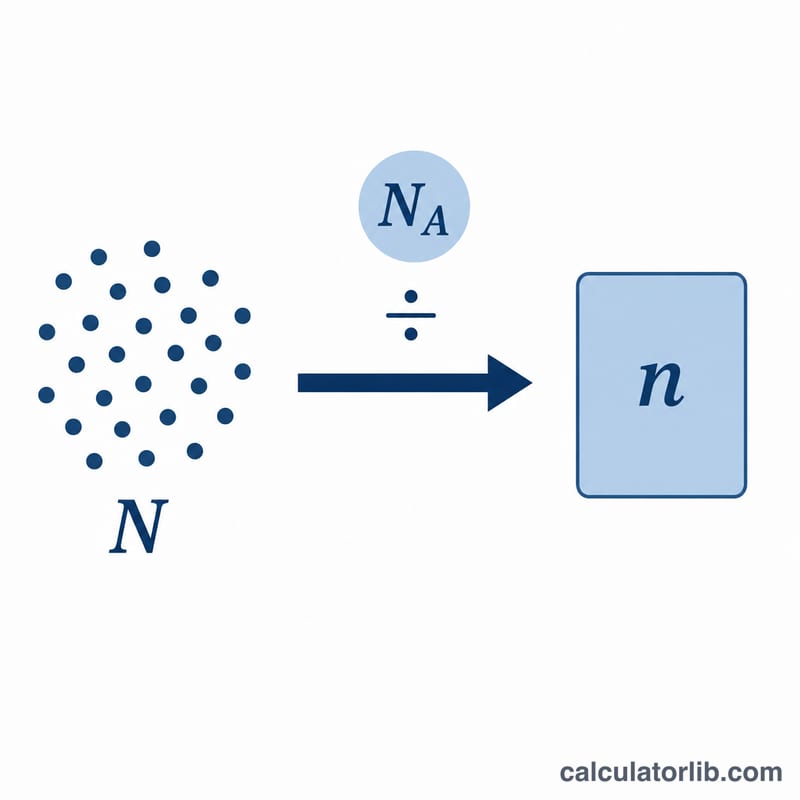
The relationship is $$n = \frac{N}{N_A}$$ where n is the amount in moles, N is the number of particles, and \(N_A = 6.022 \times 10^{23}\ \text{mol}^{-1}\) is Avogadro's number. Dividing a particle count by \(N_A\) scales it down to a convenient, lab-sized quantity. To reverse the process and find particles from moles, multiply: \(N = n \times N_A\).
Worked Example
Suppose you have \(3.011 \times 10^{23}\) molecules of water. Then $$n = \frac{3.011 \times 10^{23}}{6.022 \times 10^{23}} = 0.5\ \text{mol}.$$ So that many water molecules corresponds to exactly half a mole.
FAQ
Does this work for atoms and molecules? Yes. Avogadro's number counts any kind of elementary particle, so the same conversion applies to atoms, molecules, ions, or formula units.
How do I go from grams to moles instead? Divide the mass in grams by the molar mass (g/mol). To then get molecules, multiply the moles by Avogadro's number.
Can I enter scientific notation? Yes — values like 6.022e23 are accepted and recommended for very large counts.