
What this calculator does
This tool solves the basic percentage proportion part = (percent ÷ 100) × whole. Given a percent value and a whole (the total or base amount), it returns the corresponding part. It is the everyday "what is X% of Y" question, expressed as a proportion. The calculation is universal arithmetic and applies in any country or context.
How to use it
Enter the percent (for example 25 for 25%) and the whole (the total you are taking a percentage of). Press calculate and the part appears instantly, along with a breakdown of your inputs. Decimals and large numbers are supported.
The formula explained
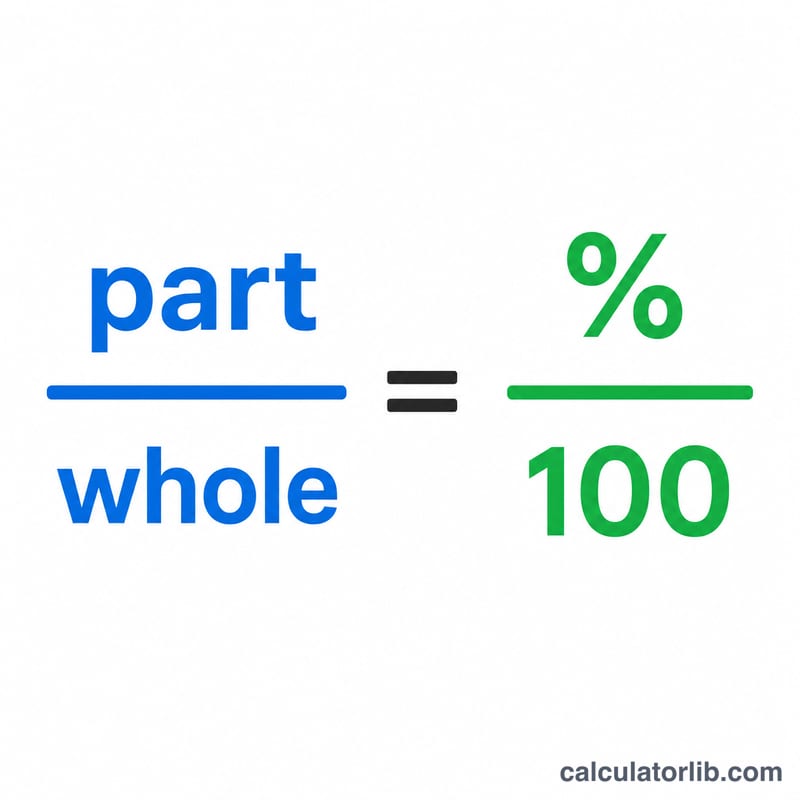
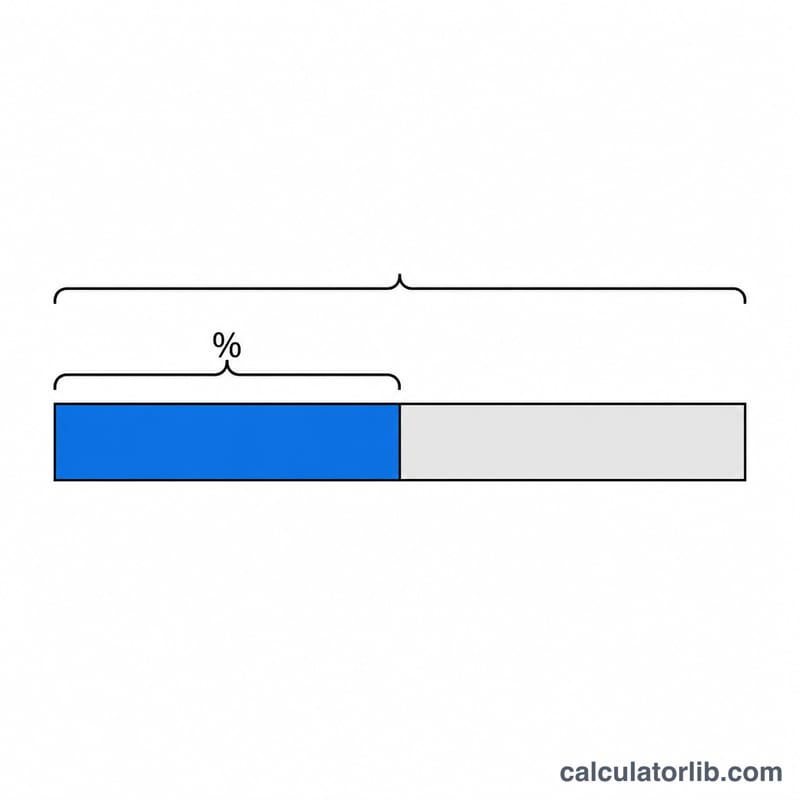
A percent is simply a number out of 100. To convert it to a multiplier you divide by 100, so 25% becomes 0.25. Multiply that multiplier by the whole and you get the part. This mirrors the proportion $$\text{part} / \text{whole} = \text{percent} / 100$$ rearranged to solve for the part.
$$\text{Part} = \frac{\text{Percent (\%)}}{100} \times \text{Whole}$$
Worked example
Suppose you want 25% of 200. Convert the percent: \(25 \div 100 = 0.25\). Multiply by the whole:
$$0.25 \times 200 = 50$$
So 25% of 200 is 50.
FAQ
Can the percent be more than 100? Yes. A percent of 150% with a whole of 80 gives \(1.5 \times 80 = 120\), which is larger than the whole — that is correct and useful for growth or markup figures.
Can I use decimals? Absolutely. Both the percent and whole accept decimal values, such as \(12.5\% \text{ of } 64 = 8\).
What if the whole is zero? Then the part is always zero, since any percent of nothing is nothing.