
What Is Return on Investment (ROI)?
Return on Investment (ROI) is one of the most widely used measures of profitability. It tells you how much money you made (or lost) on an investment relative to how much it cost you, expressed as a percentage. A positive ROI means the investment gained value; a negative ROI means it lost value. Because ROI is a ratio, it lets you compare very different investments — stocks, real estate, marketing campaigns, equipment purchases — on a level footing.
How to Use This Calculator
Enter two numbers: the Final Value (the total amount you received or the current worth of the investment) and the Cost of Investment (the amount you originally put in). The calculator subtracts cost from final value to find your net gain, divides that gain by the cost, and multiplies by 100 to express the result as a percentage.
The Formula Explained
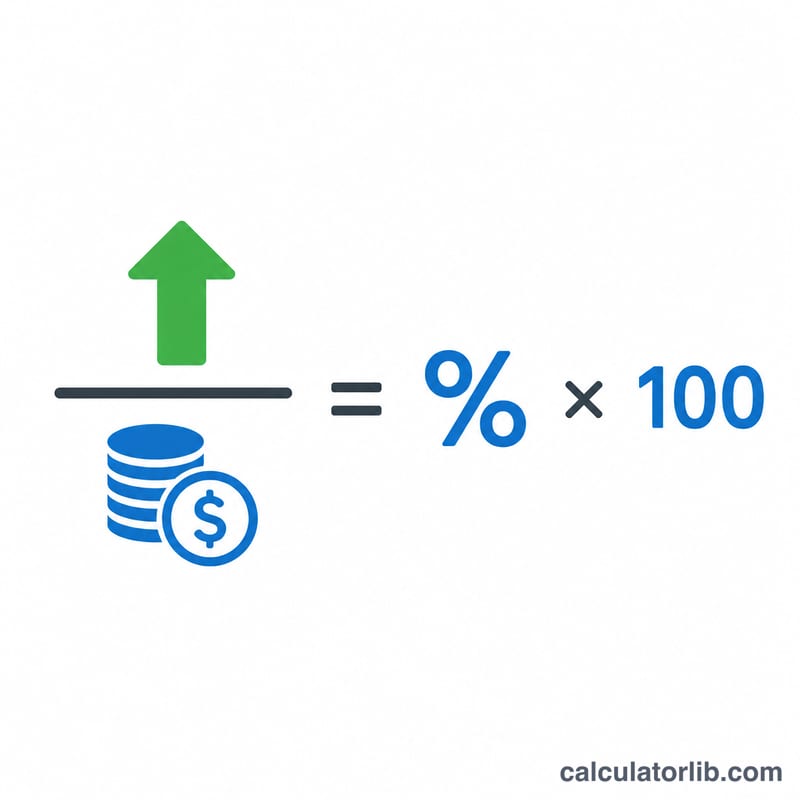
The ROI formula is:
$$\text{ROI} = \frac{\text{Net Gain from Investment}}{\text{Cost of Investment}} \times 100$$
where Net Gain = Final Value − Cost. Multiplying by 100 converts the decimal ratio into a percentage that is easy to interpret and compare.
Worked Example
Suppose you invest $10,000 in a stock and later sell it for $12,000. Your net gain is \($12{,}000 - $10{,}000 = $2{,}000\). Dividing the gain by the cost gives \(2{,}000 \div 10{,}000 = 0.20\), and multiplying by 100 gives an ROI of 20%. That means for every dollar you invested, you earned 20 cents in profit.
Frequently Asked Questions
Does ROI account for time? No. Basic ROI ignores how long the investment was held. To compare investments over time, consider annualized ROI or CAGR.
Can ROI be negative? Yes. If the final value is less than the cost, the net gain is negative and so is the ROI, indicating a loss.
Should I include all costs? For accuracy, the "Cost of Investment" should include fees, commissions, and other expenses, while the final value should reflect any income received plus the sale price.