
What This Calculator Does
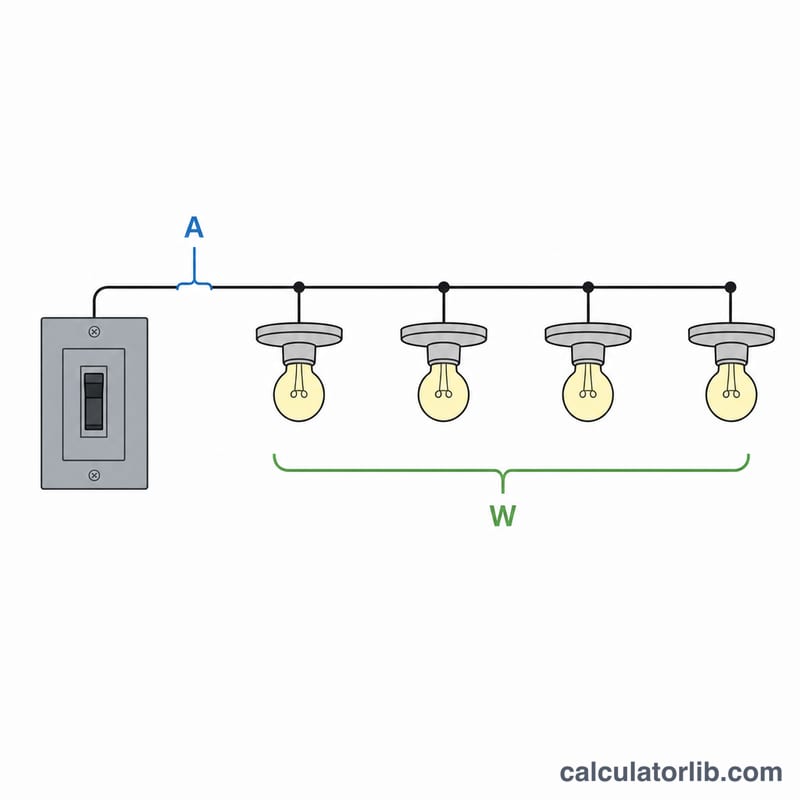
The Lighting Watts to Amps Calculator converts the total power consumption of your lighting (in watts) into the electrical current it draws (in amps) at a given supply voltage. Knowing the amperage helps you size circuit breakers, choose the correct wire gauge, and avoid overloading a circuit when planning a lighting installation.
How to Use It
Add up the wattage of every fixture or bulb on the circuit and enter the total in the watts field. Enter your supply voltage — commonly 120 V in North America or 230/240 V in Europe and many other regions. Finally enter the power factor: use 1 for resistive incandescent or halogen lamps, and roughly 0.9 for LED or fluorescent fixtures with electronic drivers (check the product label for the exact value). The calculator returns the current in amps.
The Formula Explained
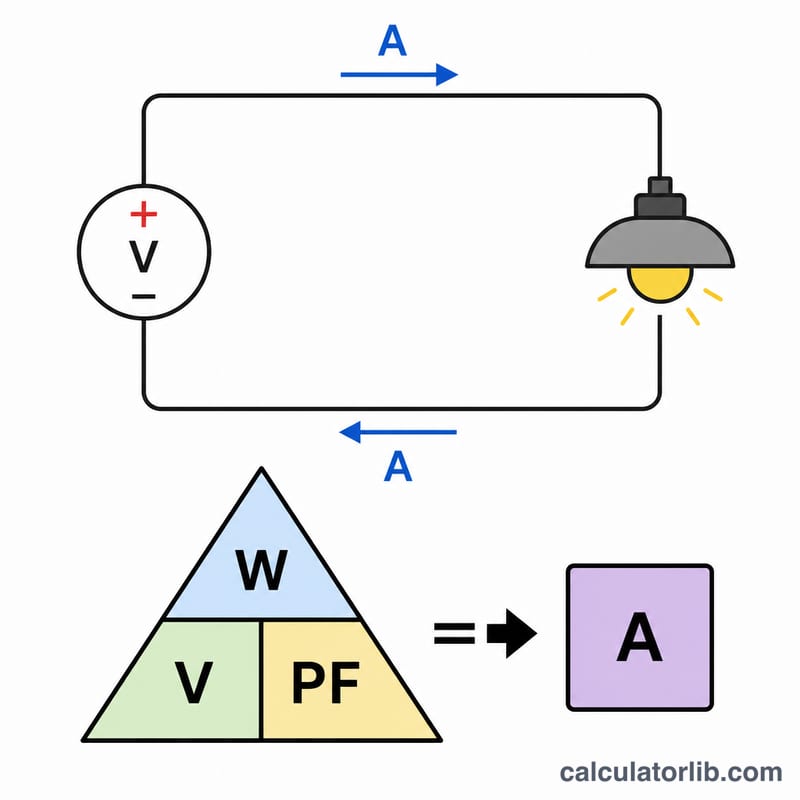
The relationship comes from the AC power equation \(P = V \times I \times PF\), rearranged to solve for current: \(A = W \div (V \times PF)\). Watts measure real power, volts measure electrical pressure, and power factor accounts for how efficiently the load uses that power. For simple resistive lighting the power factor is 1, so the equation simplifies to $$\text{Amps} = \frac{\text{Power (W)}}{\text{Voltage (V)}}$$
Worked Example
Suppose you have ten 60 W incandescent bulbs (600 W total) on a 120 V circuit with a power factor of 1. The current is $$600 \div (120 \times 1) = 5 \text{ amps}$$ That fits comfortably on a standard 15 A breaker. Switch to LED drivers with a 0.9 power factor and the same 600 W draws \(600 \div (120 \times 0.9) \approx 5.56 \text{ A}\).
FAQ
What power factor should I use? Resistive lamps (incandescent, halogen) are 1.0. Many LED and fluorescent fixtures range from 0.85 to 0.95 — check the spec sheet.
Why does voltage matter? At higher voltage the same wattage draws less current, which is why 230 V systems use thinner wiring than 120 V systems for the same load.
Should I leave headroom on a circuit? Yes. Continuous loads like lighting should not exceed 80% of the breaker rating, so keep a 15 A circuit under 12 A.