

What is the 5K Pace Calculator?
The 5K Pace Calculator turns your 5-kilometer finish time into an easy-to-read running pace, expressed in minutes and seconds per kilometer and per mile. It also reports your average running speed in km/h and mph. Whether you are training for your first 5K or chasing a personal best, knowing your target pace helps you run an even, controlled effort instead of starting too fast and fading.
How to use it
Enter your total 5K time using the hours, minutes, and seconds fields. For most runners the hours field stays at 0. Press calculate and the tool instantly shows your pace per kilometer (the primary result) plus your pace per mile and average speed. Use these numbers to set splits on your watch or to pick the right treadmill speed.
The formula explained
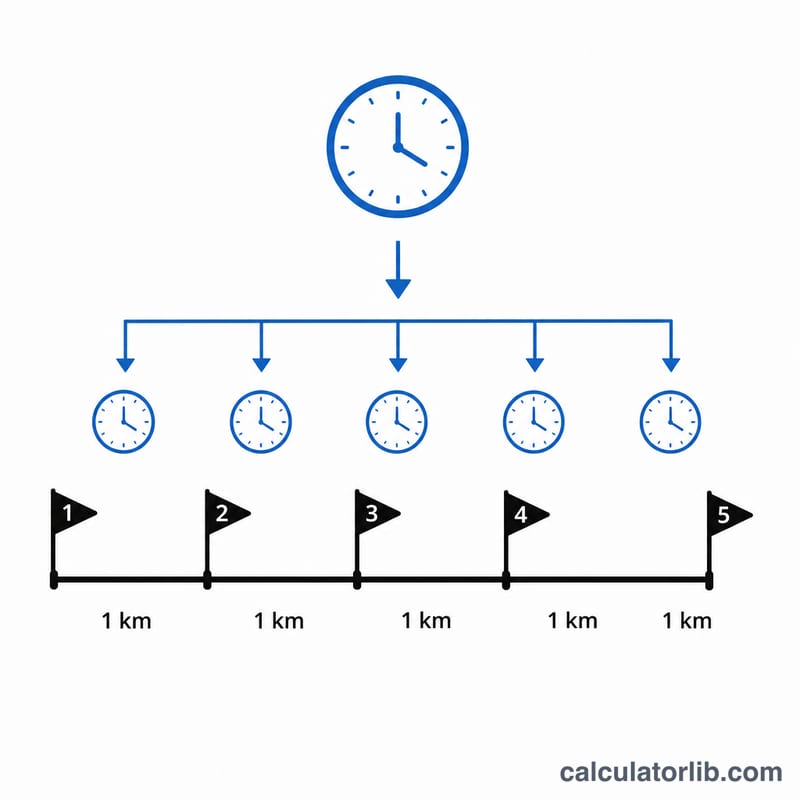
A 5K race is exactly 5 kilometers, which equals about 3.10686 miles. The math is simple division of total elapsed time:
$$\text{Pace}_{km} = \frac{\text{Total Time}}{5}$$ and $$\text{Pace}_{mi} = \frac{\text{Total Time}}{3.10686}$$. Average speed is distance divided by time, so speed (km/h) = \(5 \div \text{hours}\), giving a quick read on how fast you are moving.
Worked example
Suppose you run a 5K in 25 minutes (1500 seconds). Pace per km = $$1500 \div 5 = 300 \text{ seconds} = 5{:}00 \text{ min/km}.$$ Pace per mile = $$1500 \div 3.10686 \approx 482.8 \text{ seconds} \approx 8{:}03 \text{ min/mile}.$$ Your average speed is \(5 \text{ km} \div (1500/3600 \text{ h}) = 12 \text{ km/h}\), or about 7.46 mph.
5K Finish Time, Pace & Speed Reference Table
A 5K is exactly 5 kilometres (about 3.107 miles). Your pace per kilometre is simply your finish time in seconds divided by 5, and pace per mile is your finish time divided by 3.10686. Speed in km/h equals \(5 \div \text{hours}\); mph equals \(3.10686 \div \text{hours}\). The table below lists common 5K finish times with their corresponding pace and speed.
| Finish time | Pace /km | Pace /mile | Speed (km/h) | Speed (mph) |
|---|---|---|---|---|
| 15:00 | 3:00 | 4:50 | 20.0 | 12.43 |
| 18:00 | 3:36 | 5:48 | 16.67 | 10.36 |
| 20:00 | 4:00 | 6:26 | 15.0 | 9.32 |
| 22:30 | 4:30 | 7:14 | 13.33 | 8.28 |
| 25:00 | 5:00 | 8:03 | 12.0 | 7.46 |
| 27:30 | 5:30 | 8:51 | 10.91 | 6.78 |
| 30:00 | 6:00 | 9:39 | 10.0 | 6.21 |
| 32:30 | 6:30 | 10:28 | 9.23 | 5.74 |
| 35:00 | 7:00 | 11:16 | 8.57 | 5.33 |
| 40:00 | 8:00 | 12:52 | 7.5 | 4.66 |
For example, a 20:00 finish gives \(\frac{20 \times 60}{5} = 240\) seconds per km, or exactly 4:00/km, and a speed of \(5 \div (20/60) = 15.0\) km/h.
Pace Across Different 5K Goals
These four runner profiles show how finish time translates into pace and speed across a typical range from a beginner walk/run effort to a competitive club runner. Use them to gauge which target pace matches your current fitness and goal.
| Profile | Finish time | Pace /km | Pace /mile | Speed (km/h) | Speed (mph) |
|---|---|---|---|---|---|
| Beginner | 35:00 | 7:00 | 11:16 | 8.57 | 5.33 |
| Recreational | 28:00 | 5:36 | 9:01 | 10.71 | 6.66 |
| Intermediate | 23:00 | 4:36 | 7:24 | 13.04 | 8.10 |
| Competitive | 18:00 | 3:36 | 5:48 | 16.67 | 10.36 |
The intermediate runner finishing in 23:00 covers each kilometre in \(\frac{23 \times 60}{5} = 276\) seconds, which is 4:36/km. Holding that same pace over a longer race is a common next goal — for instance you can check what a 23:00 5K pace implies over the half-marathon distance with a half marathon pace calculator, or predict a longer race time using a Riegel-based race predictor.
FAQ
How many miles is a 5K? A 5K is 5 kilometers, which is approximately 3.10686 miles.
What is a good 5K pace? It varies by fitness, but many recreational runners finish between 25 and 35 minutes, giving paces of 5:00 to 7:00 per km. Beginners often start slower, which is perfectly fine.
Why is my mile pace slower than my km pace? A mile is longer than a kilometer (1.609 km), so it takes more time to cover, making the per-mile pace number larger.