
What Is the Absolute Reticulocyte Count?
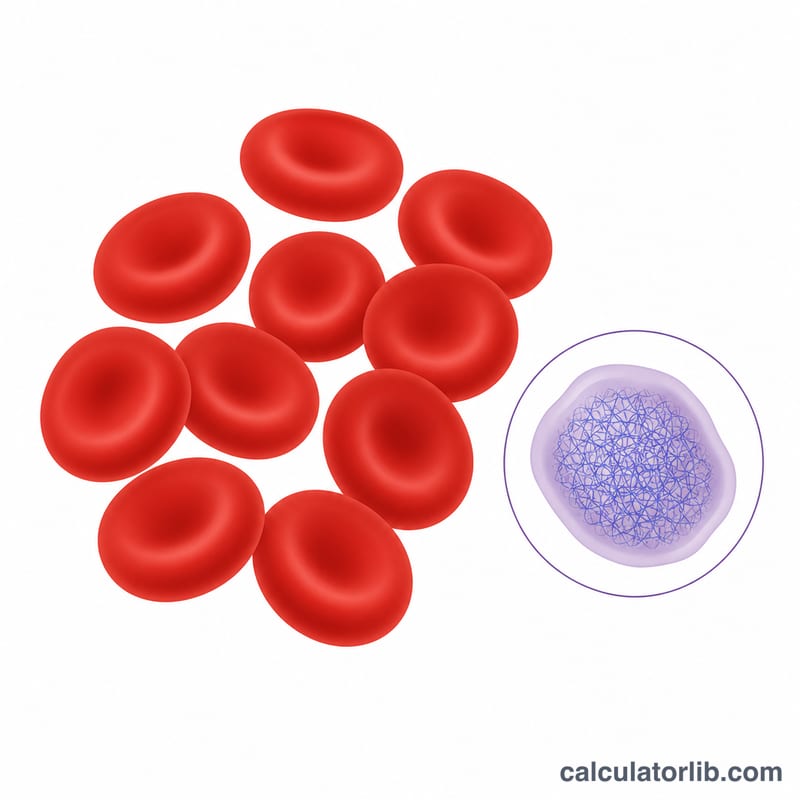
Reticulocytes are immature red blood cells released from the bone marrow. The absolute reticulocyte count (ARC) tells you how many of these young cells are circulating per microliter of blood. Because a reticulocyte percentage alone can be misleading in anemia, the ARC gives a more accurate picture of how well the bone marrow is producing red cells.
How to Use This Calculator
Enter two values from a complete blood count (CBC): the reticulocyte percentage (the proportion of red cells that are reticulocytes) and the RBC count in millions of cells per microliter (million cells/µL). The calculator returns the ARC in cells/µL.
The Formula Explained
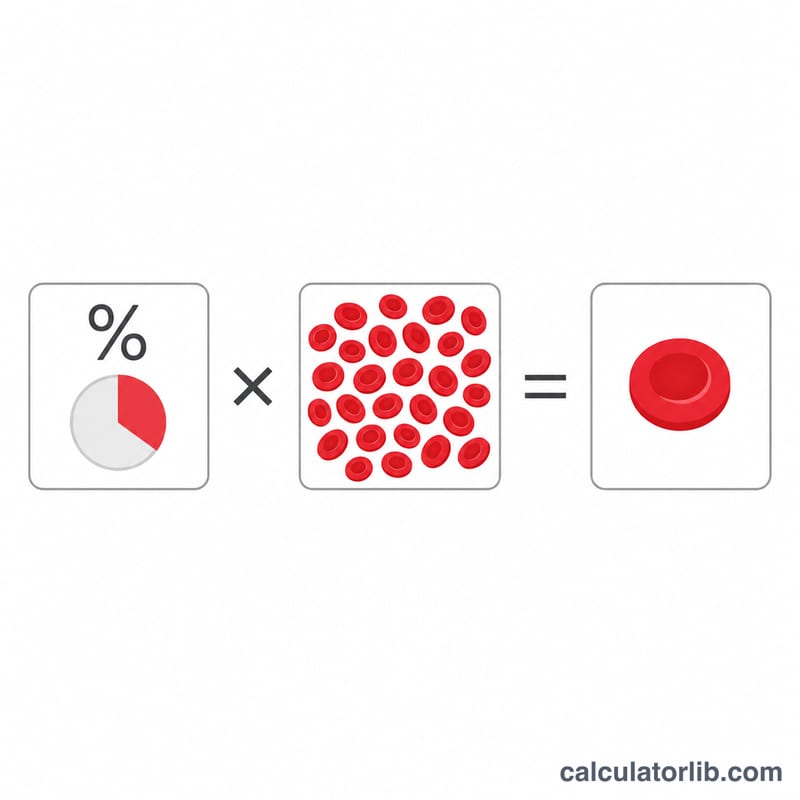
The calculation is simple:
$$\text{ARC} = \frac{\text{Reticulocyte \%}}{100} \times \text{RBC count}$$
Here the RBC count is converted to absolute cells per microliter (a value of 4.5 million/µL equals 4,500,000 cells/µL). Multiplying by the reticulocyte fraction gives the absolute number of reticulocytes.
Worked Example
Suppose a patient has a reticulocyte percentage of 2% and an RBC count of 4.5 million cells/µL. Then:
$$\text{ARC} = \frac{2}{100} \times 4{,}500{,}000 = 0.02 \times 4{,}500{,}000 = \textbf{90{,}000 cells/µL}.$$
A typical adult reference range is roughly 25,000–75,000 cells/µL, so this result suggests active red cell production.
Interpreting Your Result
The absolute reticulocyte count (ARC) expresses the actual number of immature red blood cells (reticulocytes) per microliter of blood, rather than just their relative percentage. Because the percentage alone can be misleading in anemia, the ARC is a more reliable indicator of how vigorously the bone marrow is producing new red cells in response to anemia.
| ARC (cells/µL) | Category | What it may indicate |
|---|---|---|
| < 25,000 | Low | Inadequate or hypoproliferative marrow response — seen with aplastic anemia, iron/B12/folate deficiency, chronic disease, or marrow suppression. The marrow is not compensating adequately for anemia. |
| 25,000 – 75,000 | Normal | Typical baseline production in a non-anemic adult. In the setting of anemia, a value in this range is generally considered an inadequate (hypoproliferative) response. |
| > 75,000 | Elevated | Increased erythropoiesis — consistent with hemolysis, recent blood loss, or recovery (for example, response to iron, B12, or folate replacement, or marrow recovery after suppression). |
For example, a reticulocyte percentage of 1.5% with an RBC count of 4.5 million/µL gives an ARC of 67,500 cells/µL — within the normal baseline range.
Because the percentage rises when the total red cell mass falls (without more reticulocytes actually being made), clinicians also use the corrected reticulocyte count and the reticulocyte production index to judge marrow response relative to the degree of anemia. The ARC should always be interpreted alongside the hemoglobin/hematocrit and the broader clinical picture.
This is general educational information, not medical advice. Only a qualified healthcare professional can interpret laboratory results in the context of your individual health.
Definitions & Glossary
- Reticulocyte
- A young, immature red blood cell newly released from the bone marrow that still contains residual ribosomal RNA. Reticulocytes typically mature into fully developed erythrocytes within about 1–2 days in circulation.
- Absolute reticulocyte count (ARC)
- The actual number of reticulocytes per microliter of blood, calculated from the reticulocyte percentage and the RBC count: \(\text{ARC} = \dfrac{\text{Reticulocyte \%}}{100} \times (\text{RBC} \times 1{,}000{,}000)\), reported in cells/µL.
- Reticulocyte percentage
- The proportion of red blood cells that are reticulocytes, expressed as a percent of total RBCs. Because it is a ratio, it can overstate marrow activity when the total RBC count is low.
- RBC count
- The number of red blood cells per unit volume of blood, commonly reported in millions per microliter (million/µL or ×10⁶/µL).
- Erythropoiesis
- The bone marrow process of producing new red blood cells. An increase in reticulocytes reflects accelerated erythropoiesis.
- Reticulocyte production index (RPI) / corrected reticulocyte count
- Adjustments to the reticulocyte percentage that account for the degree of anemia (and reticulocyte maturation time). The corrected reticulocyte count scales the percentage by the patient's hematocrit relative to a normal hematocrit, giving a truer picture of whether marrow output is adequate for the level of anemia.
Reference Values for Reticulocyte Counts
The values below are representative adult and pediatric reference ranges. Laboratory reference intervals vary by analyzer, method, and population, so always compare against the range reported by the testing laboratory.
| Population | Reticulocyte (%) | Absolute reticulocyte count (cells/µL) |
|---|---|---|
| Adults | 0.5 – 2.5% | 25,000 – 75,000 |
| Newborns (cord blood, first days) | 2 – 6% | ≈ 100,000 – 300,000+ |
| Infants (after ~2 weeks) | 0.5 – 3.5% | Approaches adult range |
Newborns physiologically have higher reticulocyte values, which fall toward adult levels over the first weeks of life. As a worked example, a reticulocyte percentage of 2.0% with an RBC count of 5.0 million/µL yields an ARC of 100,000 cells/µL.
Context — corrected reticulocyte count: when anemia is present, the reticulocyte percentage is often corrected for hematocrit so that the result reflects marrow effort relative to the red cell mass. A corrected value (or production index) above roughly 2–3 generally suggests an adequate marrow response to anemia, while a lower value suggests a hypoproliferative response.
FAQ
What is a normal absolute reticulocyte count? In healthy adults it is usually about 25,000 to 75,000 cells/µL, though laboratory reference ranges vary.
Why use ARC instead of reticulocyte percentage? The percentage depends on the total red cell count. In anemia a "normal" percentage can mask inadequate production, so the absolute count is more reliable.
Does this replace medical advice? No. This tool is for educational purposes. Always interpret lab values with a qualified healthcare professional.