
What is absolute uncertainty?
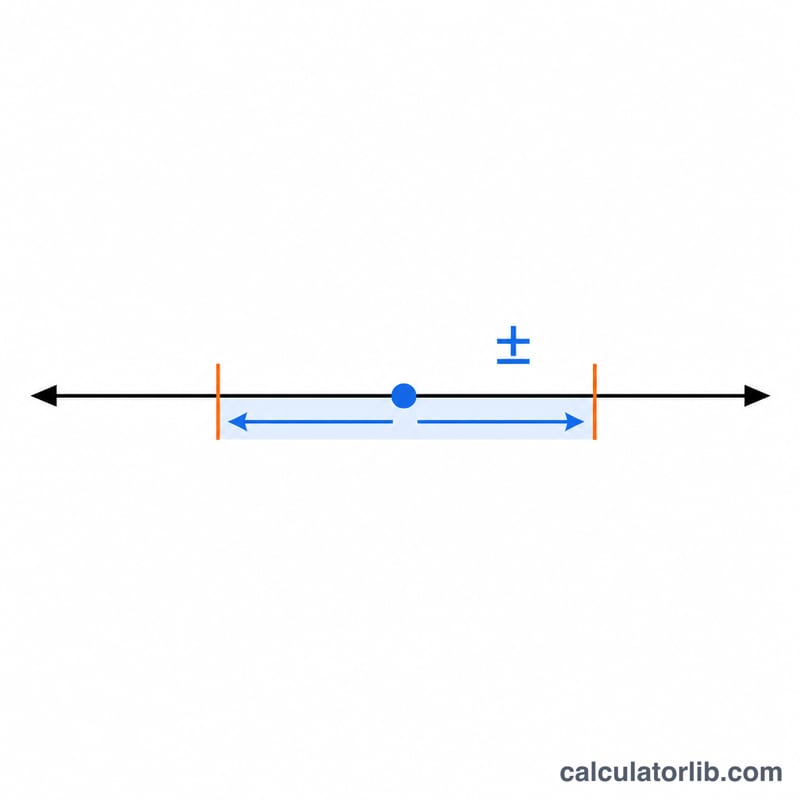
Absolute uncertainty is the amount of doubt in a measurement, expressed in the same units as the measurement itself. While relative uncertainty tells you how big the error is compared to the value (as a percentage or fraction), absolute uncertainty gives you a concrete ± figure. For example, a length of 100 mm with a relative uncertainty of 5% has an absolute uncertainty of ±5 mm.
How to use this calculator
Enter your measured value and the relative uncertainty as a percentage. The calculator multiplies the value by the relative uncertainty (converted to a fraction) and returns the absolute uncertainty, along with the lower and upper bounds of the expected measurement range.
The formula explained
The relationship is simply:
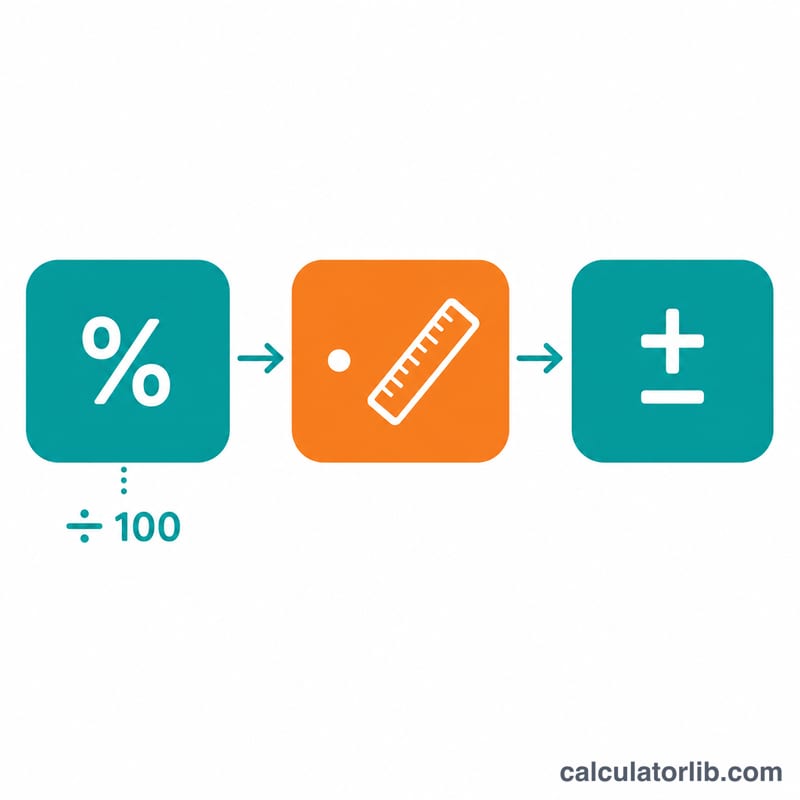
$$\text{Absolute uncertainty} = \dfrac{\text{relative uncertainty (\%)}}{100} \times \text{measured value}$$
Because the relative uncertainty is entered as a percentage, we divide by 100 to turn it into a fraction before multiplying. The result shares the same units as the measured value.
Worked example
Suppose you measure a resistor as 220 Ω with a relative uncertainty of 2%. The absolute uncertainty is $$\Delta x = \dfrac{2}{100} \times 220 = 4.4\ \Omega.$$ So the resistance is reported as \(220 \pm 4.4\ \Omega\), meaning the true value most likely lies between 215.6 Ω and 224.4 Ω.
How to Calculate Absolute Uncertainty by Hand
Absolute uncertainty tells you, in the original units of your measurement, how far the true value might plausibly lie from your reading. If you know the measured value and the relative (percentage) uncertainty, the calculation is a single multiplication. Follow these steps:
- Note the measured value and the relative uncertainty. Write down the measured quantity \(x\) with its units, and the relative (percentage) uncertainty as a percent. For example, a length measured as \(x = 2.50\ \text{m}\) with a relative uncertainty of \(3\%\).
- Convert the percentage to a fraction. Divide the percentage by 100 to get the fractional (decimal) uncertainty: \(\frac{3}{100} = 0.03\).
- Multiply by the measured value to get the absolute uncertainty. Apply the formula \(\Delta x = \frac{\text{relative \%}}{100} \times x\). Here \(\Delta x = 0.03 \times 2.50\ \text{m} = \)0.075 m. The result carries the same units as the measured value.
- Form the measurement range. Subtract and add the absolute uncertainty to the measured value to get the lower and upper bounds: \(2.50 - 0.075 = 2.425\ \text{m}\) and \(2.50 + 0.075 = 2.575\ \text{m}\). The true value is expected to fall within this interval.
- Round to an appropriate number of significant figures. Uncertainties are usually quoted to one or two significant figures, and the measured value is rounded to the same decimal place as its uncertainty. Here you would report \(x = (2.50 \pm 0.08)\ \text{m}\), so the recorded value matches the precision of the uncertainty.
Key Terms and Variables
- Measured value (\(x\))
- The numerical result of a single measurement or the best estimate (often a mean) of a quantity, expressed with its units — for example \(2.50\ \text{m}\) or \(48.6\ \text{g}\). It is the central value to which the uncertainty is attached.
- Absolute uncertainty (\(\Delta x\))
- The size of the doubt in a measurement expressed in the same units as the measured value. It states how much larger or smaller the true value could reasonably be, e.g. \(\pm 0.08\ \text{m}\).
- Relative (percentage) uncertainty
- The absolute uncertainty expressed as a percentage of the measured value: \(\text{relative \%} = \frac{\Delta x}{x} \times 100\). It has no units and makes it easy to compare the precision of different measurements.
- Fractional uncertainty
- The same idea as relative uncertainty but written as a plain decimal rather than a percentage: \(\frac{\Delta x}{x}\). Multiplying it by 100 gives the percentage form; for example a fractional uncertainty of \(0.03\) equals \(3\%\).
- Measurement range / bounds
- The interval within which the true value is expected to lie, found from \([\,x - \Delta x,\; x + \Delta x\,]\). The lower bound is \(x - \Delta x\) and the upper bound is \(x + \Delta x\).
- The \(\pm\) notation
- A measurement is reported as \(x \pm \Delta x\) (read "\(x\) plus or minus \(\Delta x\)"). The value before the symbol is the best estimate and the value after it is the absolute uncertainty, e.g. \((2.50 \pm 0.08)\ \text{m}\).
FAQ
Can I enter the relative uncertainty as a decimal fraction instead of a percentage? This tool expects a percentage. If you have a fraction like 0.05, enter 5.
What units does the result use? The absolute uncertainty and bounds are in the same units as your measured value.
How do I go the other way (absolute to relative)? Divide the absolute uncertainty by the measured value and multiply by 100.