
What Is a Fraction to Decimal Calculator?
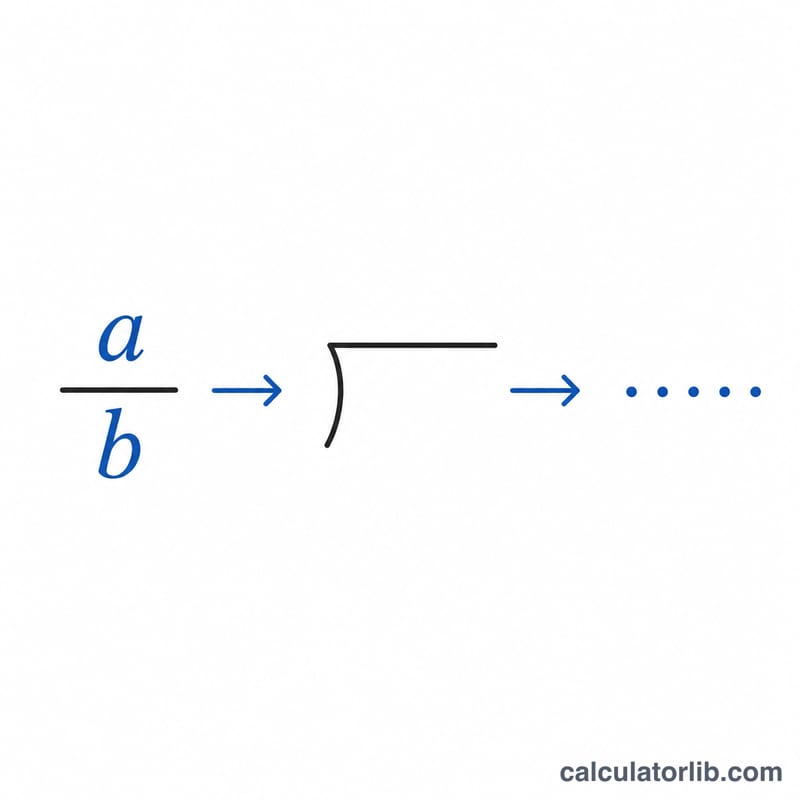
A fraction to decimal calculator converts a fraction written as a/b (numerator over denominator) into its equivalent decimal number. Fractions and decimals are simply two ways of writing the same value — this tool does the division for you and also shows the percentage equivalent.
How to Use It
Enter the numerator (the top number, a) and the denominator (the bottom number, b), then read the decimal result. The calculator divides a by b and rounds to a sensible number of decimal places. It also multiplies by 100 to give you the percentage form.
The Formula Explained
The conversion is the most basic operation in arithmetic: $$\text{decimal} = a \div b$$ The fraction bar literally means "divided by." For example, \(3/4\) means 3 divided by 4. Some fractions produce terminating decimals (like \(1/4 = 0.25\)), while others repeat forever (like \(1/3 = 0.3333...\)). The denominator can never be zero, since division by zero is undefined.
Worked Example
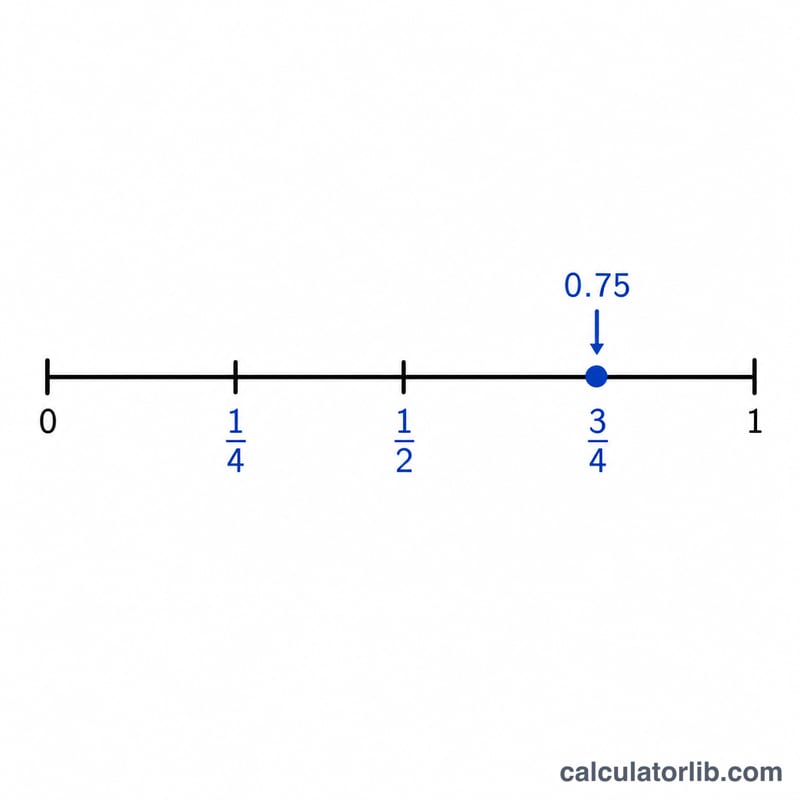
Convert 3/4 to a decimal. Divide 3 by 4: $$3 \div 4 = 0.75$$ As a percentage that is \(0.75 \times 100 = 75\%\). So three-quarters equals 0.75 or 75%.
Common Fraction to Decimal Conversions
The table below lists frequently used fractions with their exact decimal and percentage equivalents. A fraction produces a terminating decimal when its denominator (in lowest terms) has only 2 and 5 as prime factors; otherwise the decimal repeats. Repeating digits are shown with an overline notation in words.
| Fraction | Decimal | Percentage | Type |
|---|---|---|---|
| 1/2 | 0.5 | 50% | Terminating |
| 1/3 | 0.333… (repeating 3) | 33.33…% | Repeating |
| 2/3 | 0.666… (repeating 6) | 66.66…% | Repeating |
| 1/4 | 0.25 | 25% | Terminating |
| 3/4 | 0.75 | 75% | Terminating |
| 1/5 | 0.2 | 20% | Terminating |
| 2/5 | 0.4 | 40% | Terminating |
| 1/6 | 0.1666… (repeating 6) | 16.66…% | Repeating |
| 1/8 | 0.125 | 12.5% | Terminating |
| 3/8 | 0.375 | 37.5% | Terminating |
| 5/8 | 0.625 | 62.5% | Terminating |
| 7/8 | 0.875 | 87.5% | Terminating |
| 1/9 | 0.111… (repeating 1) | 11.11…% | Repeating |
| 1/10 | 0.1 | 10% | Terminating |
| 1/16 | 0.0625 | 6.25% | Terminating |
| 1/100 | 0.01 | 1% | Terminating |
To go the other direction—turning a percentage back into a fraction—see the percentage to fraction tool.
How to Convert a Fraction to a Decimal by Hand
A fraction is simply a division problem: the bar between the numerator and denominator means “divided by.” Follow these steps to convert any fraction \(\frac{a}{b}\) into a decimal.
- Set up the division. Write the numerator (top number) as the dividend and the denominator (bottom number) as the divisor: \(\text{Decimal} = a \div b\). For example, to convert \(3/8\), you compute \(3 \div 8\).
- Place the decimal point and add zeros. Since 3 is smaller than 8, write the quotient as \(0.\) and append zeros after the decimal point in the dividend, turning 3 into 3.000 so the division can continue.
- Perform the long division. Divide step by step: \(30 \div 8 = 3\) remainder 6; bring down a zero to make 60, \(60 \div 8 = 7\) remainder 4; bring down a zero to make 40, \(40 \div 8 = 5\) remainder 0. The remainder reaches zero, giving \(3 \div 8 = 0.375\). You can verify any such long division with a long division calculator.
- Identify terminating vs. repeating. If the remainder eventually becomes 0, the decimal terminates (like 0.375). If a remainder keeps recurring, the decimal repeats—for example \(1 \div 3 = 0.333\ldots\), where the digit 3 never stops.
- Convert to a percentage. Multiply the decimal by 100 and add a percent sign: \(0.375 \times 100 = 37.5\%\). This expresses the same value as a part of 100.
Worked example: \(\frac{5}{8} = 5 \div 8 = 0.625\), which as a percentage is \(0.625 \times 100 = \) 62.5%.
FAQ
What if the denominator is zero? Division by zero is undefined, so the calculator returns 0 and you should choose a non-zero denominator.
Why does my decimal repeat? Fractions whose denominators have prime factors other than 2 and 5 produce repeating decimals, such as \(1/3 = 0.333...\) The result is rounded for display.
Can I use negative numbers? Yes — enter a negative numerator or denominator and the calculator returns the correctly signed decimal.