
What Is an Acceptance Rate?
An acceptance rate (also called an admission rate) is the percentage of applicants who are offered a spot out of everyone who applied. It is one of the most-watched metrics for colleges, universities, graduate programs, scholarships, and competitive jobs because it signals how selective an institution is. A lower acceptance rate generally means more competition for each available place.
How to Use This Calculator
Enter two numbers: the count of applicants who were admitted and the total number of applicants. The calculator divides admitted by total, multiplies by 100, and returns the acceptance rate as a percentage. It also reports how many applicants were rejected and the corresponding rejection rate, which always adds up to 100% with the acceptance rate.
The Formula Explained
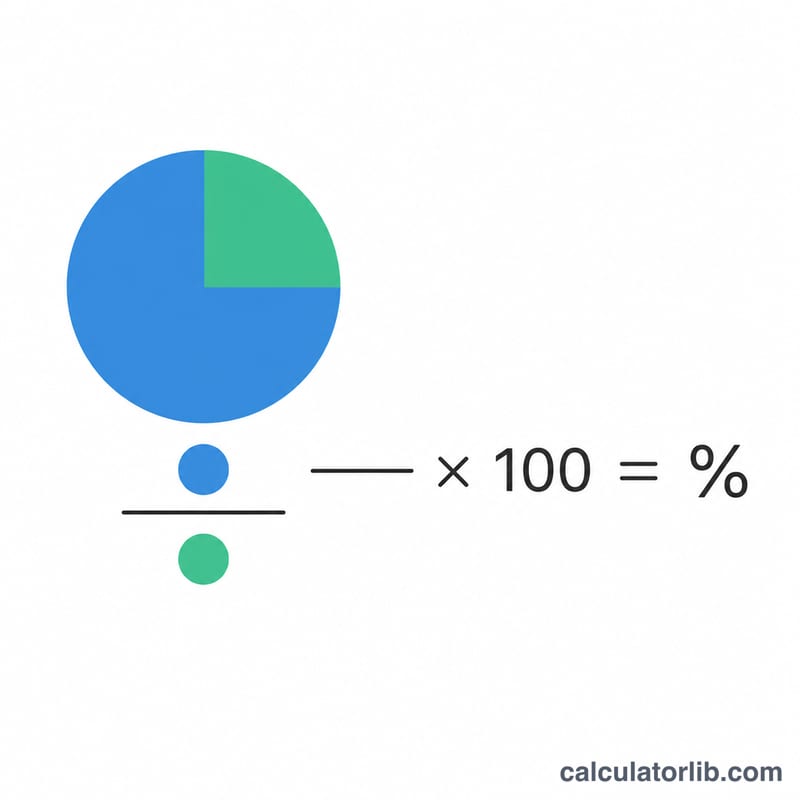
The math is a simple proportion turned into a percentage:
$$\text{Acceptance Rate} = \frac{\text{Admitted}}{\text{Applicants}} \times 100$$
Because admitted is always part of the total applicant pool, the result falls between 0% and 100%. The "rejected" figure is just total applicants minus admitted, and the rejection rate is the mirror image of the acceptance rate.
Worked Example
Suppose a university received 10,000 applications and admitted 2,000 students. The acceptance rate is $$(2{,}000 \div 10{,}000) \times 100 = 20\%$$ That means 8,000 applicants were rejected, giving an 80% rejection rate. A school admitting 2,000 of 10,000 is moderately selective.
Interpreting Your Acceptance Rate
The acceptance rate is the share of applicants who are offered admission, calculated as \(\text{Acceptance Rate} = \frac{\text{Number Admitted}}{\text{Total Applicants}} \times 100\%\). A lower rate means an institution or program turns away a larger fraction of applicants and is generally considered more selective. For example, a school that admits 2,400 of 12,000 applicants has an acceptance rate of 20%, placing it in the highly selective range.
Admissions professionals and the press often group rates into rough selectivity bands. The thresholds below are widely cited conventions for context only — they are not official designations, and the right interpretation shifts with the type of program (undergraduate, graduate, professional, or specialized).
| Acceptance Rate | Common Selectivity Label |
|---|---|
| Under 10% | Extremely / most selective |
| 10% – 25% | Highly selective |
| 25% – 50% | Selective |
| 50% – 75% | Moderately selective |
| Over 75% | Less selective / open admission |
Keep a few caveats in mind when reading these numbers. A low acceptance rate reflects the strength and size of the applicant pool as much as the institution itself — heavy marketing that boosts applications can lower the rate without changing the school. Highly specialized or competitive programs (such as medical, nursing, or top graduate tracks) routinely post far lower rates than their parent institution. Conversely, open-admission and community programs may admit nearly all qualified applicants by design. Always pair the acceptance rate with other signals like yield, applicant qualifications, and program fit rather than treating it as a single measure of quality.
FAQ
Is a low acceptance rate good or bad? It depends on perspective — a low rate means an institution is highly selective and prestigious, but it also means it is harder to get in.
Can the acceptance rate be over 100%? No. If your result exceeds 100%, you likely entered more admitted students than total applicants — double-check your numbers.
Does acceptance rate equal yield? No. Acceptance rate measures how many were offered admission; yield measures how many of those admitted actually enrolled.