
What is the BAC Calculator?
This Blood Alcohol Content (BAC) calculator estimates the percentage of alcohol in your bloodstream using the Widmark equation, the most widely used model in forensic and educational settings. It is built around the US standard drink, which the NIAAA defines as 14 grams of pure ethanol (roughly a 12 oz 5% beer, 5 oz 12% wine, or 1.5 oz 40% spirits). Results are an estimate for education only — actual BAC depends on food, genetics, medication and hydration, and this tool is not a substitute for a breathalyzer or legal advice.
How to use it
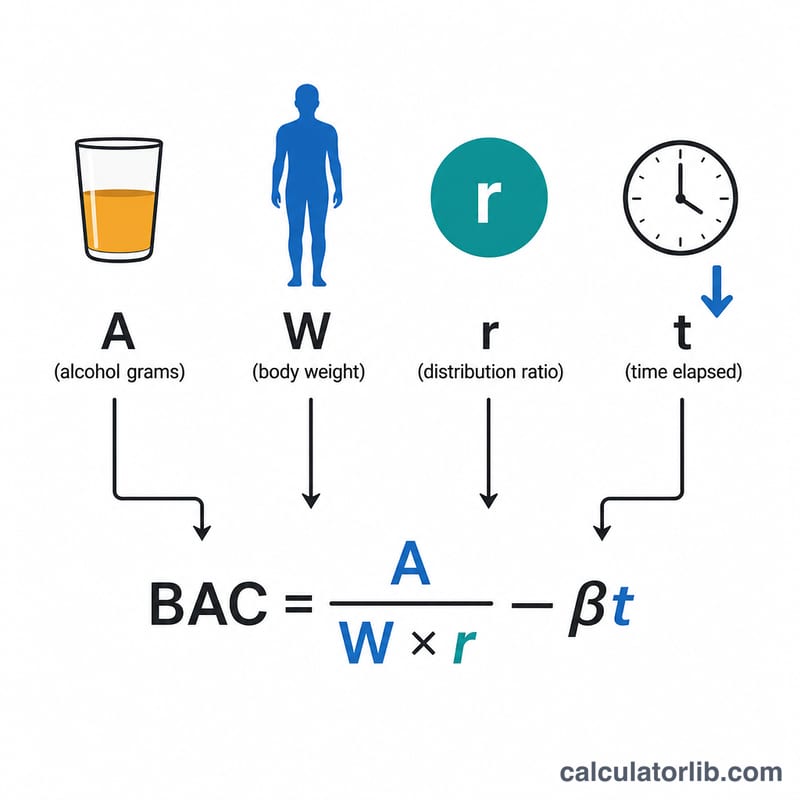
Select your sex (which sets the Widmark distribution factor \(r\)), enter your body weight in pounds, the number of standard drinks consumed, and the number of hours since your first drink. The calculator converts drinks to grams of alcohol, your weight to grams, applies the Widmark formula, and subtracts alcohol your liver has already metabolized.
The formula explained
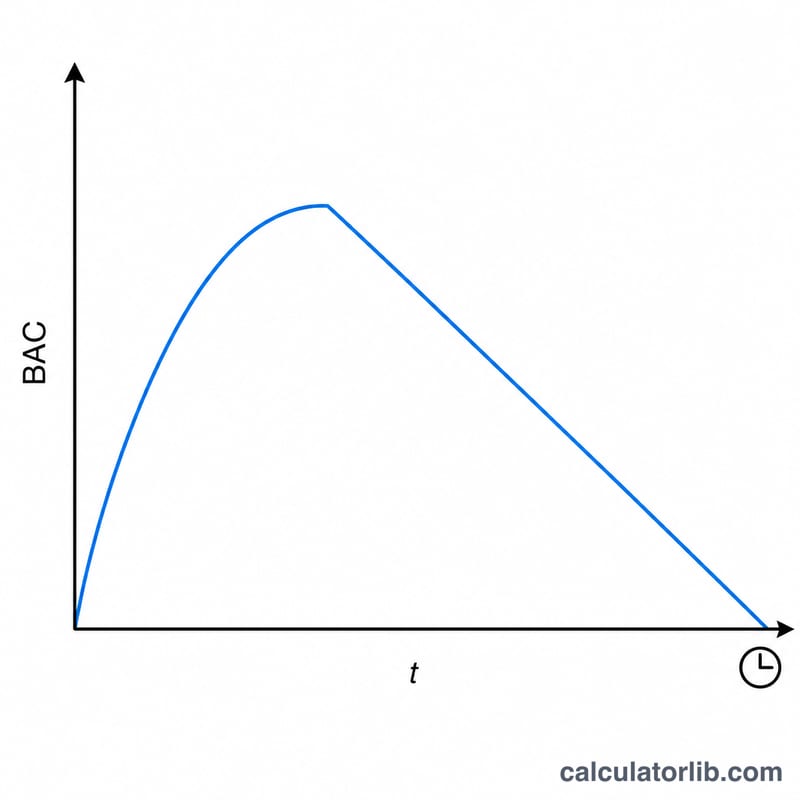
$$\text{BAC} = \frac{A}{W_g \cdot r} \times 100 - 0.015 \, t$$ Here \(A\) is total grams of alcohol (\(\text{drinks} \times 14\)), \(W_g\) is body weight in grams (\(\text{pounds} \times 453.592\)), \(r\) is 0.68 for men or 0.55 for women, and \(t\) is hours elapsed. The 0.015 term reflects that the body eliminates roughly 0.015% BAC per hour.
Worked example
A 180 lb man has 3 standard drinks over 1 hour. \(A = 3 \times 14 = 42 \text{ g}\). \(W_g = 180 \times 453.592 = 81{,}646.56 \text{ g}\). $$\text{BAC} = \frac{42}{81{,}646.56 \times 0.68} \times 100 - 0.015 \times 1 = 0.0756 - 0.015 = \mathbf{0.0606\%}$$ — under the 0.08% US driving limit, but impairment can still occur.
Interpreting Your BAC Result
Blood alcohol content (BAC) is expressed as a percentage of alcohol in the blood by volume — a BAC of 0.08 means 0.08 g of alcohol per 100 mL of blood. The Widmark estimate produced by this calculator is an approximation; actual BAC varies with food intake, hydration, medication, genetics and drinking pace. The following ranges reflect descriptions documented by the U.S. National Institute on Alcohol Abuse and Alcoholism (NIAAA) and the National Highway Traffic Safety Administration (NHTSA).
- 0.02–0.03 — Mild effects: slight relaxation, modest mood elevation, subtle decline in visual tracking and ability to divide attention.
- 0.05–0.07 — Impaired judgment, lowered alertness, reduced coordination and slower reaction time; the point at which driving-related skills measurably degrade.
- 0.08 — The legal limit for driving in all U.S. states. At and above this level, muscle coordination, speech, reaction time and self-control are clearly impaired.
- 0.15 and above — Significant impairment: major loss of balance and motor control, vomiting risk, and substantially elevated crash risk.
- 0.30 and above — Potentially life-threatening: stupor, loss of consciousness, and risk of alcohol poisoning, suppressed breathing and death.
These descriptions are general physiological references, not a measure of any individual's actual impairment or legal status. This tool is for education only and is not medical or legal advice. The only reliable way to know your BAC is a breath or blood test, and the only safe driving BAC is 0.00.
BAC Levels and Typical Effects
Typical effects associated with rising BAC, based on NIAAA and NHTSA descriptions. Individual responses vary widely with tolerance, body composition and circumstances.
| BAC (%) | Typical effects | Legal / safety significance |
|---|---|---|
| 0.02 | Some loss of judgment; relaxation, slight warmth; decline in visual tracking and divided attention. | Below driving limit, but skills already affected. |
| 0.05 | Lowered alertness, released inhibition, impaired judgment; reduced coordination and slower response. | Reduced ability to track moving objects and steer. |
| 0.08 | Poor muscle coordination, impaired reasoning, speech, vision and reaction time. | U.S. legal limit for driving — illegal to operate a vehicle. |
| 0.10 | Clear deterioration of reaction time and control; slurred speech, poor coordination, slowed thinking. | Above limit in all states; markedly elevated crash risk. |
| 0.15 | Far less muscle control than normal; vomiting may occur; major loss of balance. | Substantial impairment of all driving abilities. |
| 0.20 | Confusion, disorientation, nausea; may need help to stand or walk. | Severe impairment; risk of injury and blackout. |
| 0.30 and above | Stupor, little comprehension, possible loss of consciousness; risk of alcohol poisoning. | Potentially fatal; medical emergency. |
FAQ
What is the legal driving limit? In all US states the limit is 0.08% BAC for drivers 21 and over; commercial and underage limits are much lower.
Why do men and women differ? Women generally have a lower proportion of body water, so alcohol is less diluted, giving a smaller \(r\) value and a higher BAC for the same intake.
Can I rely on this to decide whether to drive? No. The Widmark estimate has a wide margin of error. The only safe option after drinking is not to drive.