
What Is the APR to Monthly Interest Rate Calculator?
This calculator converts an Annual Percentage Rate (APR) into the equivalent monthly and daily periodic interest rates. Lenders quote credit cards, loans, and lines of credit in APR, but interest actually accrues on shorter cycles. Knowing the monthly or daily rate helps you understand exactly how much interest is added to your balance each statement period.
How to Use It
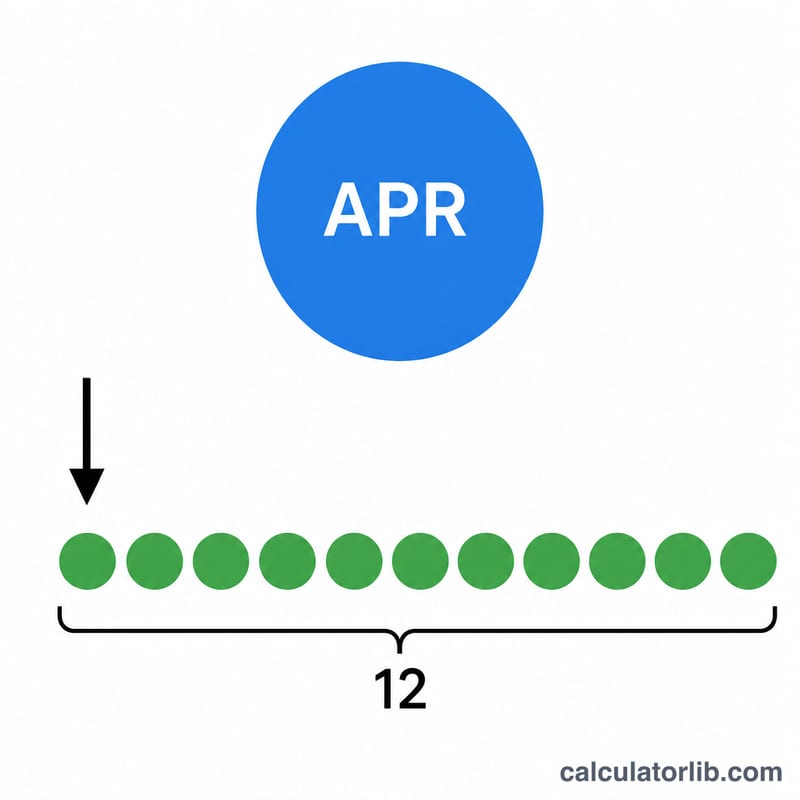
Enter the APR shown on your loan or credit card statement as a percentage (for example, type 18 for an 18% APR). The calculator instantly returns the monthly rate (APR ÷ 12) and the daily rate (APR ÷ 365). These are the nominal periodic rates most issuers use to compute finance charges.
The Formula Explained
The conversion uses simple division of the nominal annual rate:
$$\text{Monthly Rate (\%)} = \frac{\text{APR (\%)}}{12}$$ and $$\text{Daily Rate (\%)} = \frac{\text{APR (\%)}}{365}$$ This is the "nominal" or "stated" approach used in most US billing disclosures. Note it differs slightly from the effective rate, which accounts for compounding and would be calculated as \(\left(1 + \frac{\text{APR}}{n}\right)^n - 1\).
Worked Example
Suppose your credit card has an APR of 24%. The monthly periodic rate is $$24 \div 12 = 2\%$$ per month. The daily periodic rate is $$24 \div 365 \approx 0.0657\%$$ per day. If you carry a $1,000 balance, roughly $20 in interest accrues that month.
Common APR to Monthly & Daily Rate Conversions
The monthly periodic rate is found by dividing the APR by 12 months, and the daily periodic rate by dividing the APR by 365 days. The table below shows these conversions for typical credit card APRs, computed to several decimal places so you can see the exact periodic rate your issuer applies.
| APR (%) | Monthly Rate (APR ÷ 12) | Daily Rate (APR ÷ 365) |
|---|---|---|
| 12% | 1.0000% | 0.03288% |
| 15% | 1.2500% | 0.04110% |
| 18% | 1.5000% | 0.04932% |
| 19.99% | 1.6658% | 0.05477% |
| 22% | 1.8333% | 0.06027% |
| 24% | 2.0000% | 0.06575% |
| 27% | 2.2500% | 0.07397% |
| 29.99% | 2.4992% | 0.08216% |
For example, a 24% APR works out to a 2.0000% monthly periodic rate and roughly a 0.06575% daily periodic rate. Note that the daily rate based on a 360-day convention would be slightly higher (APR ÷ 360).
Interpreting Your Monthly and Daily Rate
The monthly periodic rate (APR ÷ 12) is the rate your card issuer applies to your balance each billing cycle. In practice, most issuers calculate interest on the average daily balance: they sum your balance for every day of the cycle, divide by the number of days to get the average, then multiply by the daily periodic rate (APR ÷ 365) times the number of days in the cycle. The two approaches produce very similar results because a monthly cycle is roughly one-twelfth of a year.
The APR is a nominal annual rate — it is simply the periodic rate multiplied back out over a year, and it does not account for compounding. When interest is charged each period and added to the balance, the amount you actually pay over a year is described by the effective annual rate (APY), which is always higher than the nominal APR whenever interest compounds more than once per year. For monthly compounding:
$$\text{APY} = \left(1 + \frac{\text{APR}}{12}\right)^{12} - 1$$
For instance, an 18% APR compounded monthly gives an effective annual rate of about 19.56%, noticeably higher than the stated 18%.
Finally, watch the day-count convention. Some issuers divide the APR by 365 (or 366 in a leap year), while others use a 360-day year. Dividing by 360 produces a slightly larger daily rate — for a 24% APR, that is 0.06667% per day instead of 0.06575% — so the same APR can yield marginally different finance charges depending on the convention used. Always check your cardholder agreement to see which method applies. This information is educational and not personal financial advice.
Key Terms Explained
- APR (Annual Percentage Rate)
- The stated yearly cost of borrowing expressed as a percentage. For credit cards it is a nominal rate from which the periodic billing rates are derived.
- Nominal Rate
- An annual rate that ignores the effect of compounding within the year; it equals the periodic rate multiplied by the number of periods (e.g., monthly rate × 12).
- Monthly Periodic Rate
- The interest rate applied per billing month, calculated as APR ÷ 12. A 18% APR has a 1.5% monthly periodic rate.
- Daily Periodic Rate
- The interest rate applied per day, calculated as APR ÷ 365 (or ÷ 360 under some conventions). Used to compute interest on the average daily balance.
- Effective Annual Rate (APY)
- The true annual rate of return or cost once compounding is included. It exceeds the nominal APR whenever interest compounds more than once a year.
- Average Daily Balance
- The sum of the account balance for each day of the billing cycle divided by the number of days, used as the base for calculating finance charges.
- Compounding
- The process by which interest is added to the principal so that subsequent interest is charged on the new, larger balance — the reason effective rates rise above nominal rates.
FAQ
Is the monthly rate the same as the effective monthly rate? No. This is the nominal rate (APR ÷ 12). The effective monthly rate includes compounding and is marginally higher.
Why divide by 365 for daily rate? Most US issuers use a 365-day year for the daily periodic rate, though some use 360. Check your cardholder agreement.
Does APR include fees? APR can include certain fees, but for periodic interest accrual only the interest portion is typically used.