
What is an arithmetic sequence?
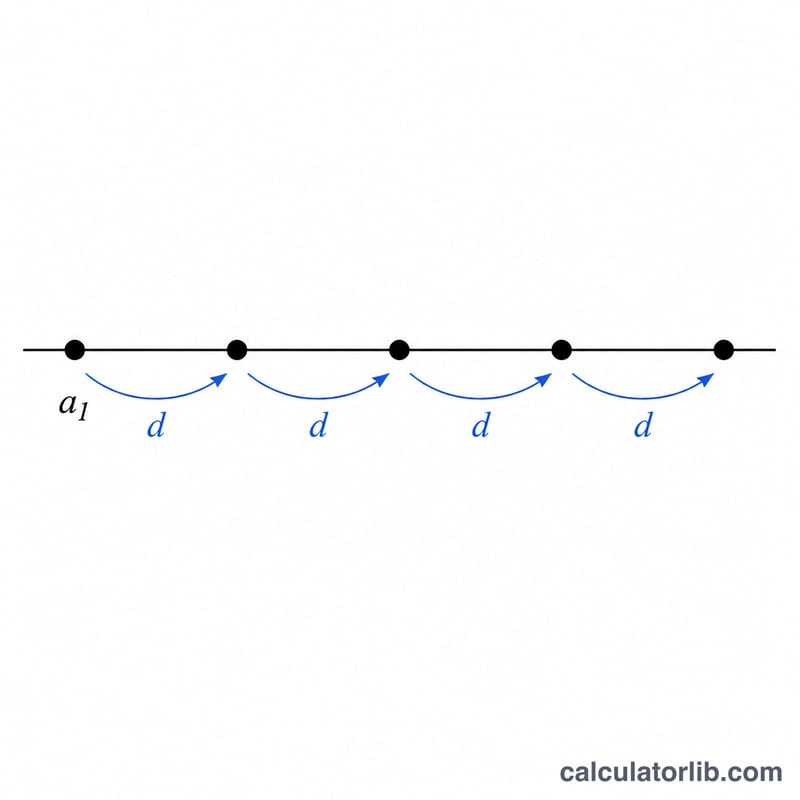
An arithmetic sequence is a list of numbers where each term increases (or decreases) by a fixed amount called the common difference, \(d\). Starting from a first term \(a_1\), every following term adds \(d\). This calculator finds the n-th term (\(a_n\)) and the sum of the first n terms (\(S_n\)) instantly from three inputs.
How to use this calculator
Enter the first term \(a_1\), the common difference \(d\) (positive for increasing sequences, negative for decreasing), and the term position \(n\) you want to reach. Press calculate to see the value of \(a_n\) and the cumulative sum \(S_n\) of all terms from \(a_1\) through \(a_n\).
The formula explained
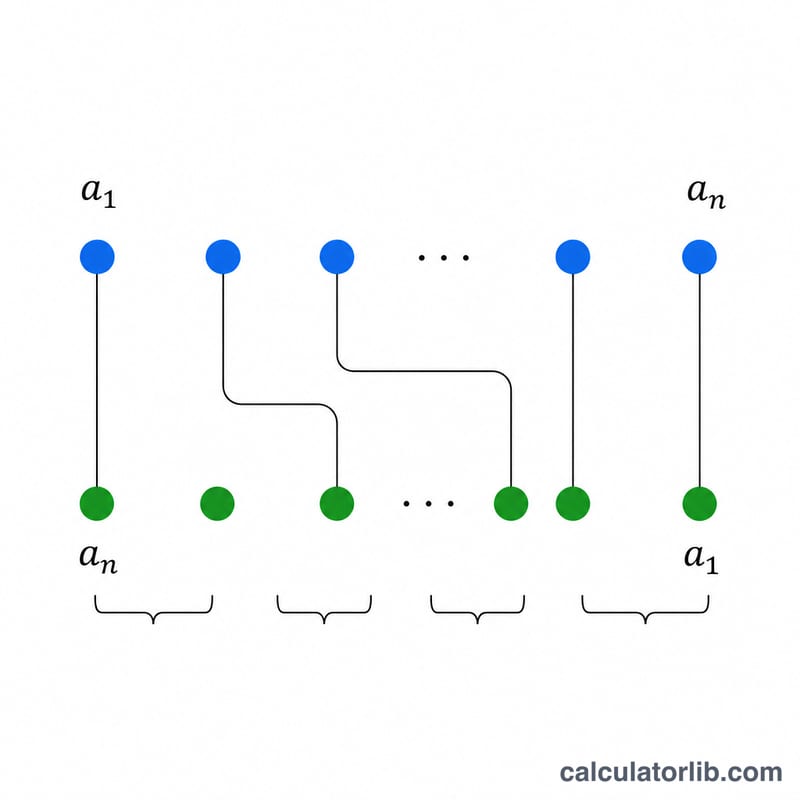
The n-th term is found with $$a_n = a_1 + (n - 1)d,$$ because you add the common difference \((n - 1)\) times after the first term. The partial sum uses the pairing trick discovered by Gauss: $$S_n = \frac{n}{2} \times (a_1 + a_n),$$ which is the average of the first and last term multiplied by how many terms there are.
Worked example
Suppose \(a_1 = 2\), \(d = 3\), and \(n = 10\). The 10th term is $$a_n = 2 + (10 - 1)\cdot 3 = 2 + 27 = 29.$$ The sum of the first 10 terms is $$S_n = \frac{10}{2} \times (2 + 29) = 5 \times 31 = 155.$$
Comparing Arithmetic Sequences Across Scenarios
The two key outputs of an arithmetic sequence are the nth term \(a_n = a_1 + (n-1)d\) and the partial sum \(S_n = \frac{n}{2}(a_1 + a_n)\). The table below applies these formulas to several realistic input sets, including a positive common difference, a negative (decreasing) one, and a fractional step.
| First term \(a_1\) | Common difference \(d\) | Terms \(n\) | nth term \(a_n\) | Sum \(S_n\) | Sequence preview |
|---|---|---|---|---|---|
| 5 | 2 | 8 | 19 | 96 | 5, 7, 9, …, 19 |
| 10 | -3 | 6 | -5 | 15 | 10, 7, 4, …, -5 |
| 0 | 0.5 | 20 | 9.5 | 95 | 0, 0.5, 1, …, 9.5 |
| 100 | -10 | 11 | 0 | 550 | 100, 90, 80, …, 0 |
| 1 | 1 | 100 | 100 | 5050 | 1, 2, 3, …, 100 |
Notice how a negative \(d\) produces a decreasing sequence, and how the sum can still be positive even when later terms turn negative, as long as the early terms outweigh them.
Key Terms and Variables
- First term \(a_1\)
- The starting value of the sequence — the value at position \(n = 1\). Every other term is built by repeatedly adding the common difference to it.
- Common difference \(d\)
- The fixed amount added from one term to the next: \(d = a_{n} - a_{n-1}\). A positive \(d\) gives an increasing sequence, a negative \(d\) a decreasing one, and \(d = 0\) a constant sequence.
- nth term \(a_n\)
- The value of the term at position \(n\), found directly with \(a_n = a_1 + (n-1)d\) without listing every term in between.
- Partial sum \(S_n\)
- The sum of the first \(n\) terms, \(S_n = \frac{n}{2}(a_1 + a_n)\). It pairs the first and last terms and multiplies by the number of pairs.
- Term position \(n\)
- A positive integer index telling you which term you want (1st, 2nd, 3rd, …). It also equals how many terms are being summed in \(S_n\).
- Arithmetic sequence vs. series
- A sequence is the ordered list of terms (5, 7, 9, …); a series is what you get when you add those terms together. \(a_n\) describes the sequence, while \(S_n\) is the value of the corresponding finite series.
How to Calculate It by Hand
Use this procedure to find both the nth term and the sum from the three inputs \(a_1\), \(d\), and \(n\). We'll carry the example \(a_1 = 5\), \(d = 2\), \(n = 8\) through each step.
- Identify \(a_1\), \(d\), and \(n\). Read the first term, the constant step between terms, and the position you need. Here \(a_1 = 5\), \(d = 2\), and \(n = 8\).
- Compute the nth term. Substitute into \(a_n = a_1 + (n-1)d\):
\(a_8 = 5 + (8 - 1)\times 2 = 5 + 7\times 2 = 5 + 14 = 19\). - Compute the partial sum. Substitute \(a_1\), \(a_n\), and \(n\) into \(S_n = \frac{n}{2}(a_1 + a_n)\):
\(S_8 = \frac{8}{2}(5 + 19) = 4 \times 24 = 96\). - Check the result. Listing the terms gives 5, 7, 9, 11, 13, 15, 17, 19 — the last is \(a_8 = 19\) and they total 96, confirming \(S_8\).
If you only need the sum and already prefer working from \(a_1\) and \(d\), the combined form \(S_n = \frac{n}{2}\bigl(2a_1 + (n-1)d\bigr)\) gives the same answer in one line: \(S_8 = \frac{8}{2}(2\times 5 + 7\times 2) = 4(10 + 14) = 96\).
FAQ
Can d be negative? Yes. A negative common difference produces a decreasing sequence, and the formulas still work exactly.
What does \(S_n\) represent? It is the total of all terms from \(a_1\) up to and including \(a_n\) — a partial (finite) sum, not an infinite series.
What if \(n = 1\)? Then \(a_n = a_1\) and \(S_n = a_1\), since there is only one term.