

What Is the ARR & MRR Calculator?
Monthly Recurring Revenue (MRR) and Annual Recurring Revenue (ARR) are the two most important metrics for any subscription or SaaS business. They measure the predictable, repeatable revenue your company earns from active subscriptions. This calculator turns two simple inputs — your number of paying customers and your average revenue per account — into instant MRR and ARR figures.
How to Use It
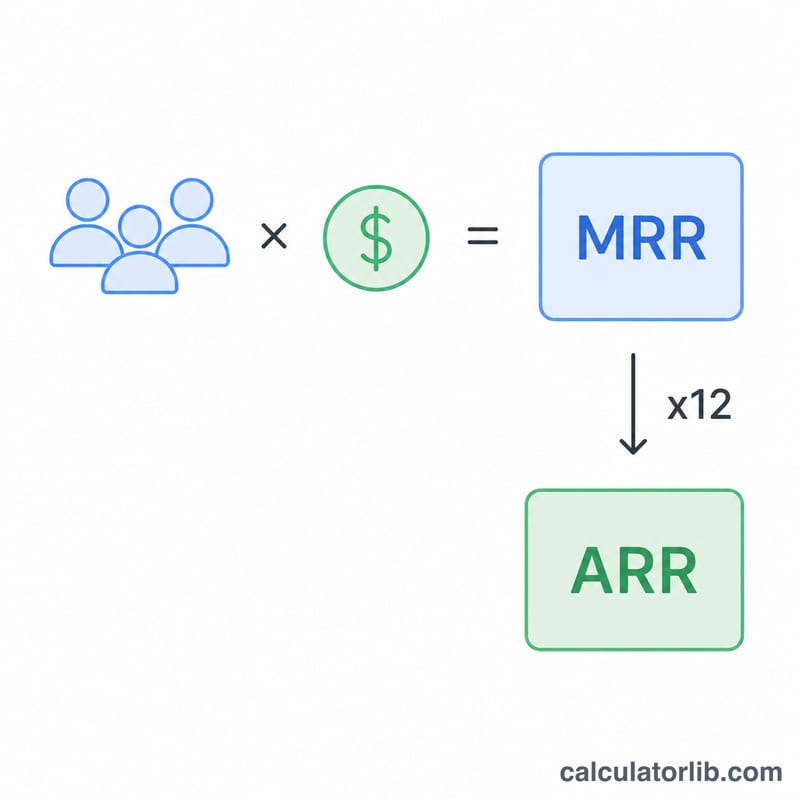
Enter the total number of paying customers you currently have, then enter the Average Revenue Per Account (ARPA) — the average amount each customer pays you per month. The calculator multiplies them to get MRR, then multiplies MRR by 12 to project ARR. This is a "run-rate" figure: it assumes your current monthly revenue stays steady for a full year.
The Formula Explained
The math is intentionally simple. $$\text{MRR} = \text{Customers} \times \text{ARPA}$$ captures how much recurring revenue arrives each month. $$\text{ARR} = \text{MRR} \times 12$$ annualizes that figure. Note that ARR is a normalized run rate, not actual booked revenue — it does not account for future churn, upgrades, or new sales.
Worked Example
Suppose you have 100 paying customers, each paying an average of $50 per month. Your MRR is $$100 \times \$50 = \$5{,}000.$$ Your ARR is $$\$5{,}000 \times 12 = \$60{,}000.$$ That means your business is generating $60,000 of recurring revenue per year at its current run rate.
MRR & ARR Across Common Scenarios
The table below shows how Monthly Recurring Revenue (MRR) and Annual Recurring Revenue (ARR) scale with your customer count and your average revenue per account (ARPA). Each MRR is calculated as Customers × ARPA, and ARR is simply MRR × 12.
| Customers | ARPA (monthly) | MRR | ARR |
|---|---|---|---|
| 50 | $25 | $1,250 | $15,000 |
| 50 | $50 | $2,500 | $30,000 |
| 50 | $100 | $5,000 | $60,000 |
| 100 | $25 | $2,500 | $30,000 |
| 100 | $50 | $5,000 | $60,000 |
| 100 | $100 | $10,000 | $120,000 |
| 500 | $25 | $12,500 | $150,000 |
| 500 | $50 | $25,000 | $300,000 |
| 500 | $100 | $50,000 | $600,000 |
| 1,000 | $25 | $25,000 | $300,000 |
| 1,000 | $50 | $50,000 | $600,000 |
| 1,000 | $100 | $100,000 | $1,200,000 |
Because ARR is a linear multiple of MRR, doubling either your customer count or your ARPA doubles both figures. This is why subscription businesses track both levers — acquiring more accounts and increasing revenue per account — when planning growth.
Key Recurring-Revenue Terms
- MRR (Monthly Recurring Revenue)
- The predictable subscription revenue a business expects every month, normalized to a monthly figure. Annual or quarterly contracts are divided down to their monthly equivalent.
- ARR (Annual Recurring Revenue)
- The annualized value of recurring revenue, calculated as MRR × 12. It represents the run-rate value of subscriptions over a 12-month period.
- ARPA (Average Revenue Per Account)
- Total recurring revenue divided by the number of accounts (customers) over the same period. Sometimes called ARPU (Average Revenue Per User). Here it is expressed as a monthly figure.
- Run rate
- A projection that extrapolates current performance into the future. ARR is itself a run rate: it assumes the current MRR holds steady for a full year.
- Churn
- The loss of recurring revenue from customers who cancel or downgrade. Customer churn counts lost accounts; revenue churn measures the lost MRR. Churn directly reduces future MRR/ARR.
- Expansion / upgrade revenue
- Additional recurring revenue from existing customers who upgrade plans, add seats, or buy add-ons. Expansion can offset churn and push net revenue retention above 100%.
- Booked revenue vs. recurring revenue
- Booked revenue (bookings) is the total contract value a customer commits to when signing — including one-time fees, services, and multi-year totals. Recurring revenue counts only the repeating subscription portion. A signed three-year, $360,000 deal is $360,000 in bookings but contributes $10,000 to MRR ($120,000 to ARR).
Interpreting Your MRR & ARR
ARR is a normalized run rate, not a figure reported under GAAP (Generally Accepted Accounting Principles) or IFRS. It is a forward-looking snapshot that takes your current MRR and multiplies it by 12, as though that exact level of recurring revenue continued unchanged for a year. GAAP revenue, by contrast, is recognized as services are actually delivered over time and appears on audited financial statements.
Because ARR is a snapshot of today's recurring base, it deliberately excludes several things that will affect your real future revenue:
- Future churn — customers who will cancel or downgrade are still counted at full value.
- Future expansion — upgrades, seat additions, and price increases that haven't happened yet are not included.
- New sales — accounts you expect to win over the coming year are not part of current ARR.
- One-time revenue — setup fees, professional services, and non-repeating charges are excluded by design.
Operators and investors favor MRR and ARR because they measure predictability: a recurring base is far easier to forecast than transactional, one-off sales. Common ways these metrics are used include tracking month-over-month MRR growth, comparing new MRR against churned MRR to gauge net momentum, and using ARR as a simple scale benchmark for a subscription business. To understand whether your run rate is durable, pair it with retention metrics such as customer and revenue churn rates and net revenue retention, which reveal how much of today's ARR is likely to persist.
This section is general educational information about recurring-revenue metrics and is not financial, accounting, or investment advice. Consult a qualified professional for guidance specific to your business.
FAQ
What is ARPA? ARPA stands for Average Revenue Per Account — total monthly recurring revenue divided by the number of accounts. It is the average monthly price each customer effectively pays.
Should I include one-time fees? No. MRR and ARR only count recurring subscription revenue. Setup fees, consulting, or one-off charges should be excluded.
Is ARR the same as annual revenue? Not exactly. ARR is a normalized projection of recurring revenue based on your current MRR, while annual revenue includes all income (including non-recurring) actually earned over a year.