
What Is the Baud Rate Calculator?
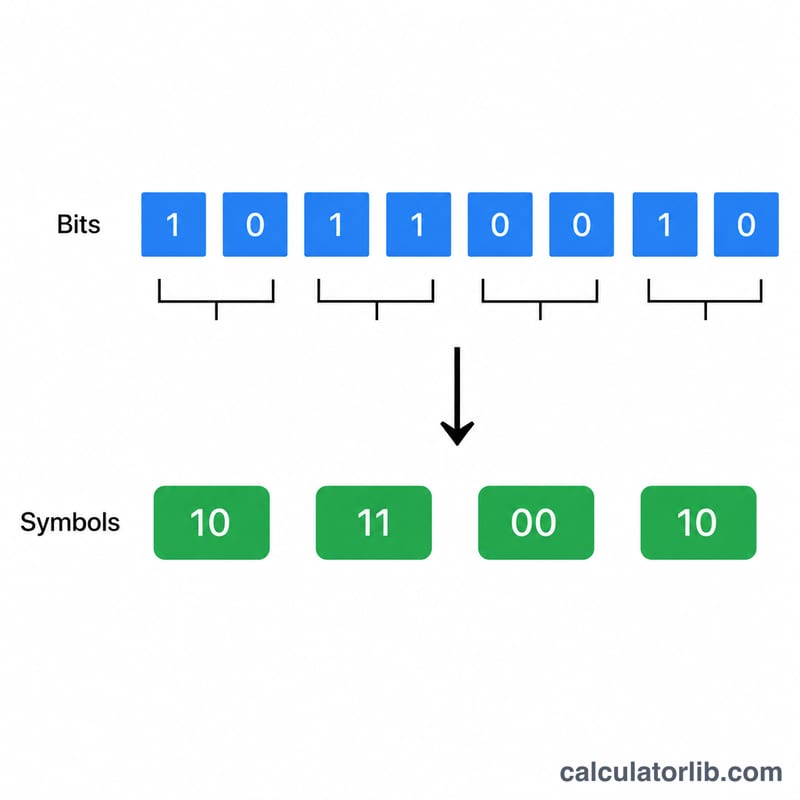
The baud rate (also called the symbol rate) measures how many signaling elements, or symbols, are transmitted per second over a communication channel. It is often confused with the bit rate, which counts the number of data bits transmitted per second. The two are only equal when each symbol carries exactly one bit. This calculator converts a known bit rate into baud rate using the number of distinct signal levels or symbols (M) used by the modulation scheme.
How to Use It
Enter the bit rate in bits per second (bps) and the number of signal levels or symbols (M) used by the modulation. For binary signaling M = 2, for QPSK M = 4, for 8-PSK M = 8, for 16-QAM M = 16, and so on. The calculator returns the baud rate along with the number of bits carried by each symbol.
The Formula Explained
Each symbol can represent \(\log_{2}(M)\) bits. For example, 4 levels carry \(\log_{2}(4) = 2\) bits per symbol. The baud rate is therefore the bit rate divided by bits per symbol:
$$\text{Baud Rate} = \frac{\text{Bit Rate (bps)}}{\log_{2}\!\left(\text{Levels (M)}\right)}$$
Rearranged, the bit rate equals \(\text{Baud} \times \log_{2}(M)\). Using more levels (a higher \(M\)) packs more bits into each symbol, so the same baud rate transmits more data.
Worked Example
Suppose a modem transmits at a bit rate of 9600 bps using 16-QAM (M = 16). Each symbol carries \(\log_{2}(16) = 4\) bits. The baud rate is $$9600 \div 4 = 2400 \text{ baud}$$ So the channel only needs 2400 symbols per second to deliver 9600 bits per second.
Common Modulation Schemes and Their M Values
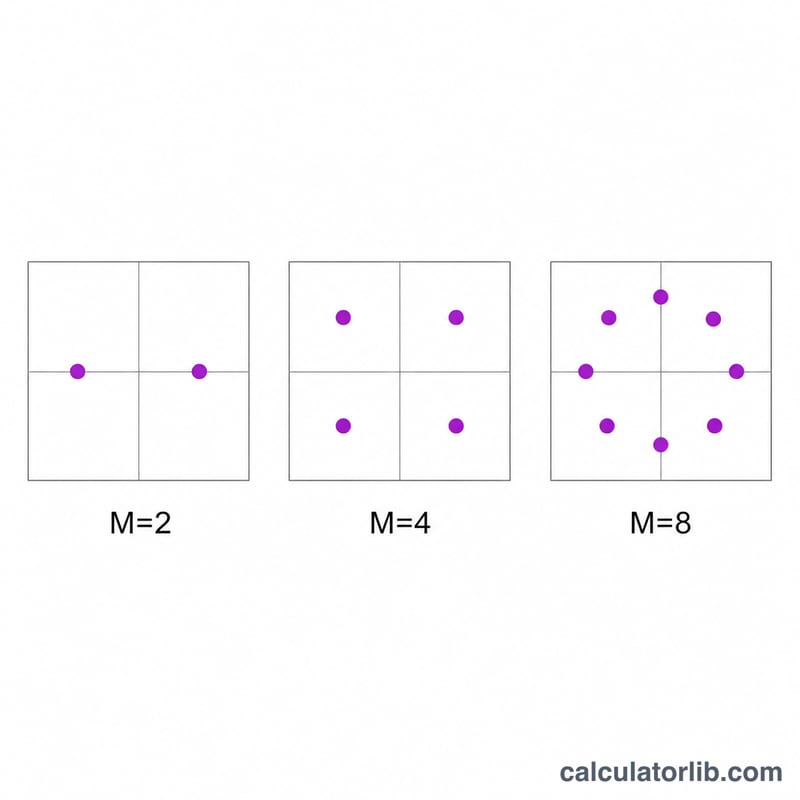
In M-ary modulation each transmitted symbol carries \(\log_2 M\) bits, where \(M\) is the number of distinguishable signal states (combinations of amplitude and/or phase). The baud rate (symbols per second) relates to the bit rate by:
$$\text{Baud Rate} = \frac{\text{Bit Rate}}{\log_2 M}$$Equivalently, the bit rate is the baud rate multiplied by the bits per symbol. The table below lists common schemes and how many bits each symbol conveys.
| Modulation Scheme | Levels (M) | Bits per Symbol \(\log_2 M\) | Bit Rate ÷ Baud Rate Multiplier |
|---|---|---|---|
| BPSK | 2 | 1 | ×1 |
| QPSK / 4-QAM | 4 | 2 | ×2 |
| 8-PSK | 8 | 3 | ×3 |
| 16-QAM | 16 | 4 | ×4 |
| 32-QAM | 32 | 5 | ×5 |
| 64-QAM | 64 | 6 | ×6 |
| 256-QAM | 256 | 8 | ×8 |
Higher-order schemes pack more bits into each symbol, lowering the baud rate (and bandwidth) needed for a given bit rate — but they require a higher signal-to-noise ratio to keep the closely spaced symbols distinguishable.
Key Terms and Variables
- Baud rate (symbol rate)
- The number of signal changes — symbols — transmitted per second, measured in baud (Bd). It reflects how fast the line state changes, not how many bits move.
- Symbol
- A single transmitted signaling event: one specific combination of amplitude, phase, and/or frequency. Each symbol represents one of the \(M\) possible states.
- Bit rate
- The amount of information transmitted per second, measured in bits per second (bps). It equals the baud rate multiplied by the bits carried per symbol.
- Bits per symbol
- The number of data bits encoded in each symbol, equal to \(\log_2 M\). For example, 16 levels carry \(\log_2 16 = 4\) bits per symbol.
- Signal levels (M)
- The number of distinct symbol states the modulation can produce. M = 2 (binary) carries 1 bit per symbol; larger M packs more bits per symbol but demands a cleaner channel.
- M-ary modulation
- A modulation scheme using \(M\) distinct symbols (where \(M > 2\)) so that each symbol conveys multiple bits. Examples include QPSK (M = 4), 16-QAM (M = 16), and 256-QAM (M = 256).
FAQ
Is baud rate the same as bit rate? Only when \(M = 2\) (one bit per symbol). With multilevel modulation the bit rate is higher than the baud rate.
What is M? \(M\) is the number of distinct symbols (signal levels) in the modulation alphabet — for example 2 for binary, 4 for QPSK, 64 for 64-QAM.
Can baud rate exceed bit rate? No. Because \(\log_{2}(M) \geq 1\) for \(M \geq 2\), baud rate is always less than or equal to bit rate.