
What is an Even Parity Bit?
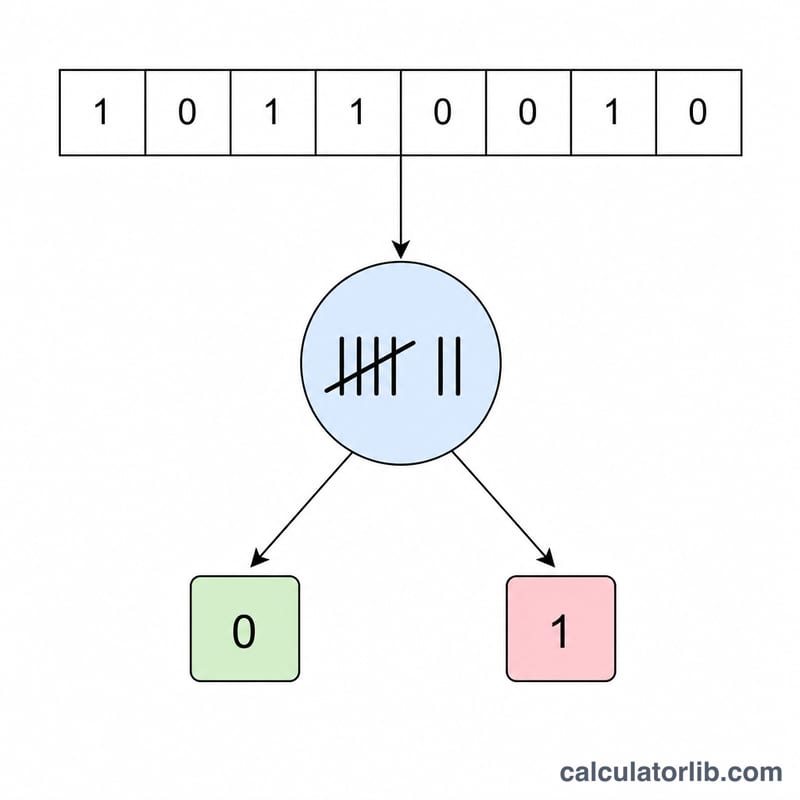
A parity bit is a single extra bit added to a block of binary data to help detect transmission errors. With even parity, the parity bit is chosen so that the total number of 1 bits — including the parity bit itself — is even. This calculator counts the 1s in your binary string and returns the correct even parity bit.
How to Use It
Type your binary data as a sequence of 1s and 0s (for example 1011001) and submit. The calculator reports the parity bit to append, how many 1s are in the original data, the data length, and the resulting total number of 1s once the parity bit is added.
The Formula Explained
The even parity bit P is computed as the number of 1 bits in the data taken modulo 2:
$$P_{\text{even}} = \left(\text{count of 1s in } \text{Binary Data}\right) \bmod 2$$
If the data already contains an even number of 1s, the parity bit is 0 (nothing needs to change). If it contains an odd number of 1s, the parity bit is 1, which brings the total to an even count.
Worked Example
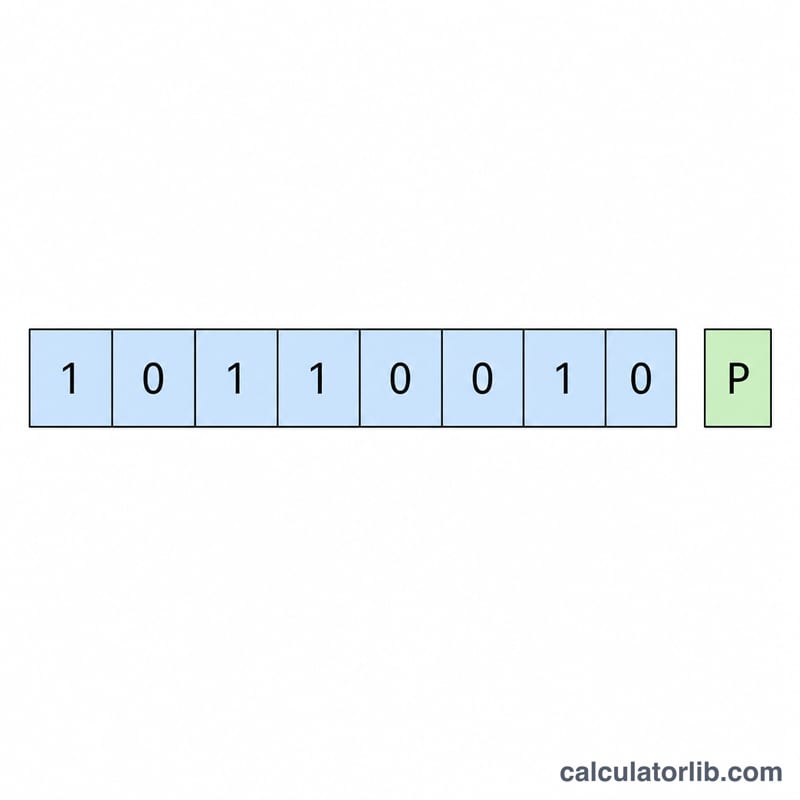
Take the data 1011001. The 1 bits are at positions 1, 3, 4, and 7, giving four 1s. Four is even, so $$4 \bmod 2 = 0.$$ The even parity bit is 0, and the transmitted word is 10110010 with a total of four 1s — still even.
FAQ
What is the difference between even and odd parity? Even parity makes the total number of 1s even; odd parity makes it odd. The two parity bits are simply inverses of each other.
Can parity detect all errors? A single parity bit detects any odd number of bit flips, but it cannot detect an even number of errors (e.g., two flipped bits) and cannot correct errors.
Where is parity used? Parity bits appear in serial communication (UART), memory (parity RAM), and as a building block for stronger error-correcting codes.