
What this calculator does
This tool rounds any number to a specified number of decimal places. Enter the value you want to round and how many digits you want to keep after the decimal point, and it returns the result rounded to the nearest representable value at that precision. It is a universal math tool, so it works the same everywhere regardless of locale.
How to use it
Type the number you want to round in the first field. In the second field, enter the number of decimal places (n) you want to keep — for example, 0 for a whole number, 2 for cents, or 4 for fine precision. The calculator instantly shows the rounded value along with the original input for reference.
The formula explained
Rounding to n decimal places uses the rule:
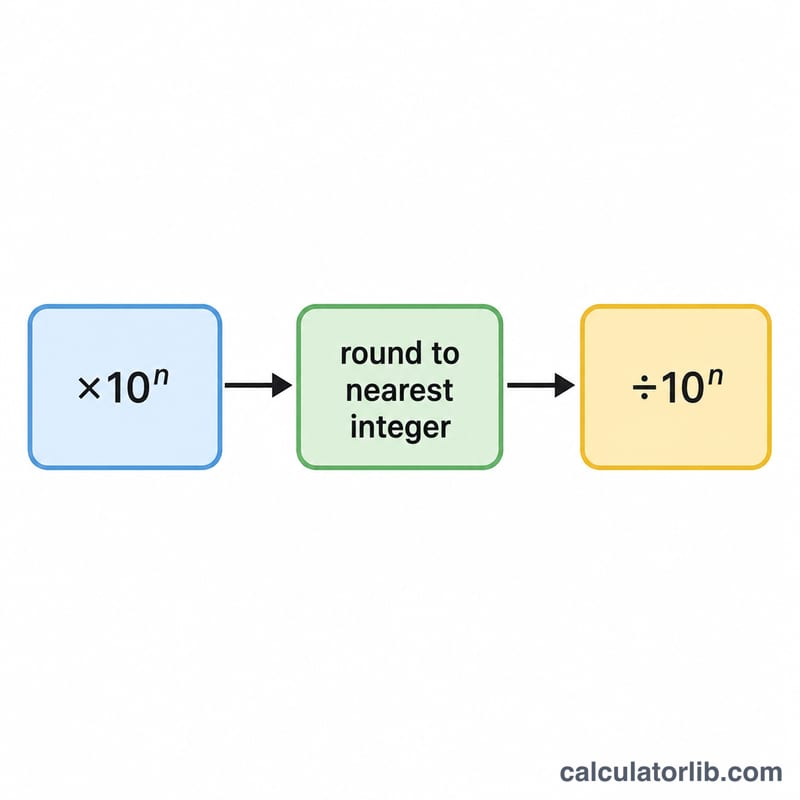
$$\text{Rounded} = \frac{\operatorname{round}\left(\text{Value} \times 10^{\text{Places}}\right)}{10^{\text{Places}}}$$
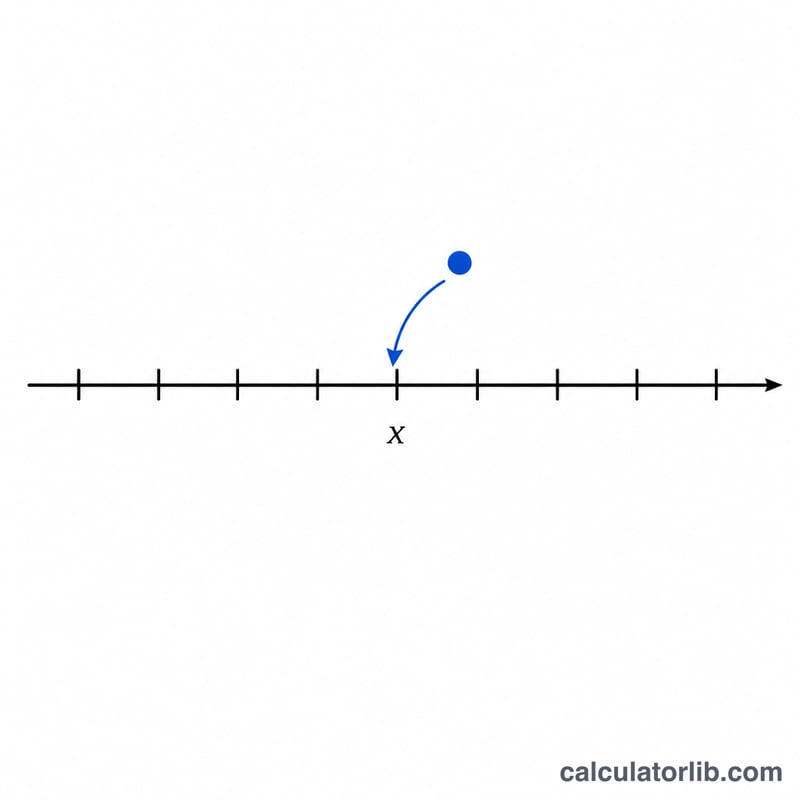
First the number is scaled up by \(10^{n}\), which shifts the digits you want to keep to the left of the decimal point. The scaled value is then rounded to the nearest whole number using standard half-up rounding. Finally it is divided by \(10^{n}\) to shift the digits back, giving a value with exactly n decimal places.
Worked example
Round 3.14159 to 2 decimal places. With \(n = 2\), the factor is \(10^{2} = 100\). Multiply: $$3.14159 \times 100 = 314.159$$ Round to the nearest integer: \(314\). Divide back: $$314 \div 100 = \mathbf{3.14}$$
Rounding the Same Number to Different Places
The number of decimal places you keep determines how much precision is retained. The table below shows two common constants, \(\pi \approx 3.14159\) and \(e \approx 2.71828\), rounded to 0, 1, 2, 3 and 4 decimal places using \(\operatorname{round}(x \times 10^n)/10^n\). Notice how each result truncates or rounds the next digit: when the following digit is 5 or greater, the kept digit rounds up.
| Places (n) | 3.14159 rounded | 2.71828 rounded |
|---|---|---|
| 0 | 3 | 3 |
| 1 | 3.1 | 2.7 |
| 2 | 3.14 | 2.72 |
| 3 | 3.142 | 2.718 |
| 4 | 3.1416 | 2.7183 |
For \(\pi\) at 3 places, the fourth decimal digit is 5, so 3.1415… rounds up to 3.142. For \(e\) at 4 places, the fifth digit is 8, so 2.71828 rounds up to 2.7183.
FAQ
Which rounding rule is used? Standard arithmetic rounding (round half up), where a trailing 5 rounds the previous digit upward.
Can I round to whole numbers? Yes — set decimal places to 0 and the result is rounded to the nearest integer.
Why might 2.675 round to 2.67 instead of 2.68? Because some decimals cannot be stored exactly in binary floating point, a value like 2.675 may be held internally as slightly less, which can affect the rounded result. This is normal floating-point behavior.