
What is BMI?
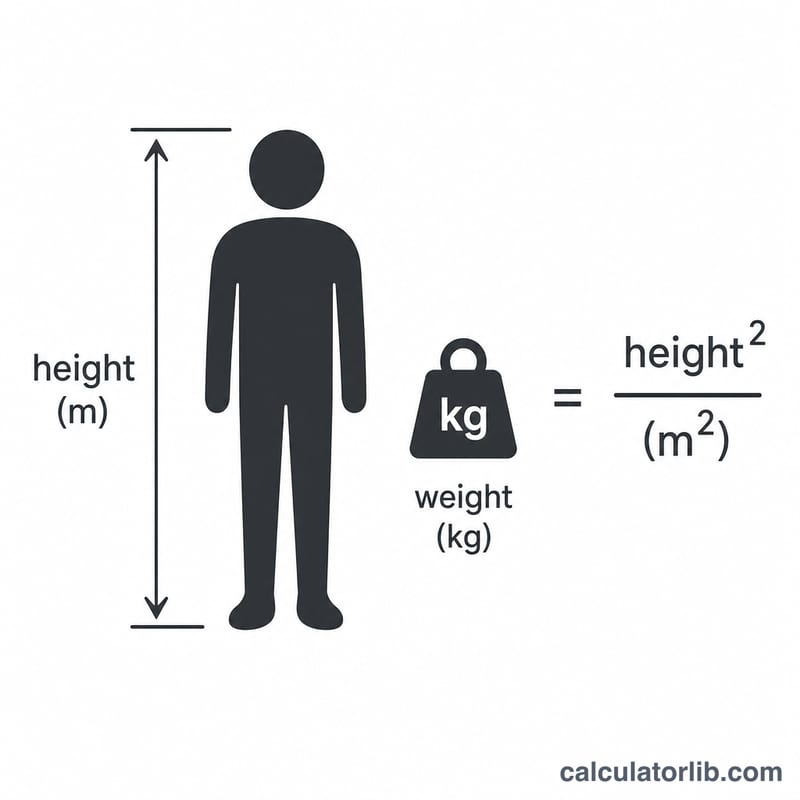
Body Mass Index (BMI) is a numerical value calculated from a person's weight and height. It provides a simple measure to categorize individuals as underweight, normal weight, overweight, or obese.
When to Use BMI Calculator
BMI calculations are valuable in the following scenarios:
- Health assessments to identify potential weight-related health risks
- Population studies to track weight trends across different demographics
- Personal weight management goals to establish a baseline and track progress
How to Calculate BMI
The BMI formula varies depending on the measurement system used:
Metric Units: \( \text{BMI} = \frac{\text{weight (kg)}}{\text{height}^2 \text{ (m}^2)} \)
Imperial Units: \( \text{BMI} = 703 \times \frac{\text{weight (lb)}}{\text{height}^2 \text{ (in}^2)} \)
BMI Categories
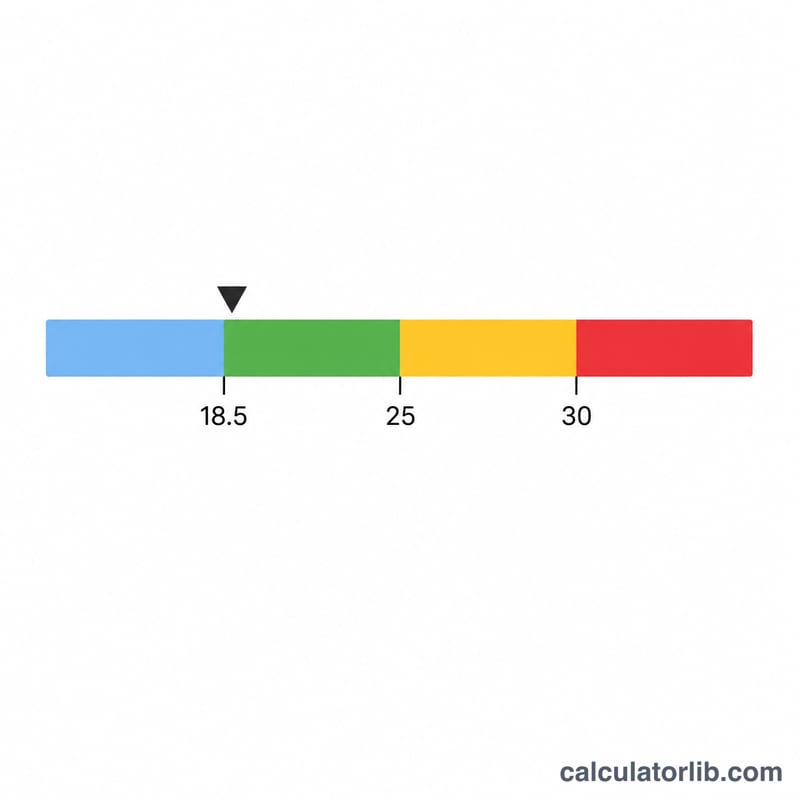
| BMI Range | Weight Category |
|---|---|
| Below 18.5 | Underweight |
| 18.5 - 24.9 | Normal weight |
| 25.0 - 29.9 | Overweight |
| 30.0 and above | Obesity |
BMI Calculation Example
Let's calculate the BMI for someone who weighs 70 kg and is 1.75 m tall:
$$ \text{BMI} = \frac{70}{1.75 \times 1.75} = \frac{70}{3.0625} = 22.86 $$
With a BMI of 22.86, this person falls within the normal weight category.
BMI Limitations
BMI doesn't distinguish between muscle and fat mass. Athletes or muscular individuals may have a high BMI despite having healthy body composition. BMI may not be suitable for children, elderly, pregnant women, or certain ethnic groups.
Interpreting Your BMI Result
Body Mass Index (BMI) is a screening measure that relates your weight to your height. The metric formula divides weight in kilograms by the square of height in metres: \(\text{BMI} = \frac{\text{weight (kg)}}{(\text{height (m)})^2}\). The result is expressed in units of \(\text{kg/m}^2\).
The World Health Organization (WHO) classifies BMI for adults into the following categories:
| BMI range (kg/m²) | WHO category |
|---|---|
| Below 18.5 | Underweight |
| 18.5 – 24.9 | Normal weight |
| 25.0 – 29.9 | Overweight (pre-obesity) |
| 30.0 and above | Obesity |
BMI reflects an estimate of total body mass relative to height across a population. It is a simple, inexpensive screening tool that is useful for comparing groups and tracking trends.
BMI does not directly measure body fat percentage, and it does not distinguish between muscle, bone, water and fat. As a result it can misclassify muscular athletes, older adults with reduced muscle mass, pregnant people, and some ethnic groups for whom different cut-off points may apply. It also does not indicate where fat is distributed on the body, which is independently relevant to health.
This calculator is for general informational purposes only and is not medical advice. For an assessment of your individual health, consult a qualified healthcare professional.
BMI Across Different Height and Weight Scenarios
The table below shows BMI values computed for several realistic height and weight combinations, with the corresponding WHO category. Each BMI is rounded to one decimal place. Values are shown in both metric and approximate imperial equivalents.
| Height | Weight | BMI (kg/m²) | WHO category |
|---|---|---|---|
| 1.70 m (5'7") | 65 kg (143 lb) | 22.5 | Normal weight |
| 1.80 m (5'11") | 95 kg (209 lb) | 29.3 | Overweight |
| 1.68 m (5'6") | 63.5 kg (140 lb) | 22.5 | Normal weight |
| 1.83 m (6'0") | 95.3 kg (210 lb) | 28.5 | Overweight |
| 1.60 m (5'3") | 45 kg (99 lb) | 17.6 | Underweight |
| 1.75 m (5'9") | 98 kg (216 lb) | 32.0 | Obesity |
Worked check for the first row: \(\text{BMI} = \frac{65}{(1.70)^2} = \frac{65}{2.89} = 22.5\,\text{kg/m}^2\), which falls in the normal range.
Height and Weight Unit Conversions
If you only know your measurements in one system of units, the factors below let you convert before calculating BMI. The metric formula needs kilograms and metres; the imperial formula uses pounds, inches and the multiplier 703.
| Conversion | Factor / formula |
|---|---|
| Kilograms to pounds | \(\text{lb} = \text{kg} \times 2.20462\) |
| Pounds to kilograms | \(\text{kg} = \text{lb} \div 2.20462\) |
| Centimetres to inches | \(\text{in} = \text{cm} \div 2.54\) |
| Inches to centimetres | \(\text{cm} = \text{in} \times 2.54\) |
| Centimetres to metres | \(\text{m} = \text{cm} \div 100\) |
| Feet and inches to inches | \(\text{in} = (\text{ft} \times 12) + \text{in}\) |
The imperial BMI formula incorporates a multiplier of 703 to convert pounds-per-inch-squared into the standard \(\text{kg/m}^2\) scale:
$$\text{BMI} = \frac{\text{weight (lb)}}{(\text{height (in)})^2} \times 703$$
Common height conversions for reference:
| Height (ft/in) | Inches | Centimetres | Metres |
|---|---|---|---|
| 5'0" | 60 | 152.4 | 1.524 |
| 5'6" | 66 | 167.6 | 1.676 |
| 5'9" | 69 | 175.3 | 1.753 |
| 6'0" | 72 | 182.9 | 1.829 |
| 6'3" | 75 | 190.5 | 1.905 |