
What Is the Boat Speed Calculator?
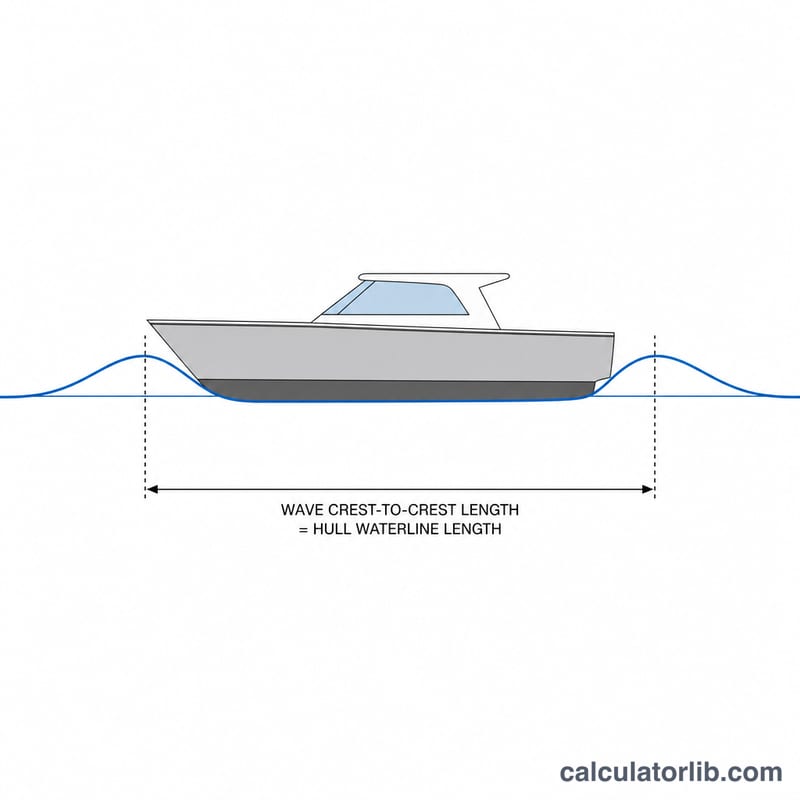
This calculator estimates the maximum hull speed of a displacement-hull boat — the practical speed limit imposed by the wave a boat makes as it moves through the water. As speed increases, the boat creates a bow wave whose wavelength grows with speed. When that wavelength matches the boat's waterline length, the hull effectively sits in a trough it cannot climb out of without enormous extra power, defining its hull speed.
How to Use It
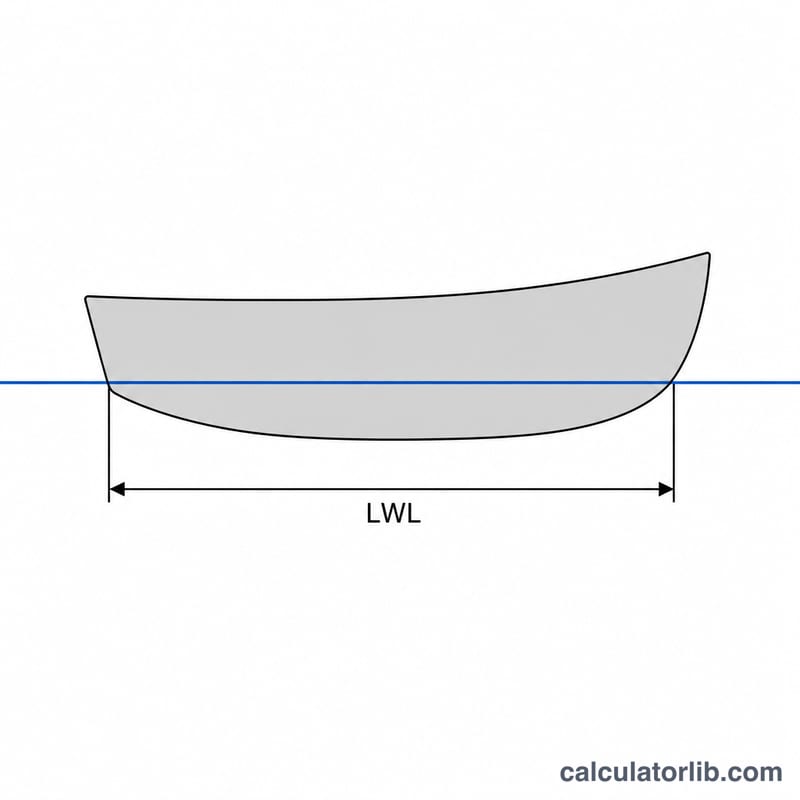
Measure the waterline length (LWL) of your boat in feet — this is the length of the hull actually touching the water when loaded, not the overall length of the deck. Enter it and the calculator returns the theoretical maximum hull speed in knots, plus equivalents in miles per hour and kilometres per hour.
The Formula Explained
The classic naval architecture rule is:
$$\text{Speed (knots)} = 1.34 \times \sqrt{\text{LWL}}$$ where LWL is the waterline length in feet.
The constant 1.34 comes from the physics of deep-water gravity waves. It applies to traditional displacement hulls; planing hulls and multihulls can exceed this limit because they lift out of the water rather than pushing through it.
Worked Example
Consider a sailboat with a 25-foot waterline. The square root of 25 is 5, so the hull speed is $$1.34 \times 5 = 6.7 \text{ knots}$$ That equals about 7.71 mph or 12.41 km/h.
Hull Speed by Waterline Length
The classic displacement hull speed formula uses the waterline length (LWL), not the overall length of the boat:
$$\text{Hull Speed (knots)} = 1.34 \times \sqrt{\text{LWL (ft)}}$$
The table below applies this formula to common waterline lengths. Knots are converted to other units using 1 knot = 1.15078 mph = 1.852 km/h.
| Waterline Length (ft) | Hull Speed (knots) | Hull Speed (mph) | Hull Speed (km/h) |
|---|---|---|---|
| 10 | 4.24 | 4.88 | 7.85 |
| 15 | 5.19 | 5.97 | 9.61 |
| 20 | 5.99 | 6.90 | 11.10 |
| 25 | 6.70 | 7.71 | 12.41 |
| 30 | 7.34 | 8.45 | 13.59 |
| 35 | 7.93 | 9.12 | 14.68 |
| 40 | 8.47 | 9.75 | 15.69 |
| 50 | 9.47 | 10.90 | 17.54 |
Worked example for a 30 ft waterline: \(1.34 \times \sqrt{30} = 1.34 \times 5.477 = 7.34\) knots. Converting that result, \(7.34 \times 1.15078 \approx 8.45\) mph.
Speed-Length Ratio Coefficients by Hull Type
The number 1.34 in the formula is the speed-length ratio (SLR) for a classic heavy displacement hull. The fuller formula is \(V = C \times \sqrt{\text{LWL}}\), where the coefficient \(C\) varies with hull shape. Lighter, finer hulls can exceed the traditional limit before their own wave train holds them back.
| Hull Type | Typical Coefficient (C) | Notes |
|---|---|---|
| Heavy displacement | ~1.34 | Traditional full-keel cruisers and classic sailboats. The hull is trapped in its own bow and stern wave near this speed. |
| Semi-displacement | ~1.5 | Moderate, easily driven hulls and some trawlers that can climb slightly above the classic limit with extra power. |
| Light / fin-keel | ~1.5–2.0 | Modern performance sailboats with light displacement and flat aft sections; able to partially lift and stretch their wave train. |
| Planing / multihull | Exceeds the rule | Planing powerboats and multihulls climb onto or over their bow wave; hull speed no longer caps them and the formula does not apply. |
Use the higher coefficients only as rough guidance — actual top speed for non-displacement hulls depends on power, weight and hull design rather than waterline length alone.
What Your Hull Speed Result Means
Hull speed is best understood as a soft efficiency threshold rather than an absolute speed limit. As a displacement boat moves, it generates a bow wave and a stern wave. Their wavelength grows with speed, and when the wavelength matches the boat's waterline length the hull settles into the trough between its own crests — roughly at the calculated hull speed.
Below this point, the power required rises gently with speed. As the boat approaches hull speed, the stern squats into the trough and the boat must effectively climb its own bow wave, so the power demand rises very steeply. Pushing a heavy displacement hull a fraction of a knot past its hull speed can require a large increase in engine power or sail force for little gain, which is why this figure is so useful for sizing engines and estimating efficient cruising speeds.
The limit is not absolute. Planing hulls escape it: with enough power they break free of the wave trough, lift onto the surface of the water and ride on top of the bow wave, after which the speed-length relationship no longer governs them. Surfing down a wave face lets even a displacement hull briefly exceed hull speed because gravity supplies the extra driving force. Light, fine-ended displacement and multihull designs can also sustain speeds well above \(1.34 \times \sqrt{\text{LWL}}\) because their slender hulls produce a smaller, more easily overtaken wave train.
For practical cruising, many owners plan a comfortable passage speed slightly below the calculated hull speed, where fuel burn and motion are far easier than at the steep end of the power curve. To estimate a passage time, divide your distance by that cruising speed in the same units.
FAQ
Can a boat go faster than its hull speed? Yes — planing hulls, surfing down waves, or very high power can exceed it, but for a typical displacement hull it represents a strong efficiency barrier.
Should I use overall length or waterline length? Always waterline length (LWL). Overhangs at the bow and stern don't contribute to hull speed.
Why is the result in knots? Knots (nautical miles per hour) are the standard maritime speed unit; we also show mph and km/h for convenience.