
What this calculator does
This tool estimates how many calories (kcal) you burn while rowing a boat or paddling a canoe. It uses the MET (metabolic equivalent of task) method, a widely used physiology approach. A MET expresses how intense an activity is relative to sitting quietly (1 MET). The MET values offered here come from a revised Compendium of Physical Activity METs table, and match the internationally recognized Compendium of Physical Activities (Ainsworth), so the estimate applies anywhere in the world.
How to use it
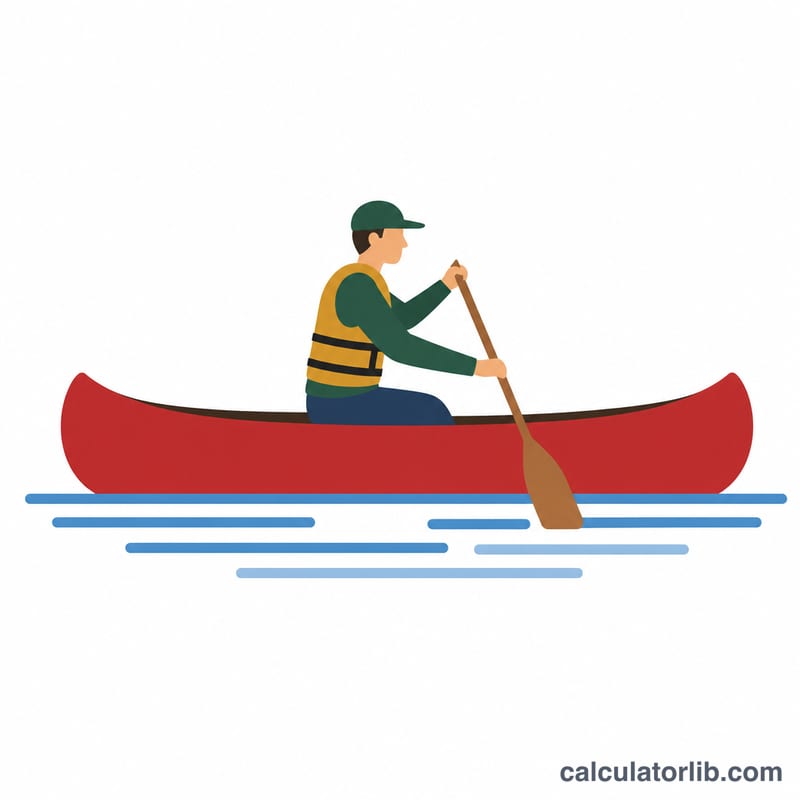
Pick the boat or canoe activity that best matches your effort level from the dropdown. Light recreational paddling is about 2.8 METs, moderate rowing about 5.8 METs, and fast competition or racing rises to 12 METs or more. Enter how long you were active in minutes, and your body weight in kilograms. The calculator returns your exercise intensity (in METs) and the estimated calories burned.
The formula explained
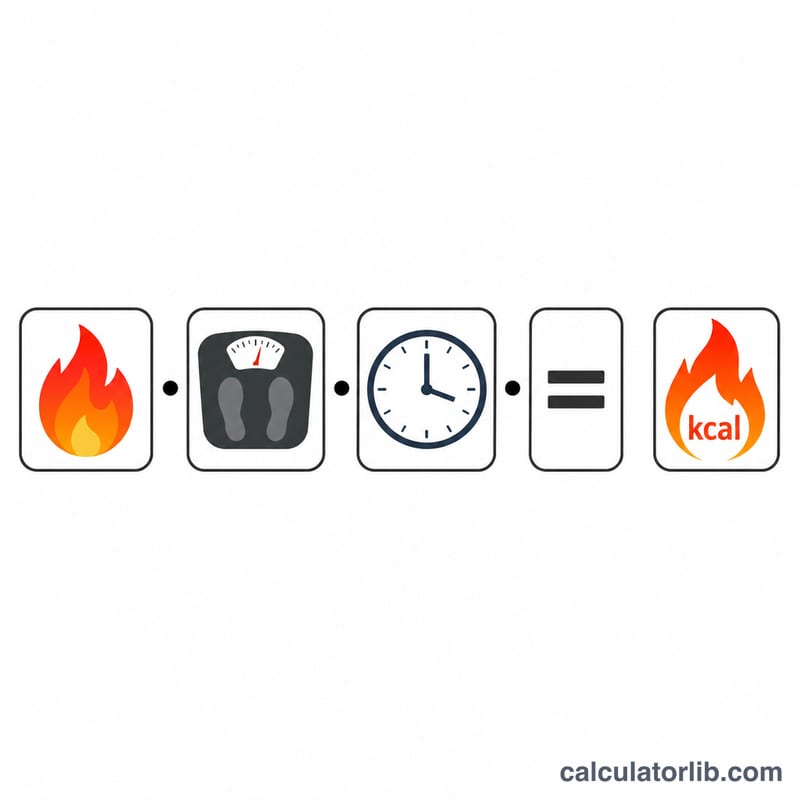
The core equation is $$\text{kcal} = \text{MET} \times \text{weight (kg)} \times \text{hours} \times 1.05$$. The duration you enter in minutes is first converted to hours by dividing by 60. The 1.05 factor reflects that at 1 MET a person burns roughly 1.05 kcal per kilogram of body weight per hour. Multiplying by the MET value scales that baseline up to the chosen activity intensity.
Worked example
Suppose you paddle a canoe at a light effort (2.8 METs) for 60 minutes and weigh 60 kg. Duration in hours = \(60 / 60 = 1.0\). Calories burned = $$2.8 \times 60 \times 1.0 \times 1.05 = 176.4 \text{ kcal}$$ with an exercise intensity of 2.8 METs.
MET Values for Rowing & Canoeing Activities
The Metabolic Equivalent of Task (MET) expresses the energy cost of an activity relative to sitting quietly at rest, where 1 MET \(\approx\) 1 kcal per kilogram of body weight per hour. The values below are drawn from the Compendium of Physical Activities and represent typical intensities for paddling and rowing.
| Activity | Intensity | MET |
|---|---|---|
| Canoeing, rowing, for pleasure | Light effort | 2.8 |
| Canoeing, rowing, 2.0–3.9 mph | Light–moderate | 3.5 |
| Kayaking, moderate effort | Moderate | 5.0 |
| Canoeing, rowing, 4.0–5.9 mph | Moderate effort | 5.8 |
| Canoeing, rowing, >6 mph | Vigorous effort | 7.0 |
| Rowing, stationary, vigorous effort | Vigorous | 8.5 |
| Canoeing, rowing, in competition / crew | Vigorous racing | 12.0 |
| Canoeing, portaging (carrying boat/gear) | Very vigorous | 12.5 |
Use the value that best matches your actual paddling pace and effort. Choosing a MET that is too high will overestimate calories burned, especially over longer sessions.
Calories Burned Across Different Weights and Durations
The table applies the formula \(\text{Calories} = \text{MET} \times \text{Weight (kg)} \times \frac{\text{Duration (min)}}{60} \times 1.05\) for light leisure paddling (2.8 MET) and moderate paddling/rowing (5.8 MET). The 1.05 factor refines the per-hour kcal estimate slightly above the simple 1 kcal/kg/hr approximation.
| Weight | MET | 30 min | 60 min |
|---|---|---|---|
| 60 kg | 2.8 (light) | 88 kcal | 176 kcal |
| 60 kg | 5.8 (moderate) | 183 kcal | 365 kcal |
| 75 kg | 2.8 (light) | 110 kcal | 220 kcal |
| 75 kg | 5.8 (moderate) | 228 kcal | 457 kcal |
| 90 kg | 2.8 (light) | 132 kcal | 265 kcal |
| 90 kg | 5.8 (moderate) | 274 kcal | 548 kcal |
Worked example for a 75 kg paddler at moderate effort for 60 minutes: \(5.8 \times 75 \times \frac{60}{60} \times 1.05 = 456.75 \approx 457\) kcal. Heavier paddlers burn more for the same activity because more mass must be moved and maintained.
What Your Calorie Result Means
The number this calculator returns is your gross energy expenditure for the session — it includes the calories your body would have burned at rest during that same period, not just the extra cost of paddling. Because MET 1 is defined as resting metabolism, an activity at 5.8 MET means you are spending roughly 5.8 times your resting rate while on the water.
The result is a population average derived from the Compendium of Physical Activities. Real expenditure varies with individual fitness, age, sex, body composition, water and wind conditions, stroke efficiency, and how steadily you actually paddle versus drifting or resting.
As a rough reference for body-weight context, about 3,500 kcal is often equated with 0.45 kg (1 lb) of body fat. So a 457 kcal moderate hour, repeated regularly, contributes meaningfully to an energy deficit when paired with diet — but this is an approximation, not a precise prediction.
To put the figure in perspective relative to your whole-day needs, compare it against your total daily energy expenditure, which combines your basal metabolic rate with all your daily activity. This is general educational information, not medical or nutritional advice; consult a qualified professional for personalized guidance.
FAQ
Is this accurate for me? It is a population-average estimate. Real energy expenditure depends on your fitness, technique, water and wind conditions, and equipment, so treat the number as a guide.
Why multiply by 1.05? The 1.05 constant converts MET-hours per kilogram into kilocalories. Some formulas omit it; this calculator includes it to match its source table.
What weight should I enter? Use your current body weight in kilograms. Heavier individuals burn more calories for the same activity and time.