
What Is Bond Order?
Bond order is a measure of the number of chemical bonds between a pair of atoms in a molecule. In molecular orbital (MO) theory, it is calculated from the number of electrons occupying bonding molecular orbitals versus antibonding molecular orbitals. A higher bond order generally means a stronger, shorter bond, while a bond order of zero indicates the molecule (or ion) will not form.
How to Use This Calculator
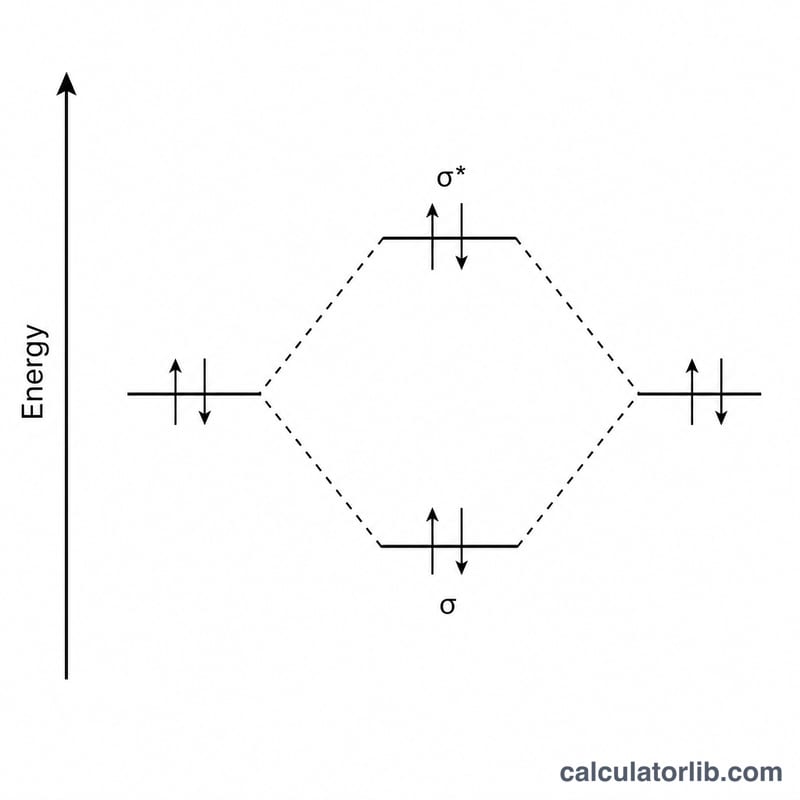
Enter the total number of electrons in bonding molecular orbitals and the total number in antibonding orbitals. These values come from filling the MO energy diagram for your molecule. The calculator instantly returns the bond order. Bonding orbitals are usually written without an asterisk (e.g. \(\sigma\), \(\pi\)) and antibonding orbitals with an asterisk (\(\sigma^*\), \(\pi^*\)).
The Formula Explained
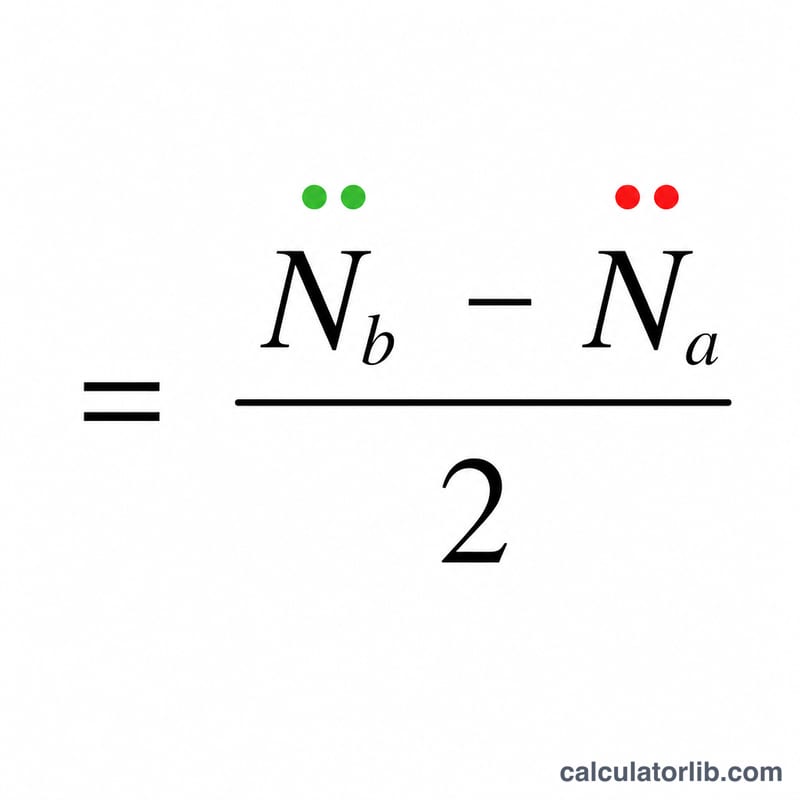
The bond order equation is:
$$\text{Bond Order} = \frac{N_b - N_a}{2}$$
Electrons in bonding orbitals stabilize the bond, while electrons in antibonding orbitals weaken it. We divide by two because each chemical bond is formed by a pair of electrons.
Worked Example
Consider the nitrogen molecule N₂. Its molecular orbitals hold 10 bonding electrons and 4 antibonding electrons. $$\text{Bond Order} = \frac{10 - 4}{2} = \frac{6}{2} = 3$$ This correctly predicts the strong triple bond in N₂.
Bond Order of Common Diatomic Molecules and Ions
The table below lists common homonuclear diatomic species along with the number of electrons in bonding molecular orbitals (\(N_b\)), the number in antibonding orbitals (\(N_a\)), and the resulting bond order computed from \(\text{BO} = (N_b - N_a)/2\). Species with a bond order of 0 are not stable as discrete molecules; species with one or more unpaired electrons are paramagnetic.
| Species | Total electrons | Bonding e⁻ (\(N_b\)) | Antibonding e⁻ (\(N_a\)) | Bond order | Stability / magnetism |
|---|---|---|---|---|---|
| H₂⁺ | 1 | 1 | 0 | 0.5 | Stable, paramagnetic |
| H₂ | 2 | 2 | 0 | 1 | Stable, diamagnetic |
| He₂ | 4 | 2 | 2 | 0 | Not stable |
| Li₂ | 6 | 4 | 2 | 1 | Stable, diamagnetic |
| B₂ | 10 | 6 | 4 | 1 | Stable, paramagnetic |
| C₂ | 12 | 8 | 4 | 2 | Stable, diamagnetic |
| N₂ | 14 | 10 | 4 | 3 | Stable, diamagnetic |
| O₂⁺ | 15 | 10 | 3 | 2.5 | Stable, paramagnetic |
| O₂ | 16 | 10 | 6 | 2 | Stable, paramagnetic |
| O₂⁻ | 17 | 10 | 7 | 1.5 | Stable, paramagnetic |
| F₂ | 18 | 10 | 8 | 1 | Stable, diamagnetic |
| Ne₂ | 20 | 10 | 10 | 0 | Not stable |
Electron counts include both core (\(\sigma_{1s}\), \(\sigma^*_{1s}\)) and valence contributions for the second-row species. Because the \(1s\)-derived bonding and antibonding electrons cancel for Li₂ through Ne₂, only valence electrons change the bond order — counting valence electrons alone gives the same result.
Interpreting Your Bond Order Result
The bond order is a direct measure of the net number of electron-pair bonds holding two atoms together, and it correlates closely with how strong and how short that bond is.
- Bond order = 0: Bonding and antibonding electrons cancel exactly, so there is no net bonding. The species (e.g. He₂, Ne₂) is not expected to exist as a stable molecule.
- Integer values: A bond order of 1 corresponds to a single bond (H₂, F₂), 2 to a double bond (O₂, C₂), and 3 to a triple bond (N₂). Higher bond order means a stronger, shorter bond.
- Fractional values: Ions and radicals often give half-integer bond orders such as 0.5 (H₂⁺), 1.5 (O₂⁻), or 2.5 (O₂⁺). A fractional result simply reflects an odd net electron count and still indicates a real, if weaker, bond.
- Bond strength and length: Within a series of similar species, higher bond order means greater bond dissociation energy and a shorter internuclear distance. For example, the N≡N triple bond (BO 3) is shorter and far stronger than the F–F single bond (BO 1).
Link to magnetism: Bond order tells you the net bonding but not the spin state. After filling the MO diagram, check whether any orbitals are singly occupied. If unpaired electrons remain — as in O₂, which keeps two unpaired electrons in its \(\pi^*\) orbitals — the molecule is paramagnetic (attracted to a magnetic field). If every electron is paired, it is diamagnetic. This is why MO theory succeeds where simple Lewis structures fail: it predicts both the bond order of 2 and the paramagnetism of molecular oxygen.
FAQ
Can bond order be a fraction? Yes. Ions and radicals such as O₂⁻ or the H₂⁺ ion can have half-integer bond orders like \(1.5\) or \(0.5\).
What does a bond order of zero mean? It means bonding and antibonding electrons cancel out, so no stable bond forms — for example, hypothetical He₂.
How does bond order relate to bond strength? Generally, higher bond order means a stronger bond and a shorter bond length.