
What is the Buffer pH Calculator?
A buffer solution resists changes in pH when small amounts of acid or base are added. This calculator uses the Henderson–Hasselbalch equation to determine the pH of a buffer from the acid dissociation constant (expressed as pKa) and the concentrations of the conjugate base [A⁻] and weak acid [HA]. It works for any acid–conjugate-base pair such as acetic acid/acetate, ammonium/ammonia, or phosphate buffers.
How to use it
Enter three values: the pKa of your weak acid, the molar concentration of the conjugate base [A⁻], and the molar concentration of the weak acid [HA]. The calculator returns the buffer pH, the base-to-acid ratio, and the corresponding pOH (at 25 °C). Concentrations can be in any consistent units because only their ratio matters.
The formula explained
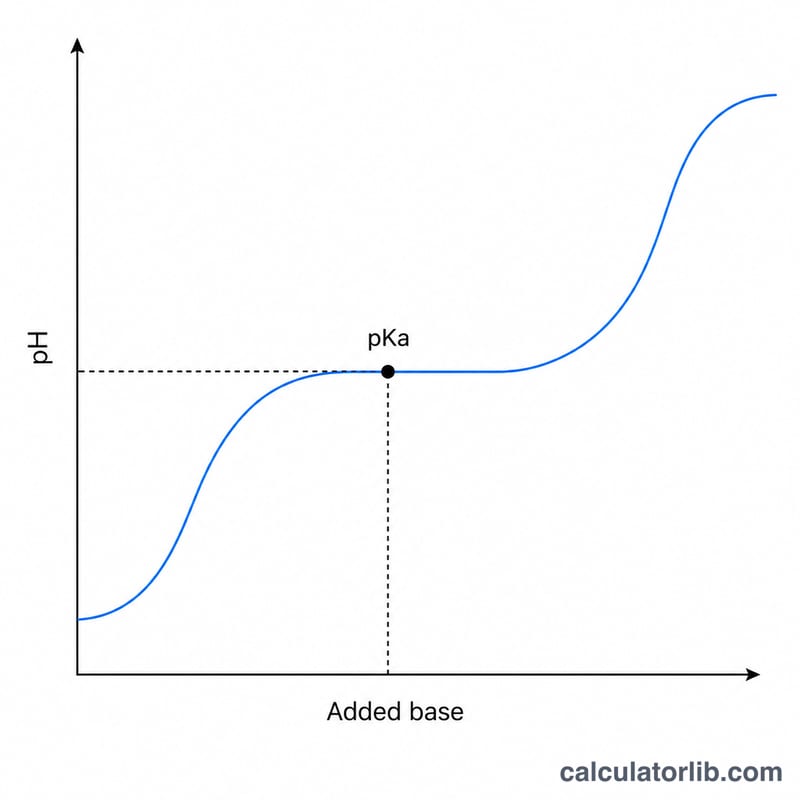
The equation $$\text{pH} = \text{p}K_a + \log_{10}\!\left(\frac{[\text{A}^-]}{[\text{HA}]}\right)$$ shows that when the base and acid concentrations are equal, the log term is zero and pH equals pKa — the point of maximum buffering capacity. More conjugate base raises the pH; more weak acid lowers it. Each tenfold change in the ratio shifts the pH by exactly one unit.
Worked example
For an acetate buffer with pKa = 4.76, [A⁻] = 0.30 mol/L and [HA] = 0.10 mol/L: the ratio is 3.0, \(\log_{10}(3.0) \approx 0.477\), so $$\text{pH} = 4.76 + 0.477 \approx \mathbf{5.24}$$
Common Buffer Systems and Their pKa Values
The most effective buffering occurs within roughly one pH unit of the system's \(\text{p}K_a\), where the conjugate base and weak acid are present in comparable amounts. The table below lists widely used buffer systems with approximate \(\text{p}K_a\) values at 25 °C and their practical buffering range (\(\text{p}K_a \pm 1\)).
| Buffer system | Equilibrium | \(\text{p}K_a\) (25 °C) | Useful buffering range |
|---|---|---|---|
| Citric acid (1st) | H₃Cit ⇌ H₂Cit⁻ | 3.13 | 2.1 – 4.1 |
| Acetic acid / acetate | CH₃COOH ⇌ CH₃COO⁻ | 4.76 | 3.8 – 5.8 |
| Citric acid (2nd) | H₂Cit⁻ ⇌ HCit²⁻ | 4.76 | 3.8 – 5.8 |
| Carbonic acid (1st) | H₂CO₃ ⇌ HCO₃⁻ | 6.35 | 5.4 – 7.4 |
| Citric acid (3rd) | HCit²⁻ ⇌ Cit³⁻ | 6.40 | 5.4 – 7.4 |
| Phosphate (2nd) | H₂PO₄⁻ ⇌ HPO₄²⁻ | 7.20 | 6.2 – 8.2 |
| Tris (Tris-HCl) | TrisH⁺ ⇌ Tris | 8.07 | 7.1 – 9.1 |
| Ammonium / ammonia | NH₄⁺ ⇌ NH₃ | 9.25 | 8.3 – 10.3 |
| Carbonic acid (2nd) | HCO₃⁻ ⇌ CO₃²⁻ | 10.33 | 9.3 – 11.3 |
As a worked check, an acetate buffer with equal concentrations of acetate \([A^-]\) and acetic acid \([HA]\) has \(\text{pH} = 4.76 + \log_{10}(1) =\) 4.76, exactly at its \(\text{p}K_a\). Note that Tris \(\text{p}K_a\) is unusually temperature-sensitive and falls as temperature rises.
Key Terms and Variables
- \(\text{p}K_a\)
- The negative base-10 logarithm of the acid dissociation constant, \(\text{p}K_a = -\log_{10} K_a\). A lower \(\text{p}K_a\) means a stronger acid. A buffer works best when the target pH is close to its \(\text{p}K_a\).
- \(K_a\) (acid dissociation constant)
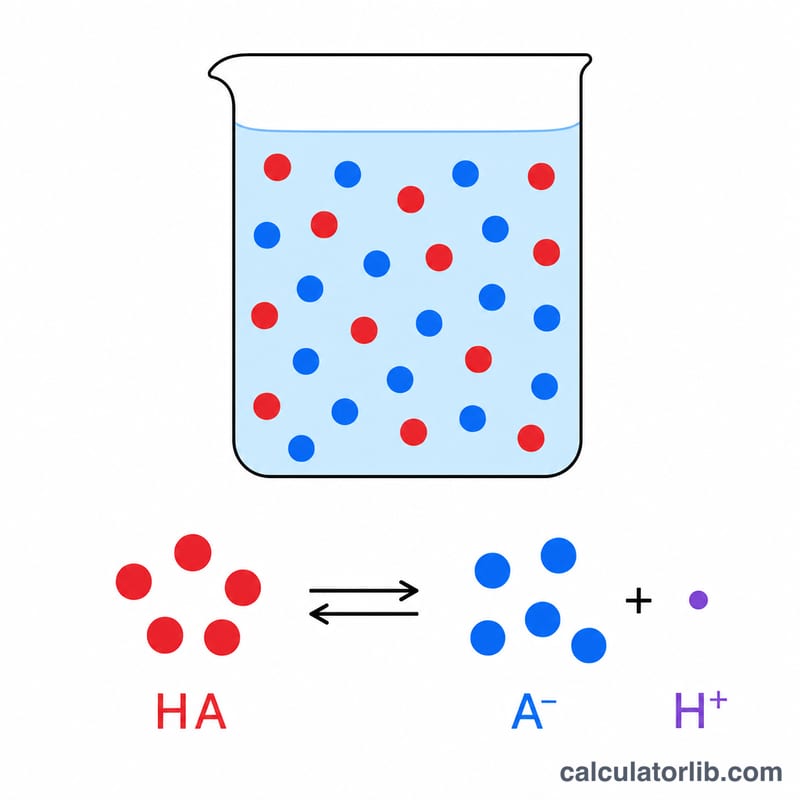
- The equilibrium constant for the dissociation \(HA \rightleftharpoons H^+ + A^-\), defined as \(K_a = \frac{[H^+][A^-]}{[HA]}\). Larger \(K_a\) indicates a stronger acid.
- Conjugate base \([A^-]\)
- The molar concentration of the species formed when the weak acid donates a proton. It is the numerator in the Henderson–Hasselbalch ratio and neutralizes added acid.
- Weak acid \([HA]\)
- The molar concentration of the undissociated (protonated) acid form. It is the denominator in the ratio and neutralizes added base.
- Buffer capacity
- A measure of how much strong acid or base a buffer can absorb with little pH change. It is greatest when \([A^-] \approx [HA]\) (at the \(\text{p}K_a\)) and at higher total buffer concentration.
- pH
- A measure of hydrogen-ion activity, \(\text{pH} = -\log_{10}[H^+]\). Lower values are more acidic; 7 is neutral at 25 °C.
- pOH
- The hydroxide-based counterpart, \(\text{pOH} = -\log_{10}[OH^-]\). At 25 °C, \(\text{pH} + \text{pOH} = 14\).
- Base-to-acid ratio \(\left(\frac{[A^-]}{[HA]}\right)\)
- The proportion of conjugate base to weak acid. A ratio of 1 gives \(\text{pH} = \text{p}K_a\); ratios from 0.1 to 10 (a \(\pm 1\) pH shift) define the practical buffering window.
FAQ
What if base and acid concentrations are equal? Then pH = pKa, since \(\log(1) = 0\).
Does the equation account for very dilute or very strong solutions? No — Henderson–Hasselbalch assumes ideal behavior and that the equilibrium concentrations approximate the initial ones, so it is most accurate for moderate buffer concentrations near the pKa.
Can I use it for a base and its conjugate acid? Yes, convert pKb to pKa using \(\text{p}K_a = 14 - \text{p}K_b\), then apply the same formula.