
What is the Pleated Skirt Calculator?
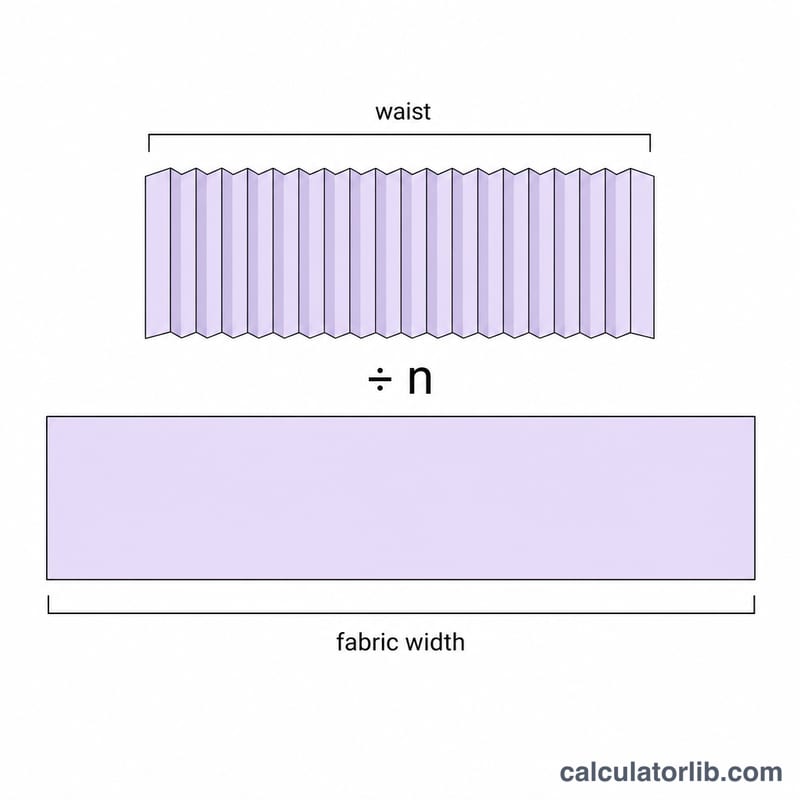
This calculator tells you how much fabric width you need to cut for a pleated skirt. Pleats fold fabric back on itself, so the flat fabric must be wider than your waist. The amount of extra width is controlled by the pleat ratio — a multiplier that says how many times your waist measurement of fabric is folded into the finished waistband.
How to use it
Enter your waist measurement (in centimetres), choose a pleat ratio, and add a seam allowance. A ratio of 2 gives lightly pleated, fuller knife pleats, while 3 produces deep, structured box or knife pleats. Seam allowance covers the side seam joins (typically 2–4 cm total).
The formula explained
The core equation is:
$$\text{fabric width} = \text{waist} \times \text{pleat ratio} + \text{seam allowance}$$
Multiplying the waist by the ratio gives the flat fabric needed to produce the folds; the seam allowance is added once for the seams. The fabric taken up by the pleats themselves is \(\text{waist} \times (\text{ratio} - 1)\).
Worked example
For a 70 cm waist with a pleat ratio of 3 and 3 cm seam allowance: $$\text{width} = 70 \times 3 + 3 = 213 \text{ cm}$$ (about 2.13 m). Of that, \(70 \times (3 - 1) = 140\) cm is folded into the pleats.
FAQ
Which pleat ratio should I pick? Use 2 for soft, economical pleats and 3 for crisp, full pleats. Heavy fabrics often look best at 2.5–3.
Does this give length too? No — this estimates fabric width. Your fabric length depends on the skirt length plus hem and waistband allowances.
What if my fabric is narrower than the result? You will need to join multiple panels; add an extra seam allowance for each join.