
What this calculator does
This tool computes how many hours fall between a start time (clock in) and an end time (clock out), correctly handling shifts that run past midnight. Enter both times in 24-hour format and an optional unpaid break, and it returns the total span and the paid hours.
How to use it
Type the clock-in hour and minute, then the clock-out hour and minute. If the clock-out is earlier than the clock-in, the calculator assumes the shift crossed midnight and adds a full day automatically. Enter any unpaid break in minutes to deduct it from paid time.
The formula explained
Both times are converted to minutes since midnight. The span is \(((\text{clockOut} - \text{clockIn} + 1440) \bmod 1440)\); adding 1440 (the minutes in a day) and taking the remainder guarantees a positive result even for overnight shifts. Paid minutes equal the span minus the break, and dividing by 60 converts to hours.
$$\text{Paid Hours} = \frac{\big[(\text{Out}-\text{In}+1440)\bmod 1440\big] - B}{60}$$ $$\text{where}\quad \left\{ \begin{aligned} \text{In} &= 60\cdot\text{In Hour} + \text{In Min} \\ \text{Out} &= 60\cdot\text{Out Hour} + \text{Out Min} \\ B &= \text{Break (min)} \end{aligned} \right.$$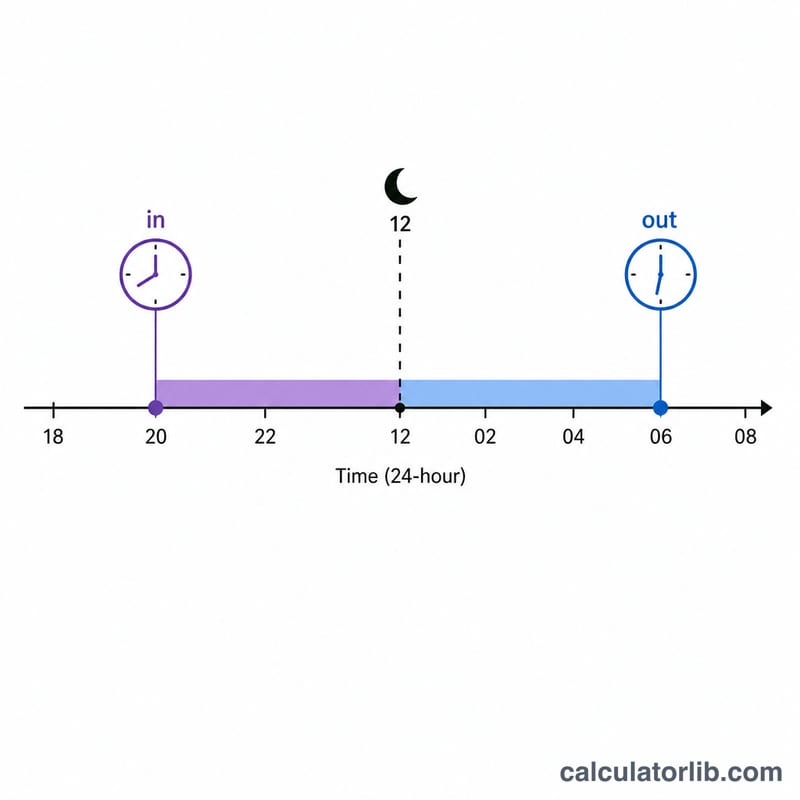
Worked example
A shift from 22:00 (10 PM) to 06:30 (6:30 AM) with a 30-minute break: clockIn = 1320, clockOut = 390.
$$\text{Span} = (390 - 1320 + 1440) \bmod 1440 = 510 \text{ minutes} = 8.5 \text{ hours}$$ $$\text{Paid minutes} = 510 - 30 = 480 = 8.0 \text{ paid hours}$$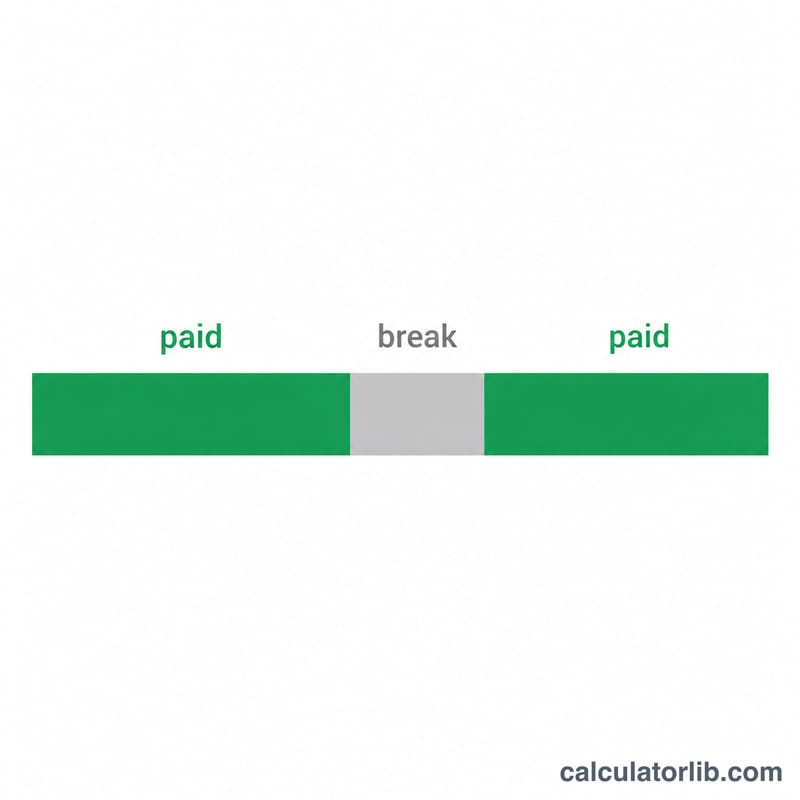
FAQ
Does it handle shifts over 24 hours? No — it assumes the end time is within one day of the start, which covers standard work shifts.
What if clock-in equals clock-out? The span is treated as 0 minutes (not 24 hours).
Is the break paid? The break is treated as unpaid and subtracted from the paid total; the total span row ignores it.