
What Is the Diamond Carat Calculator?
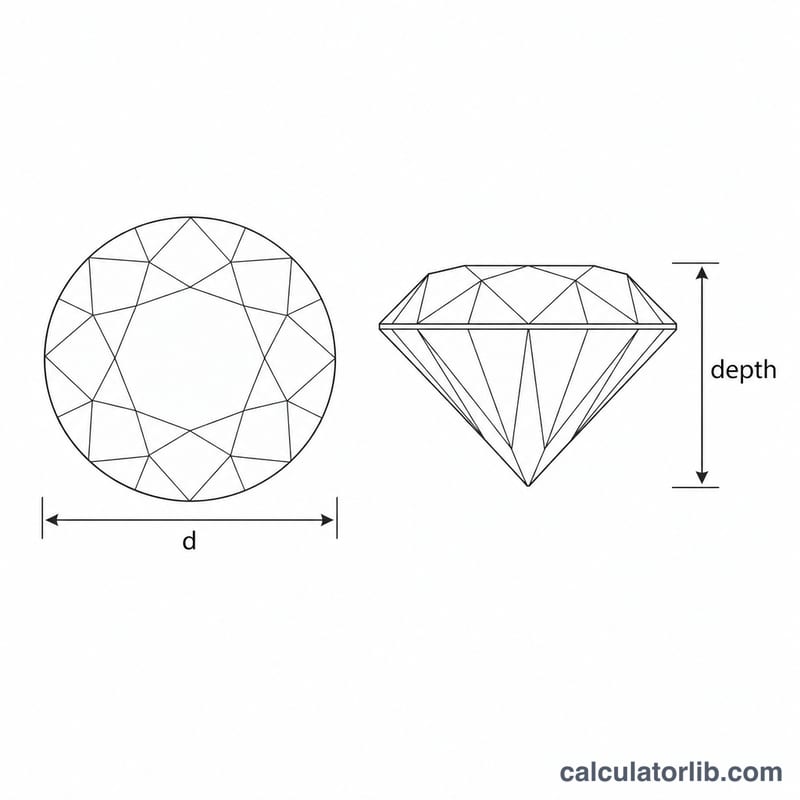
This tool estimates the weight (in carats) of a round brilliant cut diamond from its physical measurements. Jewelers and buyers often need to gauge carat weight when a stone is set in a ring and cannot be removed for weighing. By measuring the average diameter across the girdle and the total depth, you can approximate the carat weight without a scale.
How to Use It
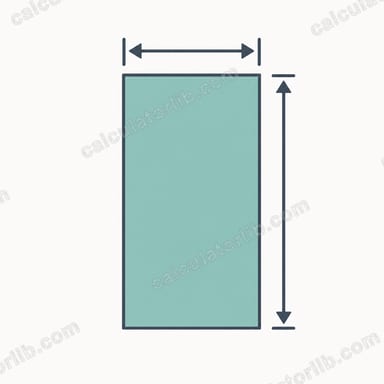
Measure the diamond's average diameter in millimeters (take two readings across the girdle and average them) and the depth from table to culet, also in millimeters. Enter both values and the calculator returns the estimated carat weight. This formula is calibrated for round brilliant cut diamonds; other shapes use different constants.
The Formula Explained
The estimate is: $$\text{Carat} = \text{Diameter (mm)}^{2} \times \text{Depth (mm)} \times 0.0061$$ The 0.0061 factor combines the volume geometry of a round brilliant and the density of diamond (about 3.52 g/cm³, where 1 carat = 0.2 g). Squaring the diameter accounts for the round cross-section, and multiplying by depth gives a volume proportional term.
Worked Example
For a stone with a diameter of 6.5 mm and a depth of 4.0 mm: \(6.5^2 = 42.25\), then \(42.25 \times 4.0 = 169\), then \(169 \times 0.0061 = 1.0309\) carats — roughly a 1-carat diamond.
FAQ
Is this exact? No — it is an estimate. Actual weight depends on the cut proportions, girdle thickness, and culet size. Expect accuracy within a few percent for well-cut stones.
Does it work for other shapes? This constant is specifically for round brilliants. Princess, oval, and other cuts require different formulas and factors.
What measurements do I need? Average diameter (mm) and depth (mm). For non-round stones the diameter is not well defined, so this tool is best for round diamonds.