
What Is the Number of Moles Calculator?
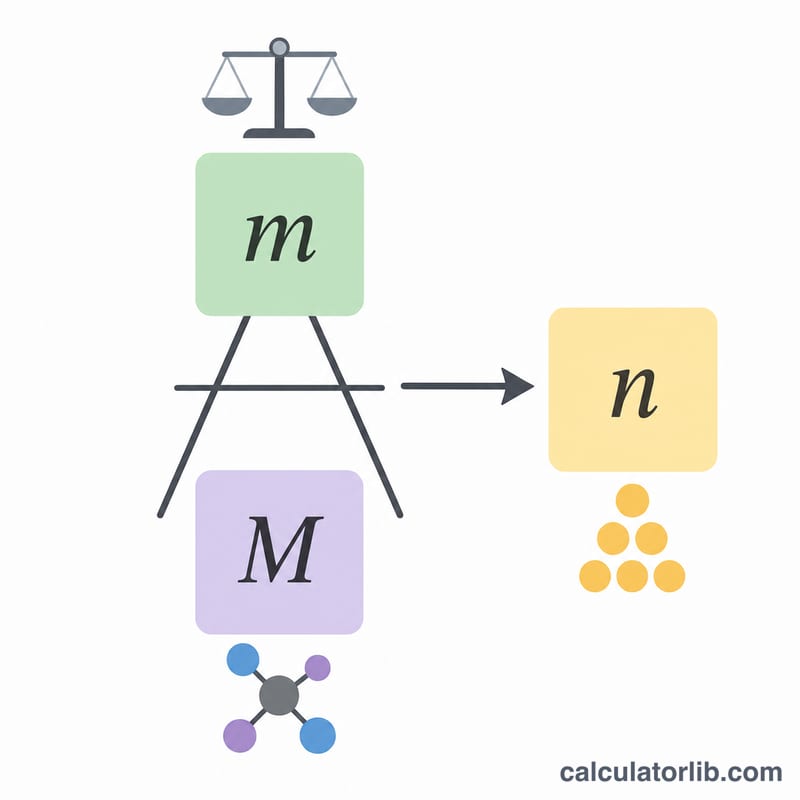
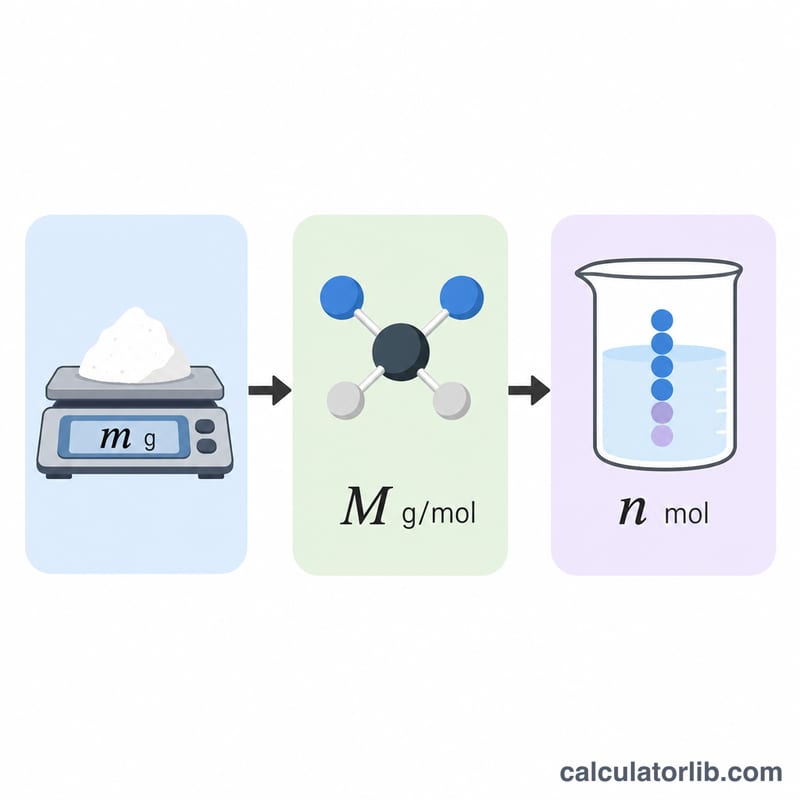
The mole is the SI unit for the amount of a chemical substance. One mole contains exactly 6.022 × 10²³ particles (Avogadro's number). This calculator converts a measured mass of a substance into the number of moles it represents, using the relationship \(n = m / M\), where n is the amount in moles, m is the mass in grams, and M is the molar mass in grams per mole.
How to Use It
Enter the mass of your sample in grams, then enter the molar mass of the substance in grams per mole. The molar mass can be found by adding the atomic masses of all atoms in the chemical formula (for example, water H₂O is about 18.015 g/mol). The calculator instantly returns the number of moles.
The Formula Explained
The equation $$n = \frac{m}{M}$$ follows directly from the definition of molar mass: molar mass is the mass of one mole of a substance. So dividing the total mass by the mass of a single mole tells you how many moles you have. The units cancel neatly: \(\text{grams} \div (\text{grams/mole}) = \text{moles}\).
Worked Example
Suppose you have 36 g of water (H₂O), which has a molar mass of 18.015 g/mol. Then $$n = \frac{36}{18.015} \approx 1.998 \text{ mol}$$ — roughly 2 moles of water molecules. That equals about \(1.2 \times 10^{24}\) molecules.
FAQ
What is molar mass? Molar mass is the mass of one mole of a substance, numerically equal to the sum of the atomic masses in its formula, expressed in g/mol.
Can I use this for elements? Yes. For a pure element, use its atomic mass from the periodic table as the molar mass (e.g. carbon ≈ 12.011 g/mol).
What if my mass is in kilograms? Convert to grams first (multiply by 1000) since molar mass is in g/mol, or keep consistent units throughout.