
What This Calculator Does
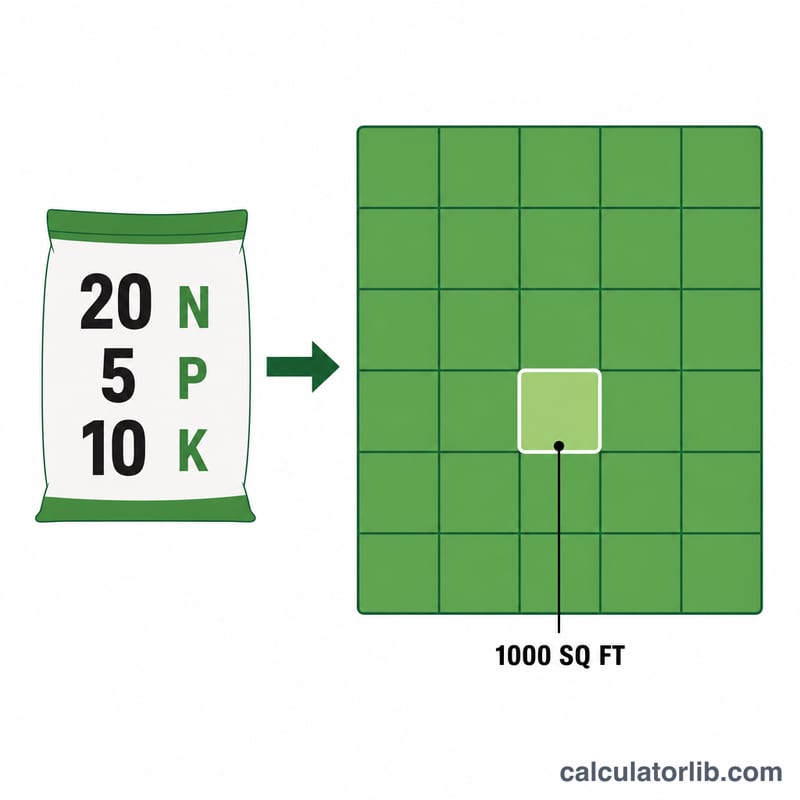
Fertilizer recommendations are usually given as a target amount of nitrogen (N) per 1,000 square feet — for example, "apply 1 lb of N per 1,000 sq ft." But fertilizer bags are sold by total product weight and list only the percentage of nitrogen (the first number in the N-P-K analysis). This calculator bridges that gap: it tells you exactly how many pounds of product to apply to hit your target nitrogen rate across your specific area.
How to Use It
Enter three values: your target nitrogen in pounds of N per 1,000 sq ft (commonly 0.5–1.0 lb), the %N printed as the first number on the fertilizer bag (a 26-3-3 product is 26% N), and the area you want to treat in square feet. The calculator returns the total pounds of product to apply, the rate per 1,000 sq ft, and the actual nitrogen you'll be applying.
The Formula Explained
The math has two steps. First, divide your target N by the decimal form of the nitrogen percentage to find how much product delivers that N over 1,000 sq ft: $$\text{rate} = \frac{\text{target\_N}}{N\% / 100}$$ Then scale by your area: $$\text{product} = \text{rate} \times \frac{\text{area}}{1000}$$
Worked Example
You want 1 lb of N per 1,000 sq ft using a 26-3-3 fertilizer (26% N) on a 5,000 sq ft lawn. Rate per 1,000 = $$1 \div 0.26 = 3.846 \text{ lb product}$$ Total = $$3.846 \times 5 = 19.23 \text{ lb of product}$$ That delivers \(19.23 \times 0.26 \approx 5\) lb of actual nitrogen over the whole lawn.
FAQ
Which number on the bag is nitrogen? The first of the three N-P-K numbers. A 10-10-10 bag is 10% N.
How much N should I apply? Most cool-season lawns target about 0.5–1.0 lb N per 1,000 sq ft per application; check your local extension guidance.
Can I split it into multiple passes? Yes — spreading the calculated amount in two perpendicular passes improves coverage uniformity.