
What is the Ideal Gas Volume Calculator?
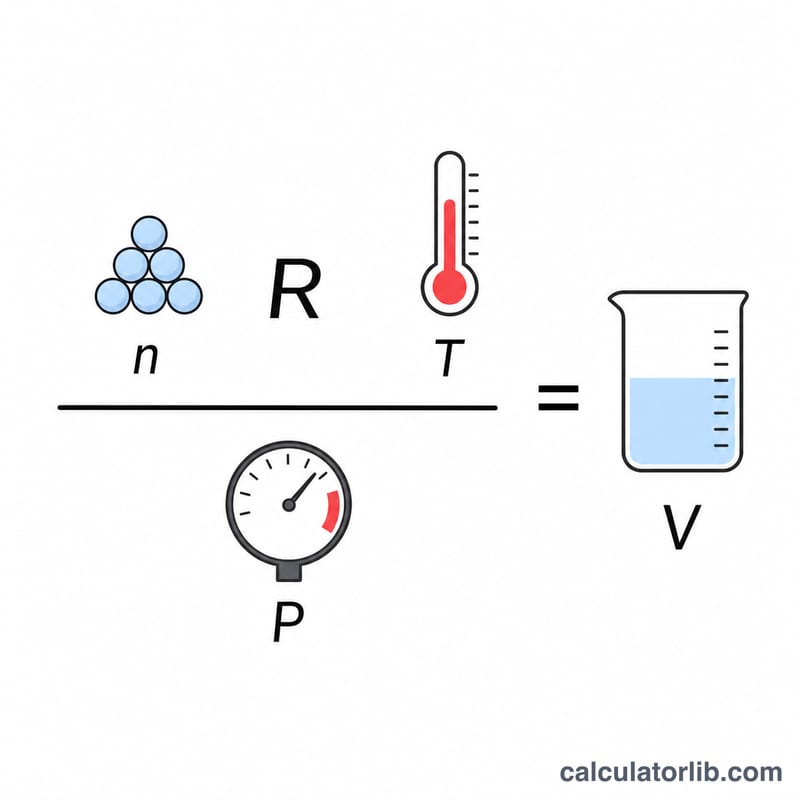
This tool computes the volume occupied by an ideal gas using the ideal gas law, \(PV = nRT\), rearranged to solve for volume: \(V = nRT / P\). Enter the amount of gas in moles, its absolute temperature in kelvin, and the pressure in atmospheres, and the calculator returns the volume in liters and milliliters. It works for any gas that behaves ideally — which is a good approximation for most common gases at moderate temperatures and pressures.
How to use it
Provide three values: the number of moles (n) of gas, the temperature (T) in kelvin (add 273.15 to a Celsius reading), and the pressure (P) in atmospheres (1 atm ≈ 101.325 kPa ≈ 760 mmHg). The calculator multiplies n, the gas constant \(R = 0.08206 \ \text{L}\cdot\text{atm}\cdot\text{mol}^{-1}\cdot\text{K}^{-1}\), and T, then divides by P to give the volume.
The formula explained
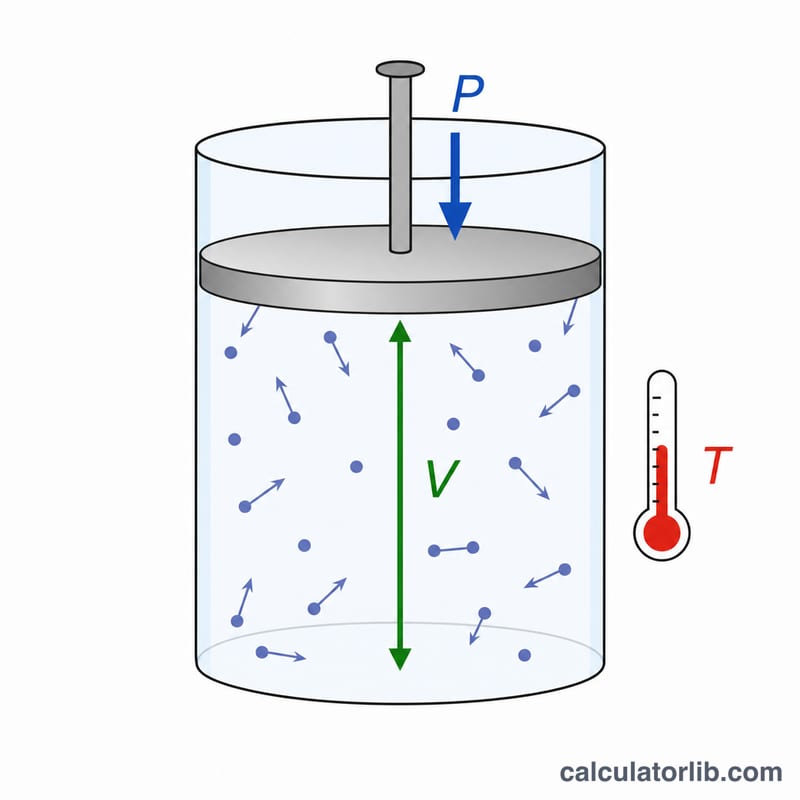
The ideal gas law links the four state variables of a gas. Solving for volume gives $$V = \frac{nRT}{P}$$ Because R is expressed in \(\text{L}\cdot\text{atm}\cdot\text{mol}^{-1}\cdot\text{K}^{-1}\), the result comes out directly in liters when temperature is in kelvin and pressure in atmospheres. Keeping units consistent is essential — using Celsius or kilopascals without converting will give wrong answers.
Worked example
Find the volume of 1 mole of gas at 273.15 K (0 °C) and 1 atm. $$V = \frac{1 \times 0.08206 \times 273.15}{1} = 22.414 \ \text{L}$$ This is the familiar molar volume of an ideal gas at standard temperature and pressure (STP).
FAQ
What temperature units do I use? Always kelvin. Convert from Celsius by adding 273.15.
Why is my answer slightly off from real gas data? Real gases deviate from ideal behavior at high pressure or low temperature; the ideal gas law is an approximation.
Can I get the volume in mL? Yes — the result table shows the volume converted to milliliters (1 L = 1000 mL).