
What Is Heart Rate as Percent of Max?
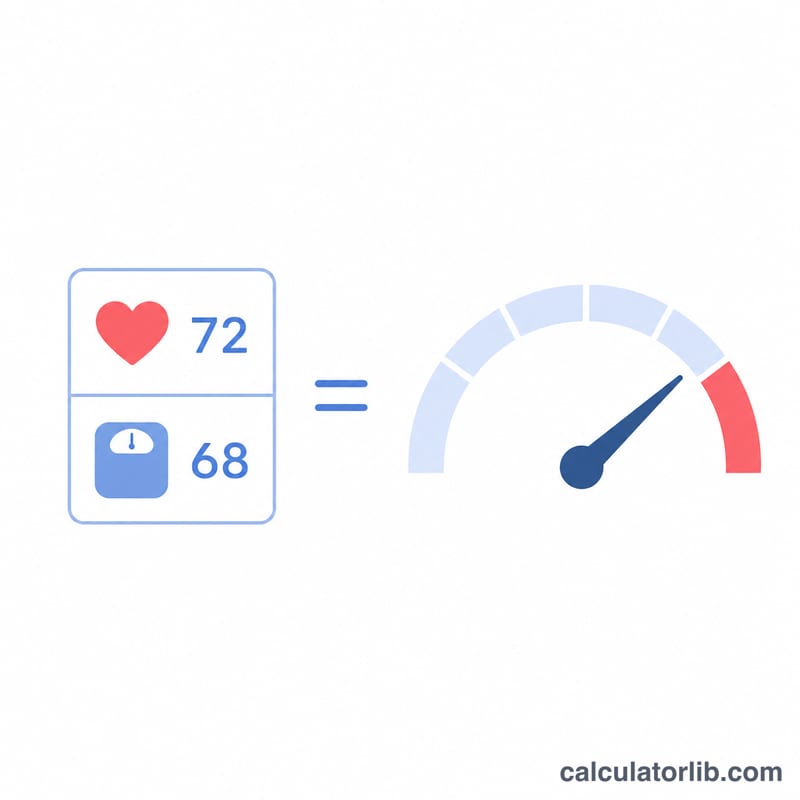
Your maximum heart rate (HRmax) is the highest number of beats per minute your heart can reach during all-out effort. Expressing your current heart rate as a percentage of this maximum tells you how hard you are working — a key metric for pacing cardio, interval training, and recovery. This calculator uses the widely known age-based estimate, \(220 - \text{age}\), to approximate your maximum.
How to Use It
Enter your age in years and your current heart rate in beats per minute (from a chest strap, watch, or pulse count). The calculator returns your estimated maximum heart rate and the percentage of that maximum you are currently working at.
The Formula Explained
The calculation is simple:
$$\%\text{ of Max} = \frac{\text{Heart Rate (bpm)}}{220 - \text{Age (years)}} \times 100$$First the estimated maximum is found by subtracting your age from 220. Then your current heart rate is divided by that maximum and multiplied by 100 to convert to a percentage.
Worked Example
Suppose you are 30 years old with a current heart rate of 150 bpm. Your estimated maximum is \(220 - 30 = 190\) bpm. Then
$$150 \div 190 \times 100 = 78.9\%$$That places you in a vigorous aerobic training zone (70–85%).
FAQ
How accurate is \(220 - \text{age}\)? It is a population average and can be off by ±10–12 bpm for any individual. For precision, a measured maximum from a stress test is better.
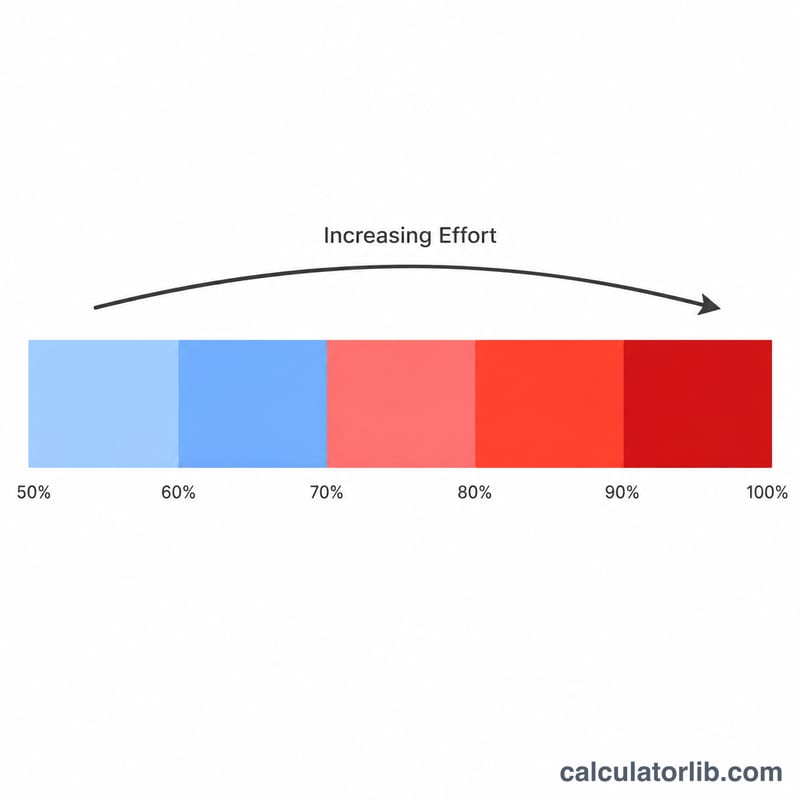
What are the training zones? Roughly: 50–60% very light, 60–70% fat-burning/light, 70–80% aerobic, 80–90% anaerobic, 90–100% maximum effort.
Is a high percentage dangerous? Sustained effort near 100% is intense and should only be done by trained, healthy individuals. Consult a doctor before high-intensity exercise if you have any health concerns.