
What Is the Insulin Sensitivity Factor?
The Insulin Sensitivity Factor (ISF), also called the correction factor, estimates how far one unit of rapid-acting insulin lowers your blood glucose. It is widely used by people with diabetes to calculate correction doses when blood sugar is above target. This tool is an educational estimate; it is not a substitute for individualized medical advice.
How to Use It
Choose a rule, enter your total daily dose (TDD) of insulin in units, and pick your glucose unit. The 1800 rule is the most common choice for modern rapid-acting analogs (lispro, aspart, glulisine), the 1700 rule is a frequent alternative, and the 1500 rule was originally designed for older regular insulin.
The Formula
The ISF is the rule constant divided by your total daily insulin dose:
$$\text{ISF} = \frac{C}{\text{TDD}}$$where \(C\) = the rule constant (1800, 1700 or 1500) and \(\text{TDD}\) = total daily insulin dose in units. For mmol/L the constant is divided by 18 (the conversion factor between mg/dL and mmol/L):
$$\text{ISF}_{mmol} = \frac{C/18}{\text{TDD}}$$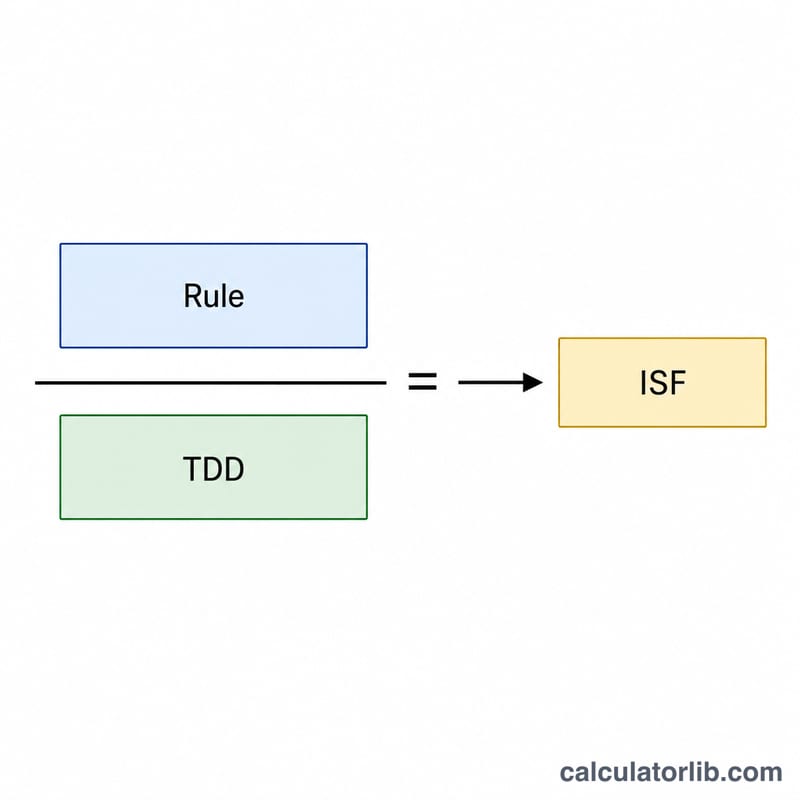
Worked Example
Suppose your total daily dose is 45 units and you use the 1800 rule in mg/dL:
$$\text{ISF} = \frac{1800}{45} = 40\ \text{mg/dL per unit}$$So one unit of insulin is expected to lower blood glucose by about 40 mg/dL. For mmol/L the same patient would get:
$$\text{ISF}_{mmol} = \frac{100}{45} \approx 2.2\ \text{mmol/L per unit}$$ISF Across Different Total Daily Doses
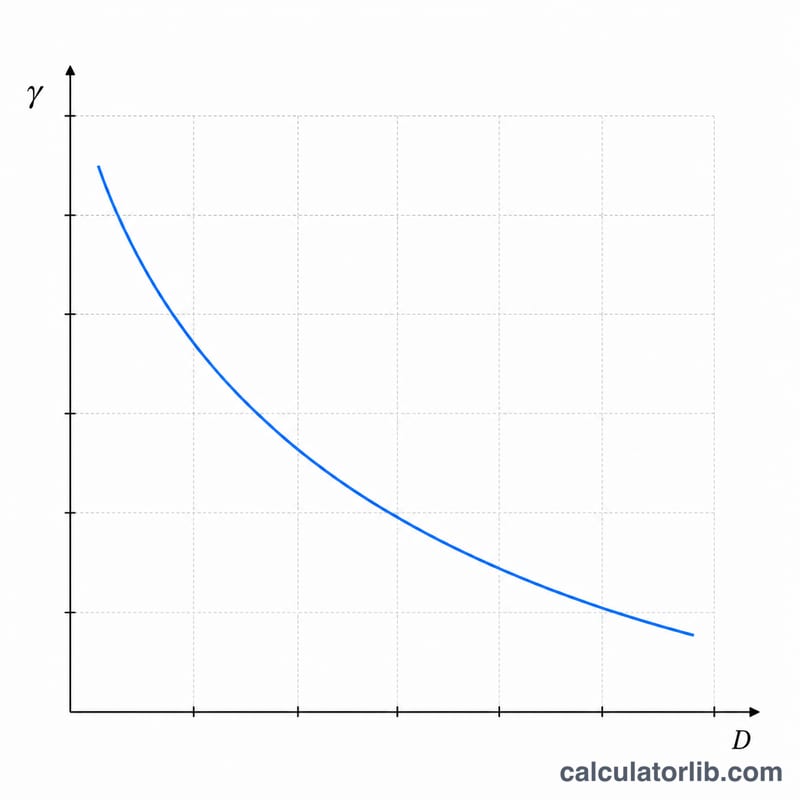
Your insulin sensitivity factor (ISF) is found by dividing a fixed constant — the "rule" number — by your total daily insulin dose (TDD). The result tells you roughly how many points your blood glucose is expected to drop per 1 unit of rapid-acting insulin. The choice between the 1800, 1700 and 1500 rules depends partly on the type of insulin and clinician preference: the 1800 and 1700 rules are most often used with rapid-acting analogs, while the 1500 rule was the original guideline for regular insulin.
$$\text{ISF} = \frac{\text{Rule}}{\text{TDD}}$$The table below shows ISF in mg/dL for several total daily doses. The mmol/L equivalent is the mg/dL value divided by 18 (rounded to one decimal place).
| TDD (units/day) | 1800 rule (mg/dL) | 1700 rule (mg/dL) | 1500 rule (mg/dL) | 1800 rule (mmol/L) |
|---|---|---|---|---|
| 20 | 90 | 85 | 75 | 5.0 |
| 30 | 60 | 57 | 50 | 3.3 |
| 45 | 40 | 38 | 33 | 2.2 |
| 60 | 30 | 28 | 25 | 1.7 |
| 80 | 23 | 21 | 19 | 1.3 |
Notice the pattern: a larger total daily dose produces a smaller ISF, meaning each unit of insulin lowers glucose by fewer points — a sign of greater insulin resistance. Conversely, someone using a small daily dose gets a large ISF, indicating high insulin sensitivity.
Key Terms & Definitions
- Insulin Sensitivity Factor (ISF) / Correction Factor
- The estimated amount your blood glucose falls per 1 unit of rapid-acting insulin, expressed in mg/dL or mmol/L. Calculated as a rule constant divided by total daily dose.
- Total Daily Dose (TDD)
- The sum of all insulin units you take in a typical 24-hour period, including both basal and bolus insulin.
- Basal Insulin
- Background, longer-acting insulin that controls glucose between meals and overnight, keeping baseline levels steady.
- Bolus Insulin
- A dose of fast-acting insulin given at meals (to cover carbohydrates) or as a correction to lower a high reading.
- Rapid-Acting Analog
- An engineered insulin (e.g. lispro, aspart, glulisine) that begins working within about 15 minutes; the 1800 and 1700 rules are typically applied to these insulins.
- Regular Insulin
- Short-acting human insulin with a slower onset (about 30 minutes) than analogs; the original 1500 rule was developed for regular insulin.
- mg/dL (milligrams per deciliter)
- The glucose concentration unit used in the United States and several other countries.
- mmol/L (millimoles per liter)
- The glucose concentration unit used in most of the world. For glucose, mmol/L = mg/dL ÷ 18.
FAQ
Which rule should I use? The 1800 rule is the default for rapid-acting analog insulin. Discuss with your clinician which constant best fits your therapy.
What is the total daily dose? It is the sum of all basal and bolus insulin units you take in a typical 24-hour period.
Is this medically reliable? It provides a starting estimate. Your real correction factor varies with activity, illness, and time of day, so always verify doses with your healthcare team.