
What Is Pulse Pressure?
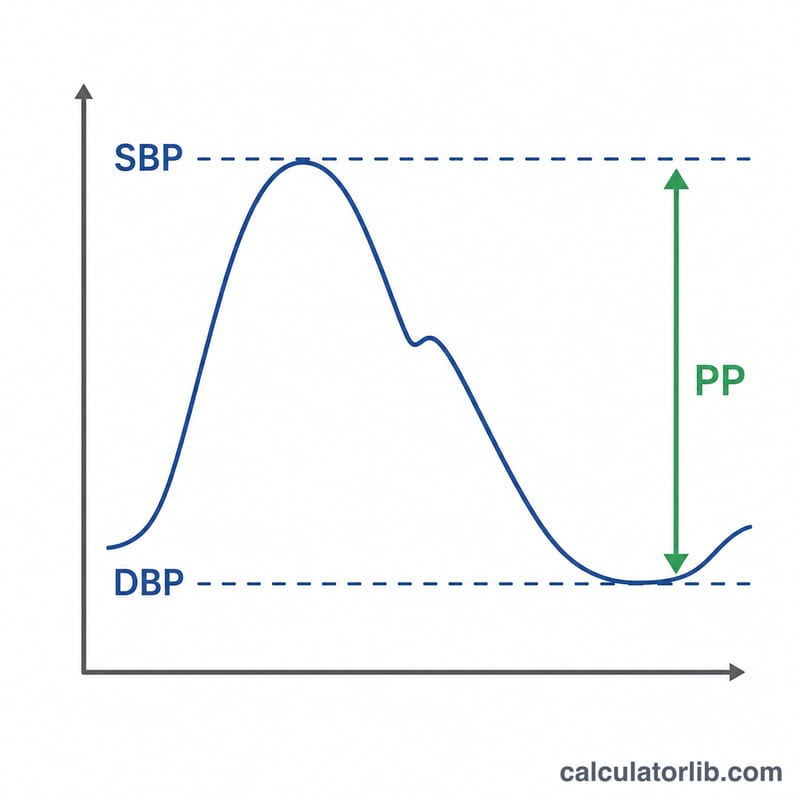
Pulse pressure (PP) is the difference between your systolic blood pressure (SBP, the top number) and your diastolic blood pressure (DBP, the bottom number). It reflects the force your heart generates with each beat and the stiffness of your large arteries. A normal resting pulse pressure is roughly 40 mmHg.
How to Use This Calculator
Enter your systolic and diastolic blood pressure readings in mmHg. The calculator instantly returns your pulse pressure and also estimates your mean arterial pressure (MAP), a useful indicator of perfusion to your organs.
The Formula Explained
Pulse pressure is simply $$\text{PP} = \text{SBP} - \text{DBP}$$. For example, a reading of 120/80 mmHg gives a pulse pressure of \(120 - 80 = 40\) mmHg. The MAP estimate uses $$\text{MAP} = \text{DBP} + \frac{\text{PP}}{3}$$, which weights the longer diastolic phase of the cardiac cycle.
Worked Example
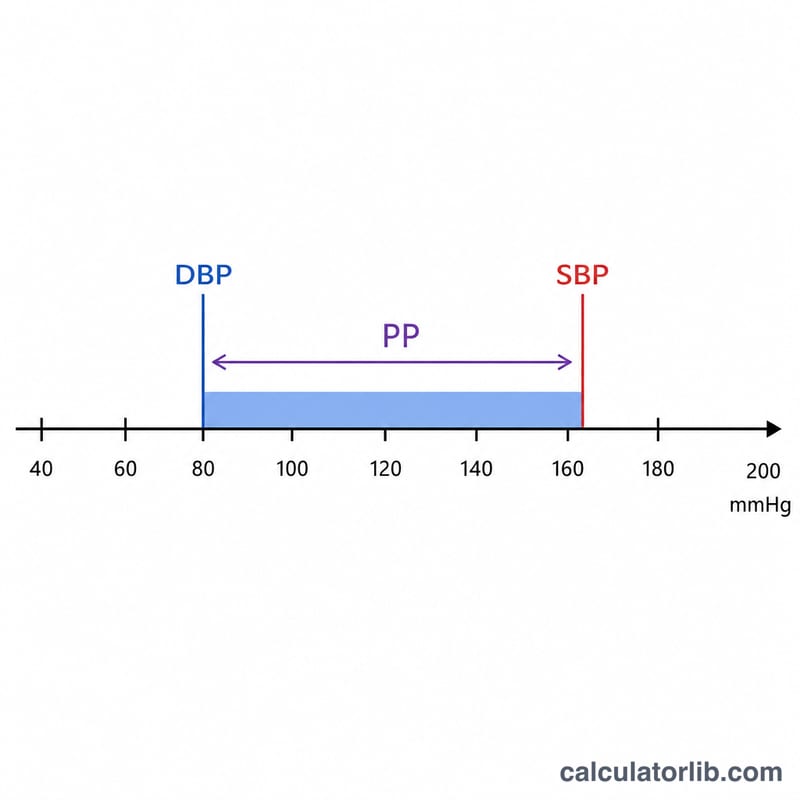
Suppose your blood pressure is 140/90 mmHg. Pulse pressure $$= 140 - 90 = \mathbf{50}\ \textbf{mmHg}.$$ MAP $$= 90 + \frac{50}{3} \approx \mathbf{106.7}\ \textbf{mmHg}.$$ A widened pulse pressure like this can be associated with arterial stiffening.
FAQ
What is a normal pulse pressure? Around 40 mmHg at rest is typical. Values consistently above 60 mmHg (wide) or below 25 mmHg (narrow) may warrant medical evaluation.
Does a high pulse pressure matter? A wide pulse pressure is often linked to stiff arteries and may be a marker of cardiovascular risk, especially in older adults.
Is this a diagnosis? No. This tool is for educational use only. Always consult a healthcare professional about your blood pressure.