
What this calculator does
The pH of a Weak Base Calculator estimates the pH, pOH, and hydroxide-ion concentration of a weak base solution when you know its base dissociation constant (Kb) and its starting molar concentration (C). Weak bases such as ammonia, methylamine, and pyridine only partially ionize in water, so a simple equilibrium expression is needed to find how basic the solution actually is.
How to use it
Enter the Kb value of the base (for example, \(1.8\times10^{-5}\) for ammonia) and the initial concentration in moles per litre. The calculator returns the hydroxide concentration \([\text{OH}^-]\), the pOH, and the final pH. All results assume a temperature of 25 °C, where the water constant gives \(\text{pH} + \text{pOH} = 14\).
The formula explained
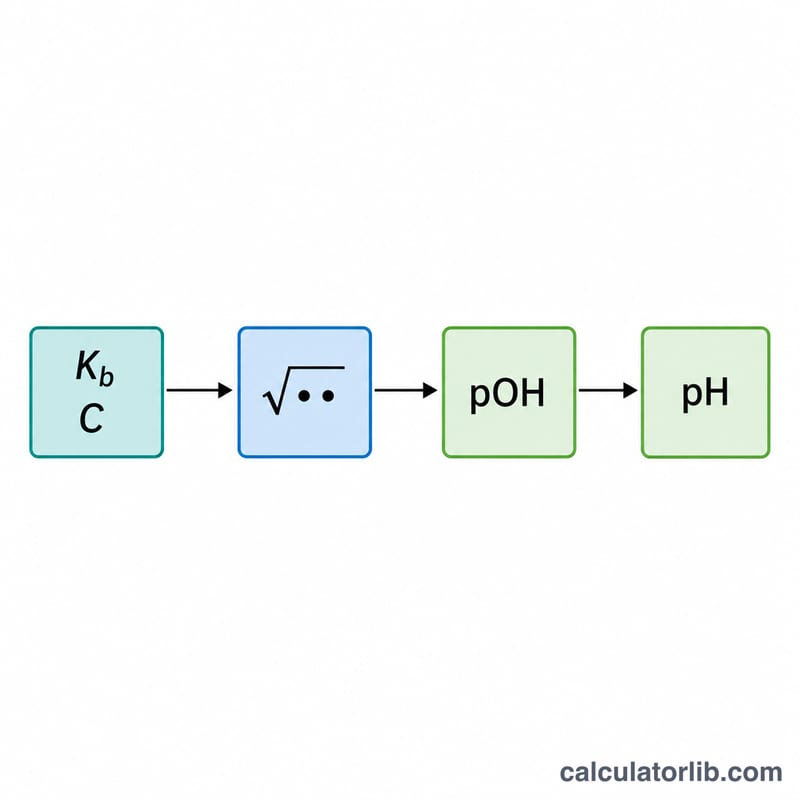
For a weak base B reacting as \(\text{B} + \text{H}_2\text{O} \rightleftharpoons \text{BH}^+ + \text{OH}^-\), the equilibrium constant is \(\text{Kb} = \frac{[\text{BH}^+][\text{OH}^-]}{[\text{B}]}\). When ionization is small, \([\text{BH}^+] \approx [\text{OH}^-] = x\) and \([\text{B}] \approx C\), giving \(\text{Kb} \approx \frac{x^2}{C}\). Solving for \(x\) yields the square-root approximation $$[\text{OH}^-] = \sqrt{\text{Kb} \cdot C}$$ Then \(\text{pOH} = -\log[\text{OH}^-]\) and \(\text{pH} = 14 - \text{pOH}\).
Worked example
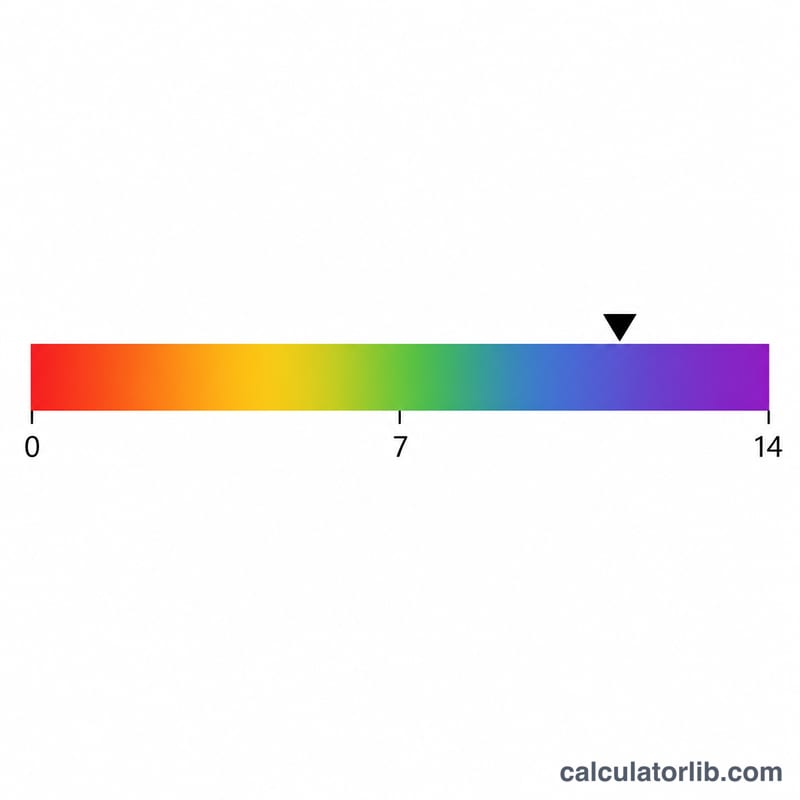
For 0.1 M ammonia with \(\text{Kb} = 1.8\times10^{-5}\): $$[\text{OH}^-] = \sqrt{1.8\times10^{-5} \times 0.1} = \sqrt{1.8\times10^{-6}} \approx 1.342\times10^{-3}\ \text{mol/L}$$ \(\text{pOH} = -\log(1.342\times10^{-3}) \approx 2.87\), so \(\text{pH} = 14 - 2.87 \approx 11.13\) — a moderately basic solution.
FAQ
When is the approximation accurate? It is reliable when the base is weak and concentration is not too low, so that \(x\) is much smaller than \(C\) (typically less than ~5%).
Can I use Ka instead of Kb? Convert with \(\text{Kb} = \frac{\text{Kw}}{\text{Ka}} = \frac{1.0\times10^{-14}}{\text{Ka}}\), then enter that Kb here.
Why is pH greater than 7? Bases produce excess hydroxide ions, lowering pOH and raising pH above the neutral value of 7.