
What Is Body Surface Area?
Body surface area (BSA) is the total external surface of the human body, expressed in square meters (m²). It is widely used in medicine — particularly to calculate drug dosages (such as chemotherapy), determine cardiac index, and assess metabolic and renal function — because it correlates better with these physiological parameters than body weight alone.
The Mosteller Formula
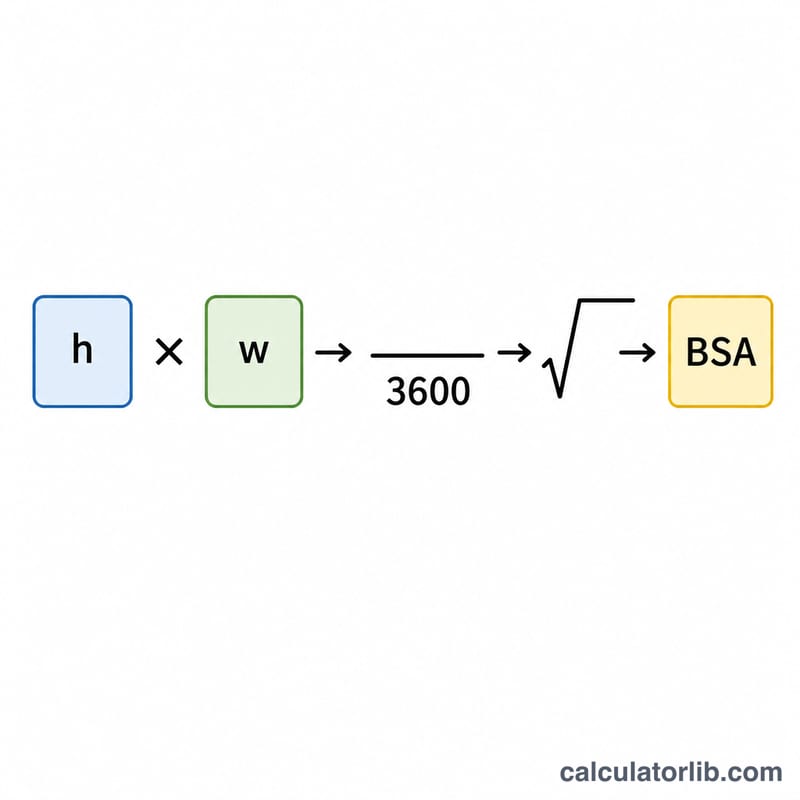
This calculator uses the Mosteller formula, published in 1987 and prized for its simplicity and accuracy:
$$\text{BSA (m}^2\text{)} = \sqrt{\dfrac{\text{height(cm)} \times \text{weight(kg)}}{3600}}$$
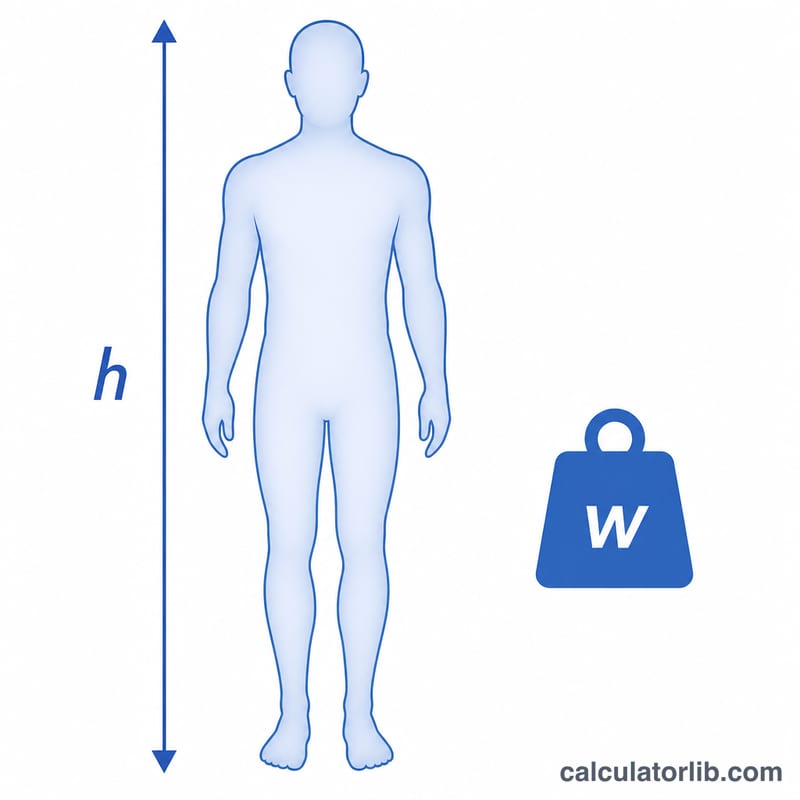
You simply multiply height in centimeters by weight in kilograms, divide by 3600, and take the square root. The constant 3600 conveniently normalizes the result into square meters.
How to Use This Calculator
Enter your height in centimeters and your weight in kilograms, then submit. The calculator returns your estimated body surface area in m². Typical adult values range from about 1.5 m² to 2.0 m².
Worked Example
For a person who is 180 cm tall and weighs 80 kg: multiply \(180 \times 80 = 14{,}400\). Divide by 3600 to get 4. The square root of 4 is exactly 2.0, so the BSA is 2.0 m².
$$\text{BSA} = \sqrt{\dfrac{180 \times 80}{3600}} = \sqrt{\dfrac{14{,}400}{3600}} = \sqrt{4} = 2.0 \text{ m}^2$$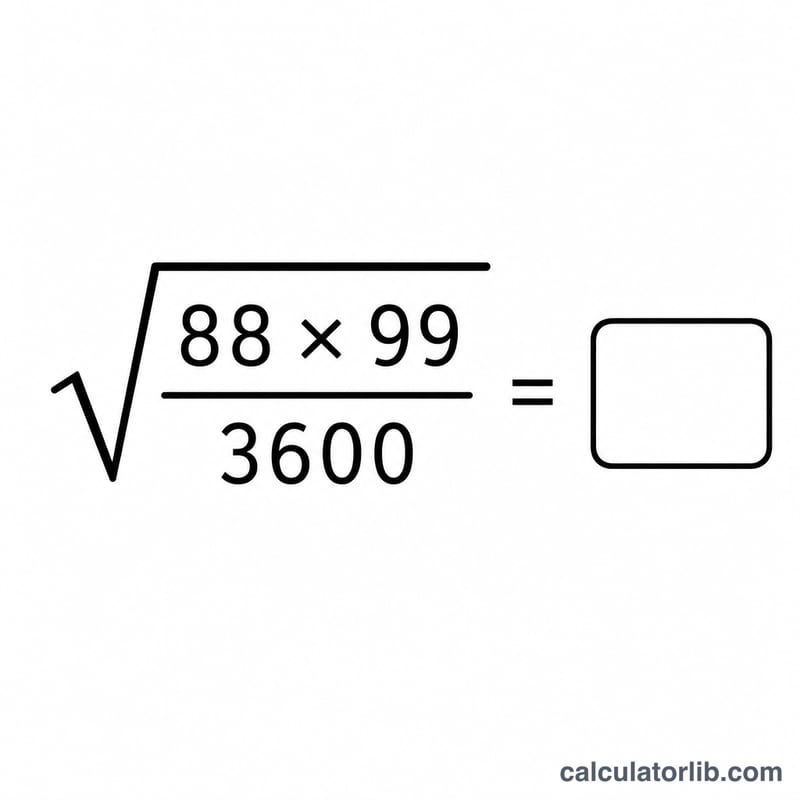
FAQ
Is the Mosteller formula accurate? Yes — studies show it agrees closely with the older Du Bois and Haycock formulas while being far easier to compute, which is why it is popular in clinical settings.
What units do I need? Height must be in centimeters and weight in kilograms. The result is always in square meters.
Should I use this for medical dosing? This tool is for educational and informational purposes. Always confirm clinical calculations with a qualified healthcare professional.