What is Percentage Deviation?
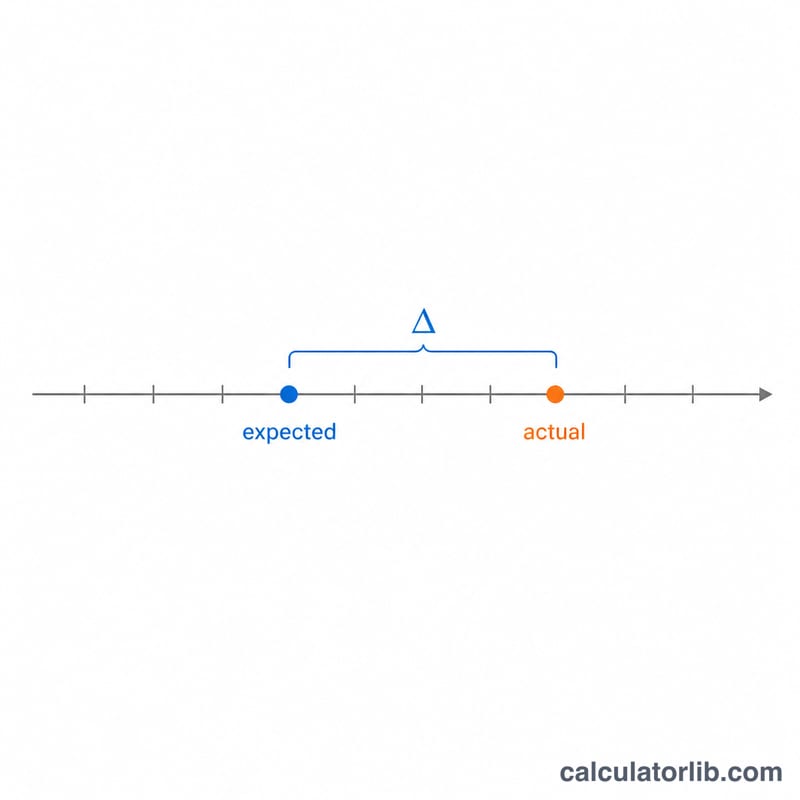
Percentage deviation is a measure that quantifies the relative difference between an actual value and an expected value, expressed as a percentage of the expected value. It helps determine how far an observed value deviates from what was anticipated, making it useful for analyzing accuracy, performance, and variation in various fields.
When to Use Percentage Deviation Calculator
The percentage deviation calculator is particularly useful in these scenarios:
- Quality control processes to measure how much manufactured products deviate from design specifications
- Scientific experiments to analyze the difference between experimental results and theoretical predictions
- Financial analysis to evaluate the variance between actual and forecasted figures, such as budget planning or sales projections
How to Calculate Percentage Deviation
Percentage Deviation is calculated using the following formula:
$$\text{Percentage Deviation} = \frac{\text{Actual Value} - \text{Expected Value}}{\text{Expected Value}} \times 100\%$$The formula consists of these steps:
- Calculate the absolute deviation: \(\text{Actual Value} - \text{Expected Value}\)
- Divide this deviation by the Expected Value
- Multiply by 100 to express the result as a percentage
A positive percentage deviation indicates the actual value is higher than expected, while a negative percentage deviation shows the actual value is lower than expected.
Examples of Percentage Deviation Calculation
Example 1: Manufacturing Quality Control
A manufacturing process is designed to produce metal rods with an expected length of 50 cm. The actual measured length of a sample rod is 52 cm. What is the percentage deviation?
$$\frac{52 - 50}{50} \times 100 = 4\%$$| Expected Value | Actual Value | Deviation | Percentage Deviation |
|---|---|---|---|
| 50 cm | 52 cm | 2 cm | 4% |
Example 2: Financial Forecasting
A company projected quarterly sales of $200,000, but the actual sales were $180,000. Calculate the percentage deviation.
$$\frac{180{,}000 - 200{,}000}{200{,}000} \times 100 = -10\%$$| Expected Value | Actual Value | Deviation | Percentage Deviation |
|---|---|---|---|
| $200,000 | $180,000 | -$20,000 | -10% |
Example 3: Scientific Experiment
In a physics experiment, the expected temperature rise was 25°C, but the actual measured rise was 26.5°C. What is the percentage deviation?
$$\frac{26.5 - 25}{25} \times 100 = 6\%$$| Expected Value | Actual Value | Deviation | Percentage Deviation |
|---|---|---|---|
| 25°C | 26.5°C | 1.5°C | 6% |
Interpreting Percentage Deviation
| Percentage Deviation Range | Interpretation |
|---|---|
| 0% | Perfect match between actual and expected values |
| 0% to ±5% | Minor deviation, generally acceptable in many applications |
| ±5% to ±10% | Moderate deviation, may require attention depending on the context |
| Greater than ±10% | Significant deviation, typically requires investigation |
The acceptability of percentage deviation varies widely depending on the field and specific application. Industries with strict quality requirements may tolerate much smaller deviations than others.
Related Calculators
For more statistical and analysis tools, you might find these calculators helpful:
- Percent Error Calculator - Calculate the error between measured and actual values
- Percentage Difference Calculator - Compare two values without designating either as "expected"
- Standard Deviation Calculator - Measure the dispersion in a dataset
Definitions & Glossary
Understanding percentage deviation requires distinguishing it from several closely related concepts. The terms below clarify what each value represents and how they relate to one another.
- Percentage deviation
- A measure of how far an actual (observed) value departs from an expected (reference) value, expressed as a percentage of the expected value. It is calculated as \(\text{Deviation \%} = \dfrac{\text{Actual} - \text{Expected}}{\text{Expected}} \times 100\). Because the numerator keeps its sign, the result can be positive (actual exceeds expected) or negative (actual falls short of expected). For example, an actual of 110 against an expected of 100 gives a deviation of 10%.
- Actual value
- The real, observed, or measured outcome — the number you actually obtained. In the formula it is the value being compared, and it forms the first term of the numerator.
- Expected (reference) value
- The predicted, target, theoretical, or baseline value against which the actual result is judged. It serves as the denominator in the percentage deviation formula, so it sets the scale for the comparison. A deviation of zero means the actual value matched the expected value exactly.
- Absolute deviation
- The unsigned magnitude of the difference between the actual and expected values, \(|\text{Actual} - \text{Expected}|\), before dividing by the reference and converting to a percentage. Taking the absolute value of the percentage deviation, \(\left|\dfrac{\text{Actual} - \text{Expected}}{\text{Expected}}\right| \times 100\), tells you the size of the discrepancy regardless of whether the actual was high or low.
- Percentage deviation vs. percentage error
- The two formulas are essentially identical in structure, but the framing differs. Percentage error treats the expected value as the “true” or accepted value and the actual as a flawed measurement, so it is usually reported as an absolute (always-positive) value to express measurement accuracy. Percentage deviation often keeps its sign, because the direction of departure (over or under the reference) carries meaningful information for analysis and decision-making.
- Percentage deviation vs. percentage difference
- Percentage deviation divides by a single chosen reference (the expected value), making the comparison directional and asymmetric. Percentage difference compares two values neither of which is treated as the baseline, dividing the absolute difference by the average of the two values: \(\dfrac{|A - B|}{(A + B)/2} \times 100\). Use deviation when one value is a clear target or prediction; use percentage difference when the two quantities are simply two measurements of equal standing.