
What is the Rain Volume Calculator?
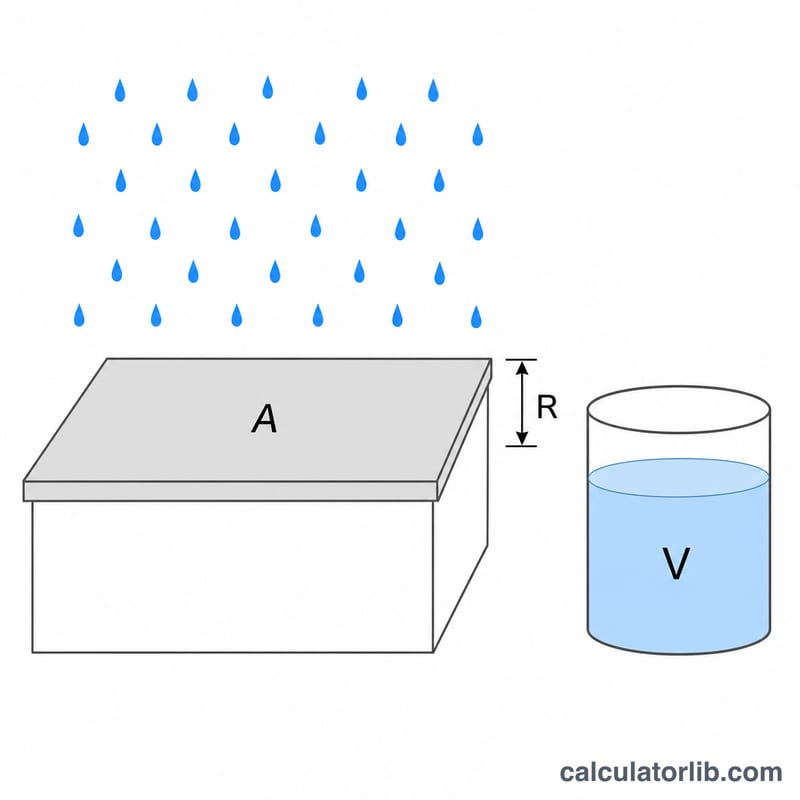
This calculator estimates how much rainwater falls on—and can be harvested from—a roof or any flat catchment surface during a rainfall event. By multiplying the surface area by the rain depth, you get the total volume of water captured, expressed in liters, US gallons, and cubic meters. It is a universal tool useful for rainwater harvesting planning, sizing storage tanks, gutter and drainage design, and understanding stormwater runoff.
How to use it
Choose your unit system. In metric mode, enter the catchment area in square meters (m²) and the rainfall depth in millimeters (mm). In imperial mode, enter the area in square feet (ft²) and rainfall in inches. Press calculate and the tool returns the collected volume in liters, gallons, and cubic meters. For a roof, use the plan (footprint) area—the horizontal projected area—rather than the sloped surface area, because rain falls vertically.
The formula explained
The metric relationship is elegantly simple: one millimeter of rain over one square meter equals exactly one liter of water. So $$\text{Liters} = \text{Area (m}^2\text{)} \times \text{Rainfall (mm)}$$ In imperial units the standard rule of thumb is $$\text{Gallons} = \text{Area (ft}^2\text{)} \times \text{Rain (in)} \times 0.623$$ where 0.623 converts the cubic-foot-inch product into US gallons. Note these figures represent gross rainfall; actual harvested water is lower after accounting for a runoff/collection efficiency factor (typically 0.8–0.9) for evaporation, splash, and first-flush losses.
Worked example
A garage roof has a footprint of 100 m² and a storm drops 25 mm of rain. $$V = 100 \times 25 = \textbf{2{,}500 liters}$$ (about 660 US gallons, or 2.5 m³). In imperial: a 1,000 ft² roof receiving 1 inch of rain collects $$1{,}000 \times 1 \times 0.623 = \textbf{623 gallons}$$
FAQ
Should I use roof footprint or sloped area? Use the horizontal footprint (plan area). Rain falls vertically, so a steep roof captures the same volume as its flat shadow.
Does this account for losses? No—it gives the gross theoretical volume. Multiply by an efficiency factor of roughly 0.8–0.9 for a realistic harvest estimate.
How many liters is 1 mm of rain per square meter? Exactly \(1\) liter, which is why the metric formula is so direct.