

What Is Scientific Notation?
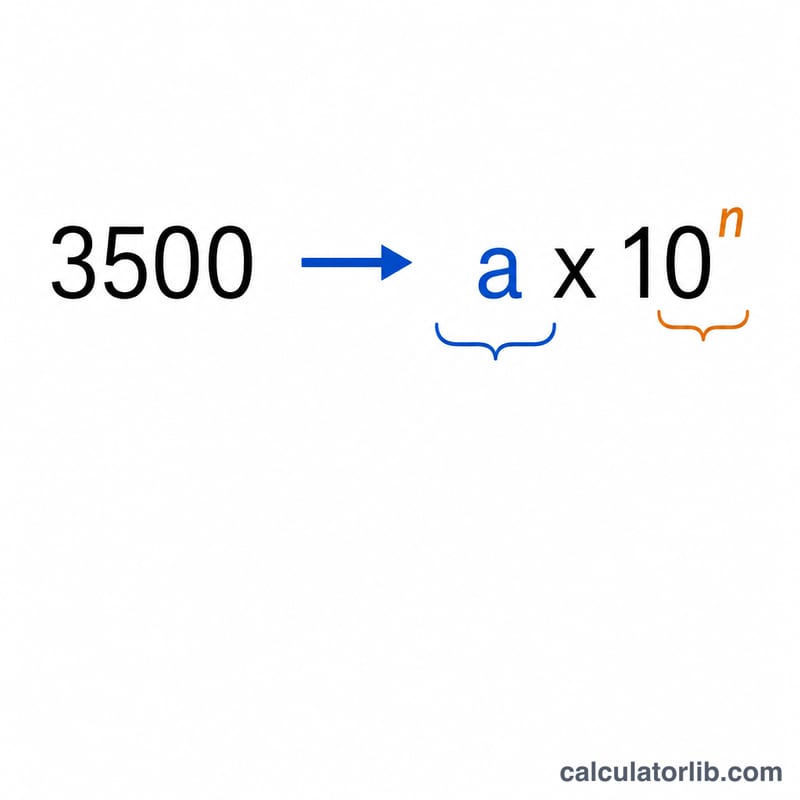
Scientific notation is a compact way to write very large or very small numbers as a coefficient multiplied by a power of ten. Every number is expressed as \(a \times 10^{n}\), where the coefficient a satisfies \(1 \le |a| < 10\) and n is an integer exponent. This calculator converts any number you type in standard (decimal) form into its scientific-notation equivalent.
How to Use the Calculator
Type a number in standard form — for example 65000, 0.00042, or -1230 — and the tool returns the coefficient and the exponent. The result is always normalised so the coefficient has exactly one nonzero digit to the left of the decimal point.
The Formula Explained
To convert, find the exponent \(n = \lfloor \log_{10} |x| \rfloor\) (the largest power of ten that fits into the number). Then divide the number by \(10^{n}\) to obtain the coefficient a. Moving the decimal point left increases the exponent; moving it right decreases it.
$$\text{Number} = c \times 10^{\,e} \qquad e = \left\lfloor \log_{10} \left| \text{Number} \right| \right\rfloor, \quad c = \frac{\text{Number}}{10^{\,e}}$$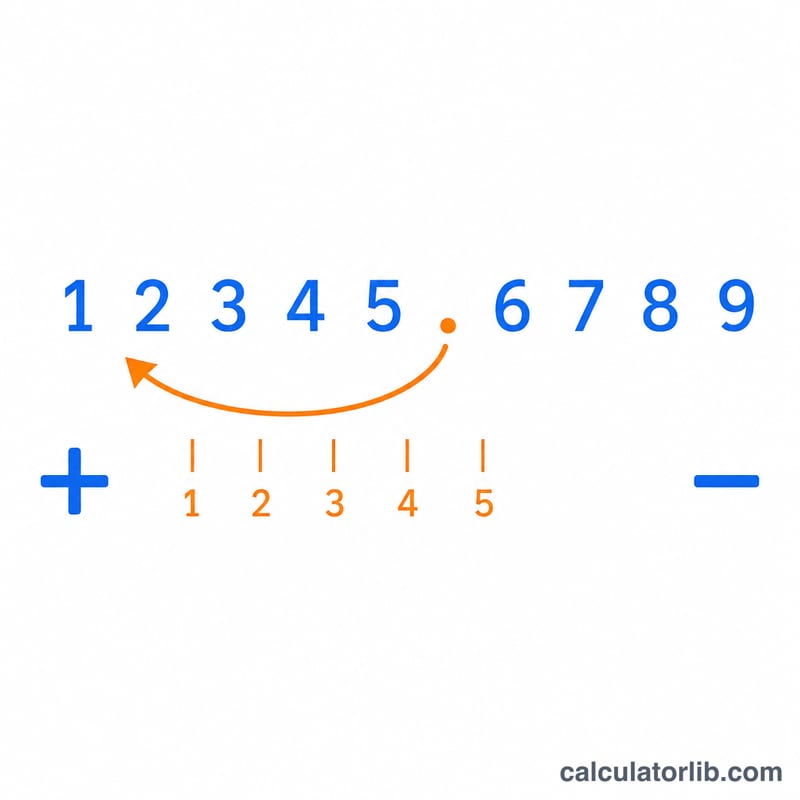
Worked Example
Convert 65,000. The largest power of ten not exceeding 65,000 is \(10^{4} = 10{,}000\). So \(n = 4\) and \(a = 65{,}000 / 10{,}000 = 6.5\). The answer is \(6.5 \times 10^{4}\). For a small number like 0.00042, \(n = -4\) and \(a = 4.2\), giving \(4.2 \times 10^{-4}\).
FAQ
What if I enter zero? Zero has no standard scientific-notation form; the calculator returns a coefficient and exponent of 0.
Does it handle negative numbers? Yes. The sign stays with the coefficient, while the rule \(1 \le |a| < 10\) applies to the absolute value.
How many digits are shown? The coefficient is displayed to up to six decimal places, which is enough for most everyday and classroom conversions.