
What Is the Trip Carbon Footprint (Flight) Calculator?
This tool estimates the carbon dioxide (CO₂) emissions produced by a flight. Air travel is one of the most carbon-intensive ways to move, so knowing the footprint of a trip helps you compare routes, choose offsets, or plan greener travel. The calculator multiplies the distance flown by an emission factor and the number of passengers to give a clear figure in kilograms and tonnes of CO₂.
How to Use It
Enter the one-way distance of your flight in kilometres, the number of passengers travelling, and an emission factor in kg CO₂ per kilometre per passenger. A typical economy-class factor is around 0.115 kg/km; premium cabins emit more because each passenger occupies more space. Select whether the trip is one-way or round-trip — round-trip simply doubles the distance. The result shows total CO₂, CO₂ per passenger, and an estimate of trees needed to offset it.
The Formula Explained
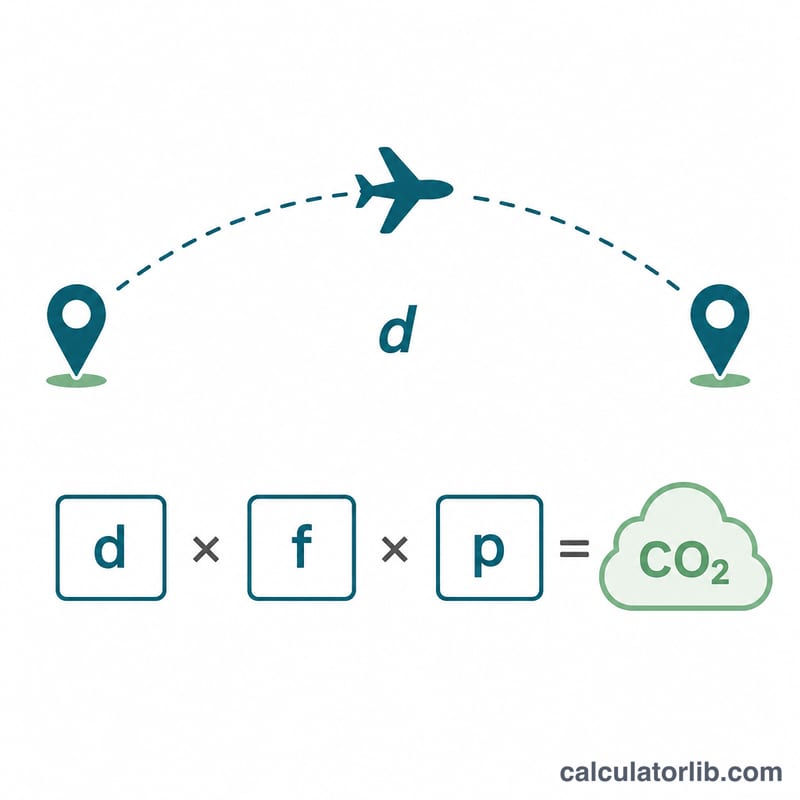
The calculation is straightforward: $$\text{CO}_2\ (\text{kg}) = \text{Distance} \times \text{Emission Factor} \times \text{Passengers}$$ The emission factor bundles fuel burn, aircraft efficiency and load factors into a single per-kilometre value. For offsets, the tool divides total CO₂ by \(21.77\) kg — roughly the annual CO₂ absorbed by one mature tree.
Worked Example
A round-trip flight of 1,000 km one-way for 2 passengers at 0.115 kg/km: total distance = 2,000 km. $$\text{CO}_2 = 2{,}000 \times 0.115 \times 2 = 460\ \text{kg}$$ or 0.46 tonnes — about 230 kg per passenger, equivalent to roughly 21 tree-years of offset.
FAQ
Is this an exact figure? No. It is an estimate. Real emissions depend on aircraft type, cabin class, weather, routing and load factor. Use it for comparison and awareness.
What emission factor should I use? Economy short/medium haul is often near \(0.10\text{–}0.15\) kg/km; business class can be \(2\text{–}3\times\) higher. Adjust the factor to match your data source.
Does altitude matter? Yes — high-altitude emissions have extra warming effects (radiative forcing). Some sources apply a multiplier of \(1.9\) to account for this; this tool uses the direct CO₂ figure unless you build that into your factor.