
What is air density?
Air density (\(\rho\)) is the mass of air per unit volume, measured in kilograms per cubic metre (kg/m³). It depends on pressure, temperature, and humidity. This calculator uses the dry-air ideal gas model, which is accurate for most engineering, aviation, and weather applications. At sea level under standard conditions (101325 Pa, 15 °C) dry air has a density of about 1.225 kg/m³.
How to use this calculator
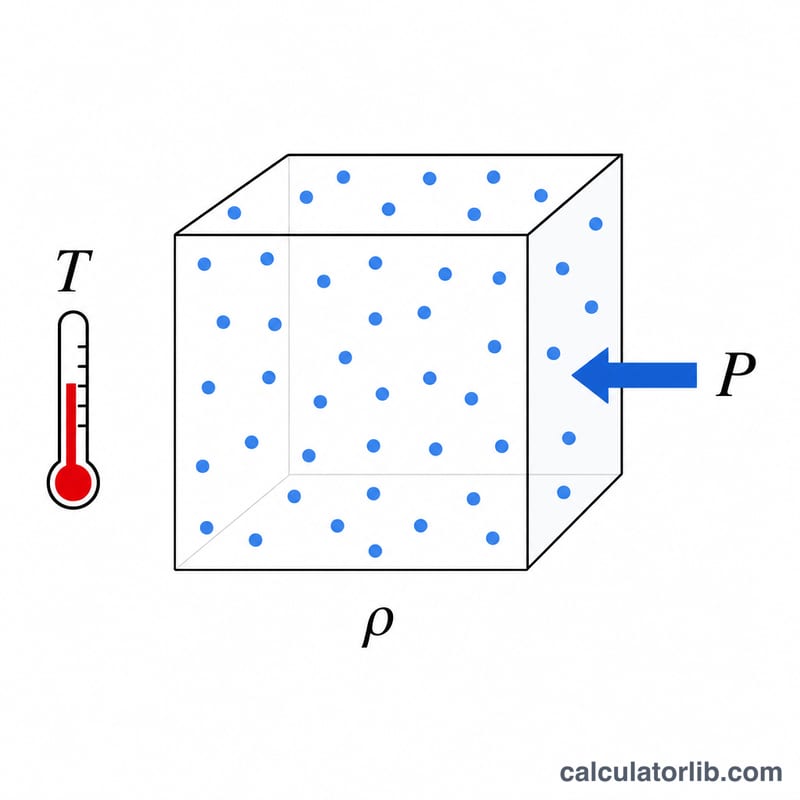
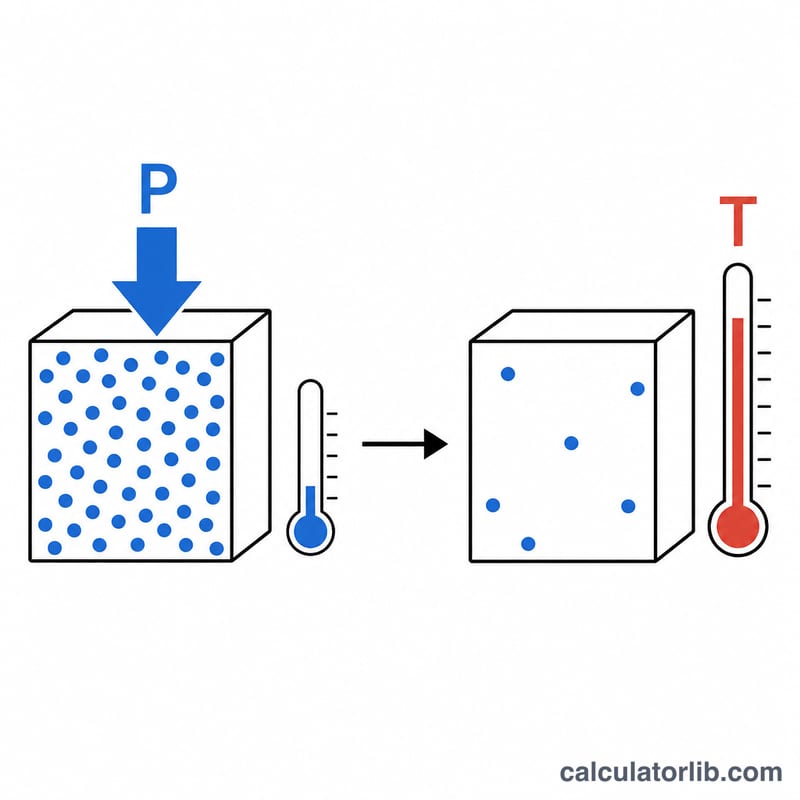
Enter the absolute air pressure in pascals (sea level is 101325 Pa) and the temperature in degrees Celsius. The tool converts temperature to kelvin and returns the air density instantly. Higher pressure increases density, while higher temperature decreases it.
The formula explained
The ideal gas law rearranges to $$\rho = \dfrac{P}{R \cdot T},$$ where \(P\) is absolute pressure (Pa), \(R\) is the specific gas constant for dry air (287.058 J/kg·K), and \(T\) is absolute temperature in kelvin. Because \(R\) for dry air is fixed, only pressure and temperature are needed.
Worked example
For standard sea-level conditions, \(P = 101325\) Pa and \(T = 15\,°\text{C} = 288.15\) K. Then $$\rho = \frac{101325}{287.058 \times 288.15} = \frac{101325}{82716.27} \approx 1.225\ \text{kg/m}^3$$ — the textbook value for air density at sea level.
Air Density at Standard Altitudes
The International Standard Atmosphere (ISA) defines reference values of pressure and temperature at each altitude. Applying the ideal gas law \(\rho = \frac{P}{287.058\,(T_{^\circ\!C} + 273.15)}\) to those values gives the dry-air density shown below.
| Altitude (m) | Pressure (Pa) | Temperature (°C) | Air density (kg/m³) |
|---|---|---|---|
| 0 | 101325 | 15.0 | 1.225 |
| 1000 | 89875 | 8.5 | 1.112 |
| 2000 | 79495 | 2.0 | 1.007 |
| 5000 | 54020 | −17.5 | 0.7361 |
| 10000 | 26436 | −49.9 | 0.4127 |
Density falls with altitude because pressure drops faster than the cooling air gains density. Values assume dry air; humidity slightly lowers density because water vapor is less dense than dry air.
Pressure Unit Conversions
The ideal gas law requires pressure in pascals (Pa). Convert your measured pressure to pascals before entering it, using the factors below.
| From unit | Multiply by | Result (Pa) |
|---|---|---|
| 1 hectopascal (hPa) | 100 | 100 |
| 1 millibar (mbar) | 100 | 100 |
| 1 standard atmosphere (atm) | 101325 | 101325 |
| 1 inch of mercury (inHg) | 3386.39 | 3386.39 |
| 1 bar | 100000 | 100000 |
For example, a barometer reading of 1013.25 hPa equals \(1013.25 \times 100 = 101325\) Pa, the standard sea-level pressure.
Temperature note: the formula adds 273.15 to convert Celsius to kelvin: \(T_K = T_{^\circ\!C} + 273.15\). So 15 °C becomes 288.15 K. Always use absolute temperature in the gas law — never raw Celsius.
FAQ
Does this account for humidity? No. It models dry air. Moist air is slightly less dense, so humid conditions give a marginally lower true density.
Why convert to kelvin? The ideal gas law requires an absolute temperature scale; using Celsius directly would give wrong results.
What pressure should I enter? Use absolute pressure in pascals. To convert from hectopascals (hPa) or millibars, multiply by 100 (e.g. 1013.25 hPa = 101325 Pa).