
What Is Traffic Density?
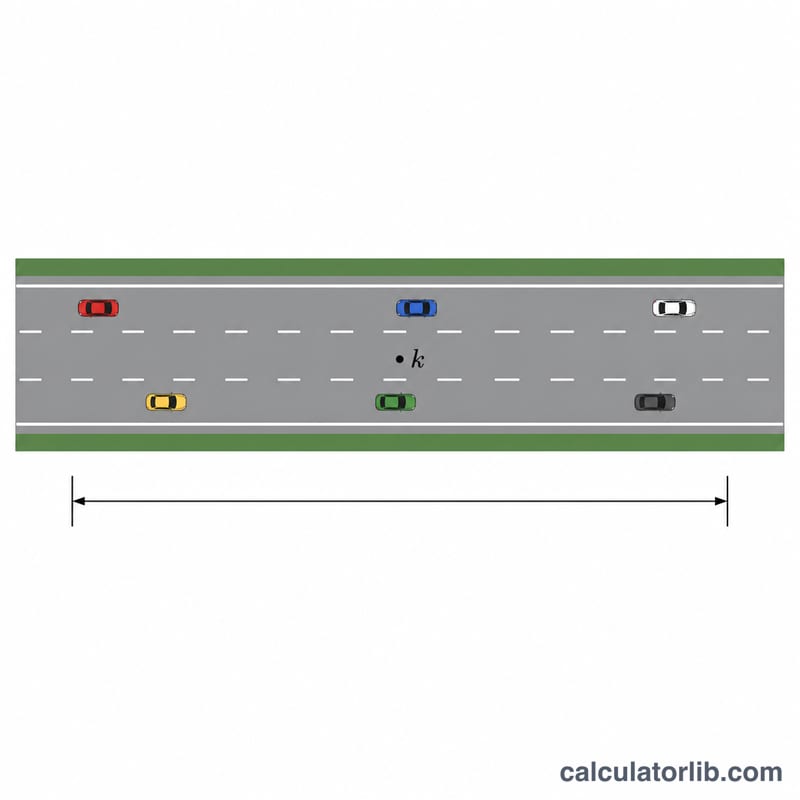
Traffic density is the number of vehicles occupying a given length of roadway at an instant, normally expressed in vehicles per mile (veh/mi) per lane. It is one of the three core variables of traffic flow theory, linked to flow and speed by the fundamental relationship of traffic flow.
The Formula
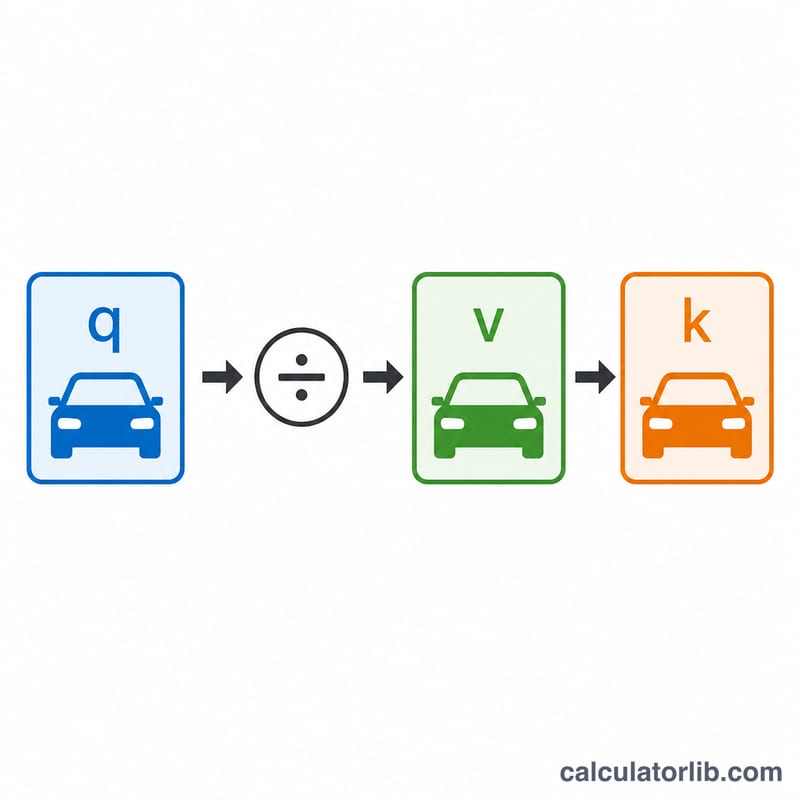
The fundamental relation states that flow equals density times speed (\(q = k \cdot v\)). Rearranging gives density:
$$k = \frac{q}{v}$$
where q is flow in vehicles per hour, v is average (space-mean) speed in miles per hour, and k is density in vehicles per mile. This calculator also estimates the average spacing between vehicles as \(5280 \div k\) feet.
How to Use It
Enter the traffic flow rate (how many vehicles pass a point each hour) and the average travel speed in miles per hour. The calculator instantly returns the density in vehicles per mile and the typical bumper-to-bumper spacing in feet.
Worked Example
Suppose a freeway lane carries a flow of 1,800 vehicles per hour at an average speed of 60 mph. Density:
$$\text{Density} = \frac{1800}{60} = 30 \text{ vehicles per mile}$$Spacing:
$$\text{Spacing} = \frac{5280}{30} = 176 \text{ feet between vehicles}$$As congestion rises, speed falls, so the same flow produces a much higher density.
FAQ
What units does this use? Flow in vehicles per hour, speed in miles per hour, density in vehicles per mile, spacing in feet.
Why does density rise as speed drops? Because flow = density \(\times\) speed; for a fixed flow, lower speed must mean more vehicles packed per mile.
What is jam density? The maximum density when traffic is stopped bumper to bumper, typically around 185–250 veh/mi per lane depending on vehicle length.