

What Is the Tesla Charging Cost Calculator?
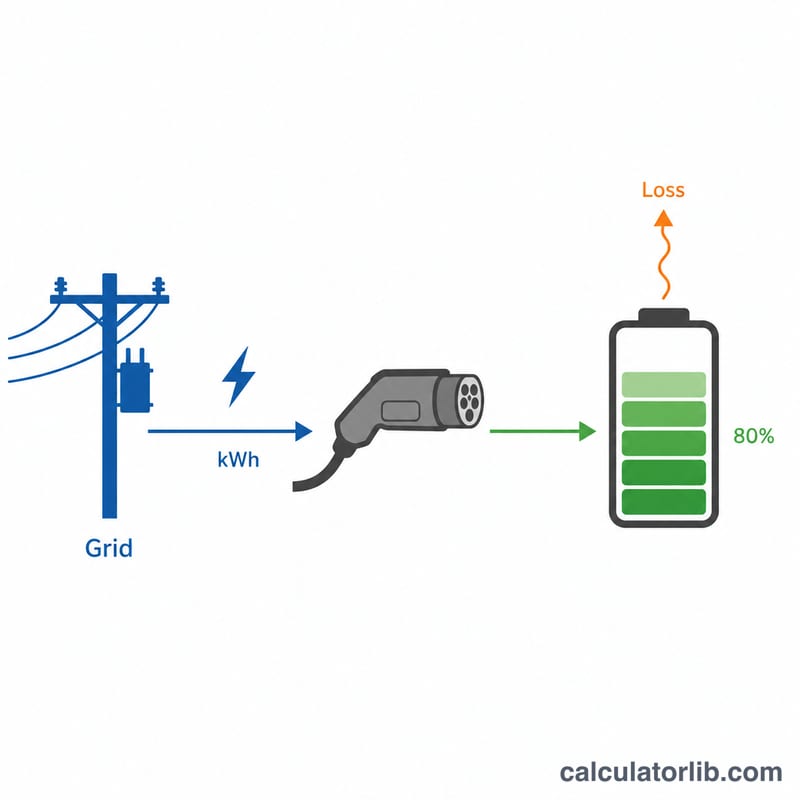
This tool estimates how much it costs to charge your Tesla (or any electric vehicle) for a single charging session. It works for any region — simply enter your local electricity price per kWh in your own currency. Because no charger is perfectly efficient, the calculator also accounts for charging losses so the figure reflects what you actually pay on your utility bill, not just the energy stored in the battery.
How to Use It
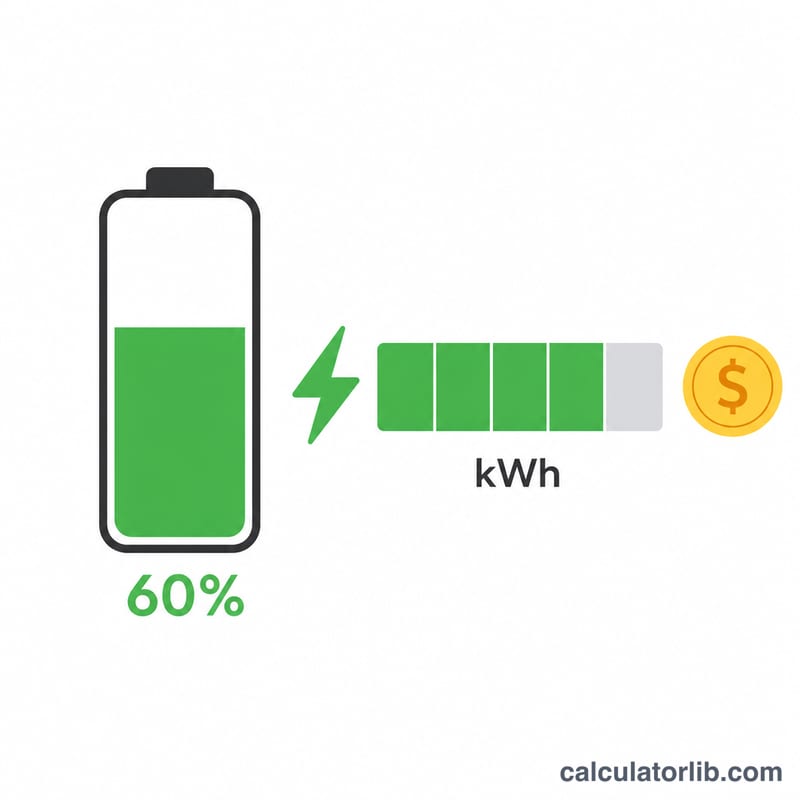
Enter four values: your battery capacity in kWh (e.g. 75 kWh for a Model 3 Long Range), the percentage of charge you want to add, your charging efficiency (typically 85–95% for AC home charging), and your electricity price per kWh. The result shows the session cost plus a breakdown of energy added to the battery versus energy actually drawn from the grid.
The Formula Explained
Energy stored in the battery equals battery capacity times the charge fraction. To find the energy pulled from the grid, divide that by the efficiency fraction — lower efficiency means more grid energy for the same battery gain. Multiply grid energy by your price per kWh to get the cost:
$$\text{Cost} = \frac{\text{Battery} \times \dfrac{\text{Charge\%}}{100}}{\dfrac{\text{Efficiency\%}}{100}} \times \text{Price}$$
Worked Example
Suppose you charge a 75 kWh battery by 80% at 90% efficiency, with electricity at $0.15/kWh. Energy to battery = \(75 \times 0.80 = 60\) kWh. Grid energy = \(60 \div 0.90 = 66.67\) kWh. Cost = \(66.67 \times 0.15 =\) $10.00.
FAQ
Why include efficiency? Some energy is lost as heat during charging, so your meter records more than the battery actually gains. Ignoring this underestimates your bill by roughly 5–15%.
What efficiency should I use? Home AC (Level 2) charging is about 85–92%. DC fast charging is often slightly higher, around 90–95%. If unsure, 90% is a reasonable default.
Does this work outside the US? Yes. The math is currency-agnostic — just enter your local price per kWh and read the result in that currency.