
What is the Altitude Air Pressure Calculator?
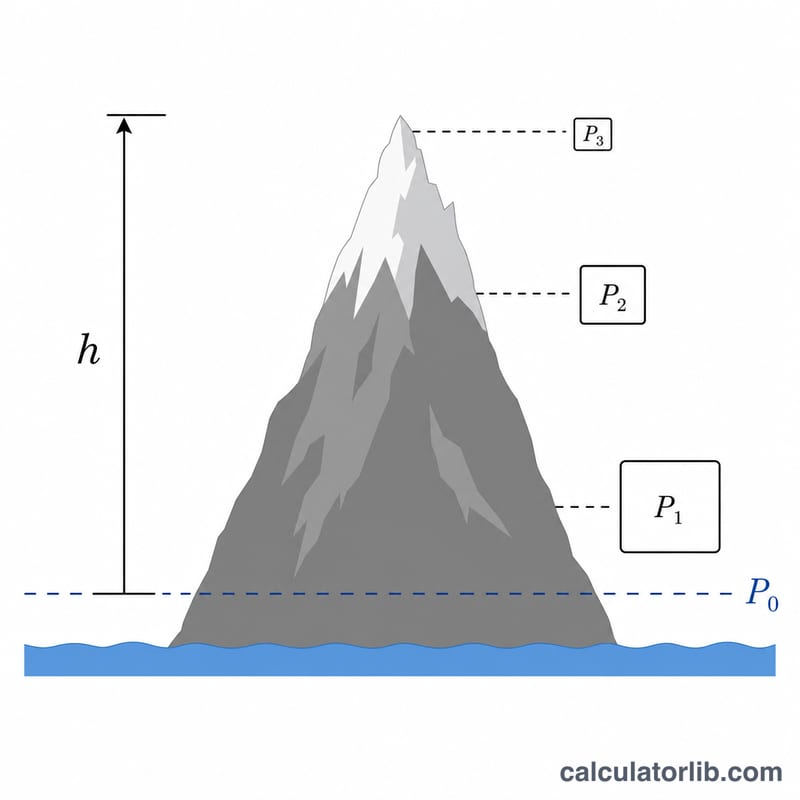
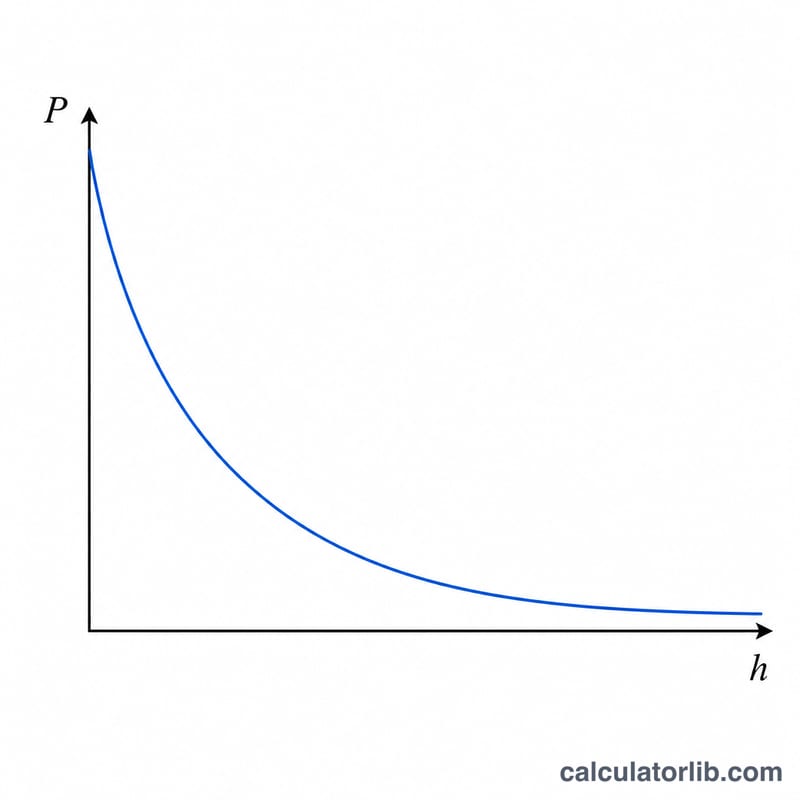
This tool estimates the atmospheric pressure at a given altitude above sea level using the barometric formula derived from the International Standard Atmosphere (ISA) model. As you climb higher, there is less air above you, so atmospheric pressure drops. This calculator quantifies that drop for any height up to the tropopause (~11,000 m).
How to use it
Enter the altitude in meters above sea level and the sea-level reference pressure (the standard value is 1013.25 hPa). The calculator returns the air pressure at that altitude in hectopascals (hPa, equivalent to millibars), plus conversions to millimeters of mercury (mmHg) and pounds per square inch (psi).
The formula explained
The model uses the equation $$P = P_0 \left(1 - \frac{0.0065\,h}{288.15}\right)^{5.255}$$ Here 0.0065 K/m is the standard temperature lapse rate, 288.15 K is the standard sea-level temperature, and the exponent 5.255 comes from the ratio of gravity, molar mass of air, and the gas constant. The term in parentheses represents the relative temperature at altitude, raised to a power that accounts for the adiabatic relationship between pressure and temperature.
Worked example
At 1000 m with \(P_0 = 1013.25\) hPa: the inner term is $$1 - \frac{0.0065 \times 1000}{288.15} = 1 - 0.022557 = 0.977443.$$ Raising to the 5.255 power gives \(\approx 0.88701\), so $$P \approx 1013.25 \times 0.88701 \approx 898.76 \text{ hPa}.$$
Standard Atmosphere Pressure at Common Altitudes
The table below gives atmospheric pressure predicted by the barometric formula using the International Standard Atmosphere (ISA) sea-level value of \(P_0 = 1013.25\) hPa. Values are shown in hectopascals (hPa, equivalent to millibars), millimetres of mercury (mmHg), and pounds per square inch (psi). Conversions use \(1\ \text{hPa} = 0.750062\ \text{mmHg} = 0.0145038\ \text{psi}\).
| Altitude (m) | Pressure (hPa) | Pressure (mmHg) | Pressure (psi) |
|---|---|---|---|
| 0 (sea level) | 1013.25 | 760.0 | 14.70 |
| 500 | 954.6 | 715.9 | 13.85 |
| 1000 | 898.7 | 674.1 | 13.04 |
| 2000 | 794.9 | 596.2 | 11.53 |
| 3000 | 701.1 | 525.9 | 10.17 |
| 5000 | 540.2 | 405.2 | 7.83 |
| 8000 | 356.0 | 267.0 | 5.16 |
| 8849 (Mt. Everest) | 314.0 | 235.5 | 4.55 |
| 11000 (tropopause) | 226.3 | 169.7 | 3.28 |
Note: the barometric formula in this tool applies the constant ISA tropospheric lapse rate and is most accurate up to the tropopause (about 11,000 m). Above that altitude the temperature profile changes and a different model is required.
Constants Used in the Barometric Formula
This calculator uses the simplified barometric (pressure-altitude) formula:
$$P = P_0 \left(1 - \frac{L \cdot h}{T_0}\right)^{5.255}$$where \(h\) is altitude in metres and the remaining quantities are the standard-atmosphere constants below.
| Symbol | Name | Value |
|---|---|---|
| \(P_0\) | Standard sea-level pressure | 1013.25 hPa |
| \(L\) | Temperature lapse rate (troposphere) | 0.0065 K/m |
| \(T_0\) | Standard sea-level temperature | 288.15 K (15 °C) |
| \(g\) | Gravitational acceleration | 9.80665 m/s² |
| \(M\) | Molar mass of dry air | 0.0289644 kg/mol |
| \(R\) | Universal gas constant | 8.31447 J/(mol·K) |
The exponent 5.255 is not arbitrary — it is the dimensionless group
$$\frac{g \cdot M}{R \cdot L} = \frac{9.80665 \times 0.0289644}{8.31447 \times 0.0065} \approx 5.255.$$This grouping arises from integrating the hydrostatic equation \(dP = -\rho g\,dh\) together with the ideal gas law and a linear temperature profile \(T(h) = T_0 - L h\). The lapse rate \(L\) describes how the standard atmosphere cools with height (about 6.5 °C per kilometre) through the troposphere.
Interpreting Your Pressure Result
The pressure value tells you how much thinner the air is than at sea level — and that has practical, physical consequences:
- Oxygen availability. Air is about 20.9% oxygen at every altitude, but the partial pressure of oxygen falls in direct proportion to total pressure. At 3000 m the total pressure is roughly 701 hPa, about 69% of sea level, so each breath delivers about 69% of the oxygen molecules it would at sea level. This is why high altitude causes shortness of breath and, above ~2500 m, can trigger altitude sickness.
- Water boiling point. Lower pressure lets water boil at a lower temperature. Water boils at 100 °C at sea level, but near 93–94 °C at 2000 m and around 85 °C at 5000 m, which lengthens cooking times. You can estimate this with a boiling point at altitude calculation.
- Comparison to sea level. Express your result as a percentage of 1013.25 hPa to gauge how "thin" the air is. Roughly, pressure halves every ~5500 m: about 540 hPa at 5000 m and about 314 hPa at the summit of Everest (8849 m) — only about 31% of sea-level pressure.
- Convert the units. If you need a different unit (inHg for aviation altimeters, mb for meteorology, psi for engineering), pass the result through a barometric pressure unit converter.
Real conditions deviate from the ISA. This formula models a single idealized standard atmosphere with a fixed 15 °C sea-level temperature and a uniform lapse rate. Actual pressure varies with weather systems (high- and low-pressure fronts can shift readings by 30–50 hPa), with air temperature, and with humidity. For a location-specific estimate, use the locally reported sea-level pressure and, where available, a model that accepts the actual ground temperature rather than the fixed ISA value.
This is general technical information for educational and planning purposes and is not medical advice. If you are travelling to high altitude or have a respiratory or heart condition, consult a qualified professional.
FAQ
Is this accurate for high altitudes? It is valid within the troposphere (below ~11,000 m). Above that, temperature stops decreasing and a different model is needed.
Why use 288.15 K? That is the ISA standard sea-level temperature (15 °C). Real conditions vary, so actual pressure may differ slightly.
What is hPa? A hectopascal equals one millibar; standard sea-level pressure is 1013.25 hPa.