
What Is the Clock Angle Calculator?
This calculator finds the angle between the hour and minute hands of an analog clock for any given time. It's a classic math and interview puzzle, and it's also useful for teaching geometry, working with clock mechanisms, or simply satisfying curiosity. Enter an hour and a minute, and the tool returns both the smaller (non-reflex) angle and the reflex angle.
How to Use It
Type the hour (0 to 12) and the minute (0 to 59), then read the result. For example, at 3:00 the hands form a perfect right angle of 90°. The calculator automatically accounts for the fact that the hour hand moves continuously as the minutes pass — it is not fixed on the number.
The Formula Explained
The minute hand sweeps 360° in 60 minutes, so it moves 6° per minute. The hour hand sweeps 360° in 12 hours (720 minutes), so it moves 0.5° per minute. From the 12 o'clock position, the hour hand sits at \(30H + 0.5M\) degrees and the minute hand at \(6M\) degrees. The difference is:
$$\text{angle} = \left| (30H + 0.5M) - 6M \right| = \left| 30H - 5.5M \right|$$If this value is greater than 180°, we subtract it from 360° to report the smaller angle between the hands.
Worked Example
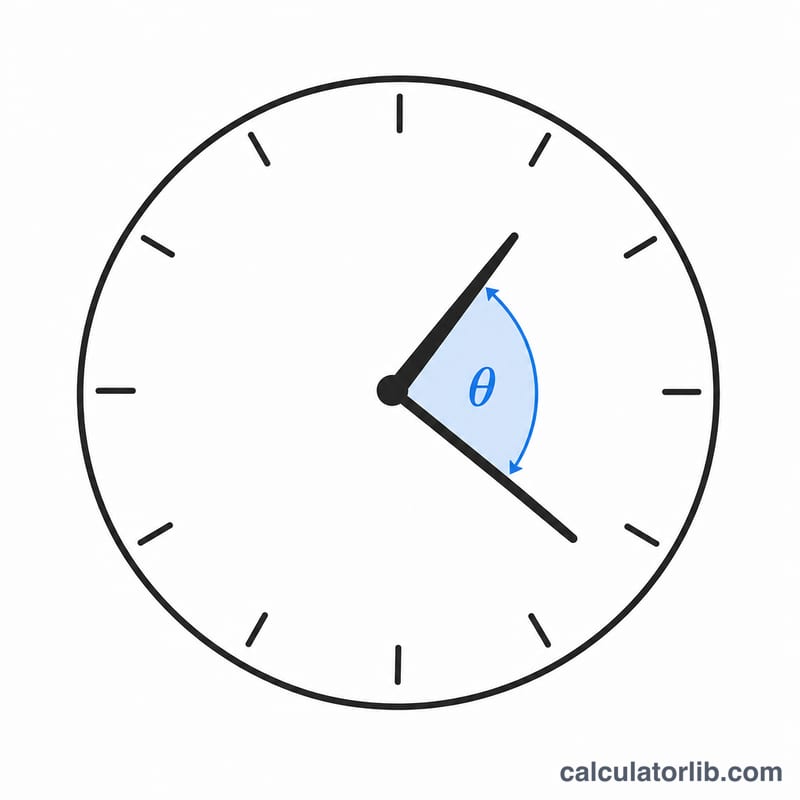
At 3:30, \(H = 3\) and \(M = 30\). Then \(30 \times 3 = 90\) and \(5.5 \times 30 = 165\). The difference is $$\left| 90 - 165 \right| = 75^\circ.$$ Since \(75^\circ \le 180^\circ\), the angle between the hands at 3:30 is 75°, and the reflex angle is \(360 - 75 = 285^\circ\).
Clock Angles at Common Times
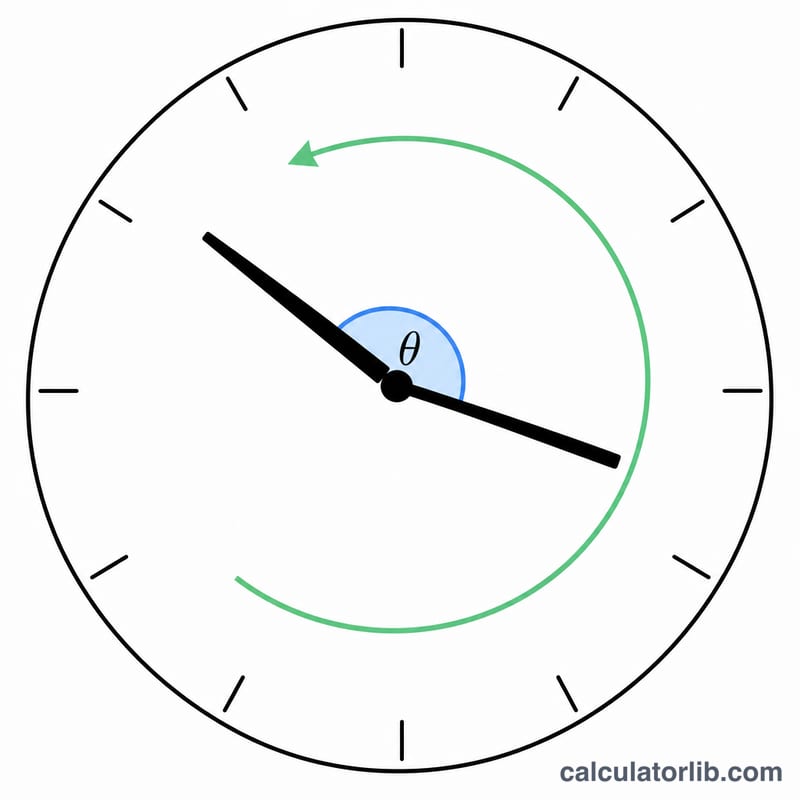
The angle between the hour and minute hands is found with the formula \(\theta = |30H - 5.5M|\), where \(H\) is the hour (mod 12) and \(M\) is the minutes. If the result exceeds 180°, the smaller (non-reflex) angle is \(360^\circ - \theta\). The table below lists the non-reflex angle for a range of common times.
| Time | Calculation \(|30H-5.5M|\) | Non-reflex angle |
|---|---|---|
| 12:00 | |30·0 − 5.5·0| = 0 | 0° |
| 1:00 | |30·1 − 5.5·0| = 30 | 30° |
| 2:00 | |30·2 − 5.5·0| = 60 | 60° |
| 3:00 | |30·3 − 5.5·0| = 90 | 90° |
| 4:00 | |30·4 − 5.5·0| = 120 | 120° |
| 5:00 | |30·5 − 5.5·0| = 150 | 150° |
| 6:00 | |30·6 − 5.5·0| = 180 | 180° |
| 7:00 | |30·7 − 5.5·0| = 210 → 360−210 | 150° |
| 8:00 | |30·8 − 5.5·0| = 240 → 360−240 | 120° |
| 9:00 | |30·9 − 5.5·0| = 270 → 360−270 | 90° |
| 10:00 | |30·10 − 5.5·0| = 300 → 360−300 | 60° |
| 11:00 | |30·11 − 5.5·0| = 330 → 360−330 | 30° |
| 3:15 | |30·3 − 5.5·15| = |90 − 82.5| = 7.5 | 7.5° |
| 6:30 | |30·6 − 5.5·30| = |180 − 165| = 15 | 15° |
| 9:45 | |30·9 − 5.5·45| = |270 − 247.5| = 22.5 | 22.5° |
| 12:30 | |30·0 − 5.5·30| = 165 | 165° |
More Worked Examples
Each example applies \(\theta = |30H - 5.5M|\), then checks whether the result is over 180° (in which case the reflex angle is reported separately).
Example 1 — 9:30 (a reflex-angle case)
- Hour \(H = 9\), minute \(M = 30\).
- \(30 \cdot 9 = 270\) and \(5.5 \cdot 30 = 165\).
- \(\theta = |270 - 165| = 105\).
- Since 105° is less than 180°, the non-reflex angle is 105°, and the reflex angle is \(360 - 105 = 255^\circ\).
Example 2 — 12:00 (hands overlap)
- Hour \(H = 12\), which is \(12 \bmod 12 = 0\); minute \(M = 0\).
- \(30 \cdot 0 = 0\) and \(5.5 \cdot 0 = 0\).
- \(\theta = |0 - 0| = 0\).
- The hands coincide exactly, so the angle is 0°.
Example 3 — 4:20 (fractional position)
- Hour \(H = 4\), minute \(M = 20\).
- \(30 \cdot 4 = 120\) and \(5.5 \cdot 20 = 110\).
- \(\theta = |120 - 110| = 10\).
- The small gap of 10° reflects that the hour hand has already drifted two-thirds of the way from the 4 toward the 5 by 20 past, nearly catching the minute hand at the 4 mark. The \(5.5\) coefficient captures this: the minute hand moves 6°/min while the hour hand moves 0.5°/min, a relative speed of 5.5°/min.
FAQ
Why isn't 3:30 exactly 90°? Because by 30 minutes past, the hour hand has moved halfway toward the 4, shrinking the angle to 75°.
What is the reflex angle? It's the larger angle (over 180°) measured the other way around the clock; the two angles always sum to 360°.
Can I enter 12? Yes — 12 is treated the same as 0, since the hour hand returns to the top of the dial.