
What Is the Angle Bisector Theorem?
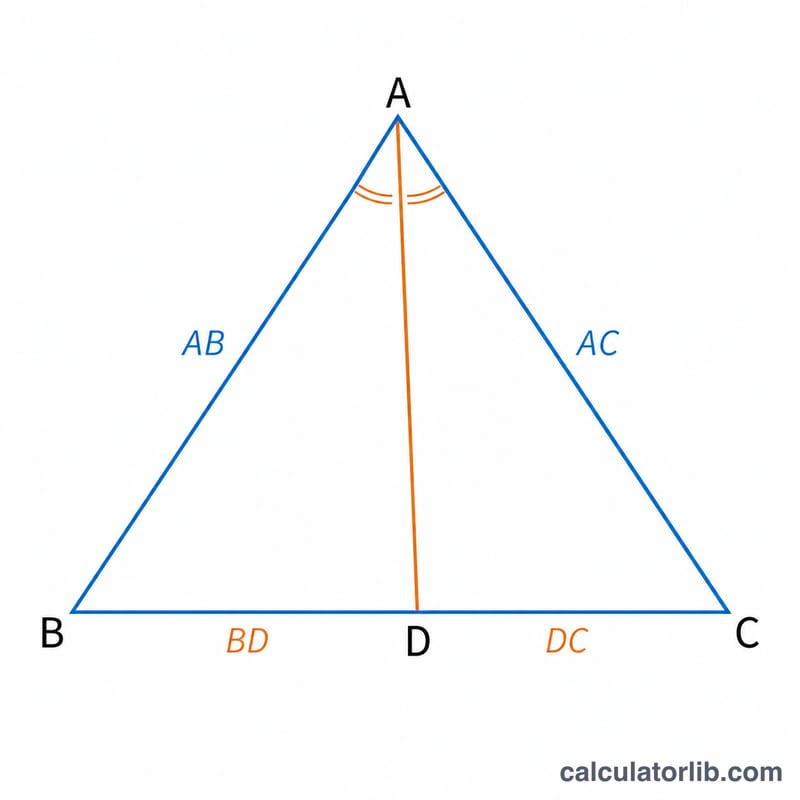
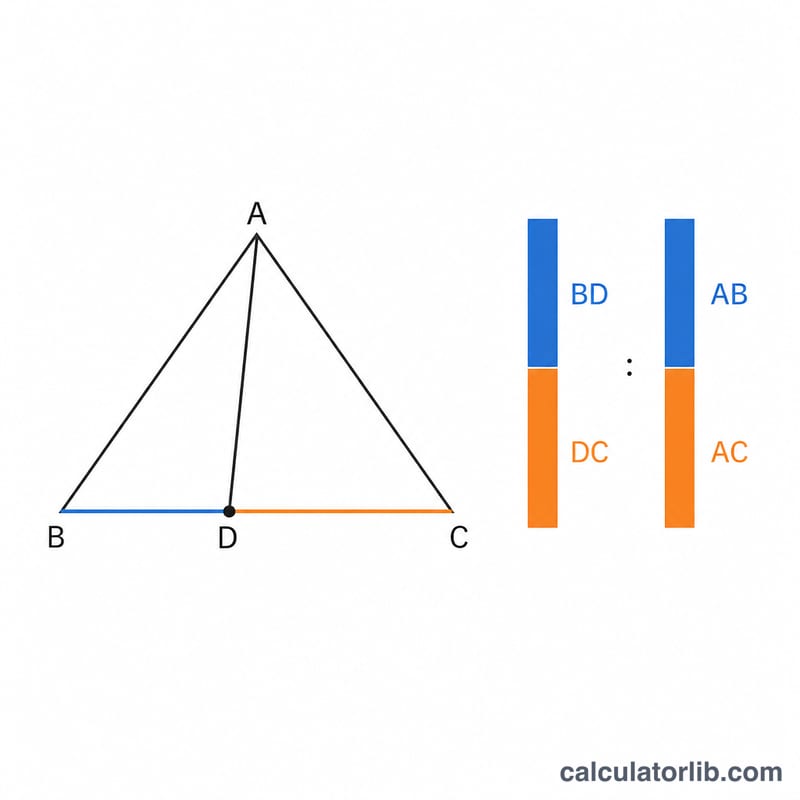
The Angle Bisector Theorem is a classic result in Euclidean geometry. In a triangle ABC, when the bisector of angle A meets the opposite side BC at point D, it divides that side into two segments, BD and DC, whose lengths are proportional to the two sides that form the bisected angle. Formally, \(\frac{BD}{DC} = \frac{\text{AB}}{\text{AC}}\). This calculator finds the exact length of each segment when you know the three relevant side measurements.
How to Use the Calculator
Enter the length of side AB (the side adjacent to vertex B), side AC (adjacent to vertex C), and the full length of the bisected side BC. The calculator returns the length of segment BD (from B to the foot of the bisector), segment DC (from D to C), and the proportional ratio AB:AC. Together BD and DC always add up to BC.
The Formula Explained
Because the bisector splits BC in the ratio of the adjacent sides, we let $$BD = \text{BC} \cdot \frac{\text{AB}}{\text{AB} + \text{AC}} \qquad DC = \text{BC} \cdot \frac{\text{AC}}{\text{AB} + \text{AC}}$$ These two expressions are derived directly from the proportion \(\frac{BD}{DC} = \frac{\text{AB}}{\text{AC}}\) combined with \(BD + DC = BC\). Notice that the bisector length itself is not needed — only the two adjacent sides set the ratio.
Worked Example
Suppose \(AB = 8\), \(AC = 4\), and \(BC = 9\). The sum \(AB + AC = 12\). Then $$BD = \frac{9 \times 8}{12} = 6 \qquad DC = \frac{9 \times 4}{12} = 3$$ Check: \(6 + 3 = 9 = BC\), and the ratio \(6:3 = 2:1\) matches \(AB:AC = 8:4 = 2:1\). The angle bisector cuts the side closer to the shorter adjacent side.
Segment Splits Across Different Triangles
The Angle Bisector Theorem divides the opposite side \(BC\) into two parts, \(BD\) and \(DC\), whose lengths follow the ratio of the two adjacent sides \(AB:AC\). When the two adjacent sides are equal, the bisector lands exactly at the midpoint; the more lopsided the sides, the more the foot \(D\) is pushed toward the shorter side. The table below works through three representative cases.
| Case | AB | AC | BC | BD | DC | AB : AC |
|---|---|---|---|---|---|---|
| Balanced (isosceles) | 6 | 6 | 10 | 5 | 5 | 1 : 1 |
| Moderate | 8 | 4 | 9 | 6 | 3 | 2 : 1 |
| Skewed | 10 | 2 | 6 | 5 | 1 | 5 : 1 |
Worked check for the moderate case: with \(AB = 8\), \(AC = 4\), \(BC = 9\),
$$BD = BC \cdot \frac{AB}{AB + AC} = 9 \cdot \frac{8}{8 + 4} = 9 \cdot \frac{8}{12} = 6,$$ $$DC = BC \cdot \frac{AC}{AB + AC} = 9 \cdot \frac{4}{12} = 3.$$The two segments add back to \(BD + DC = 6 + 3 = 9 = BC\), and the ratio \(BD:DC = 6:3 = 2:1\) matches \(AB:AC = 8:4 = 2:1\), confirming the theorem.
Key Terms & Variables
- Triangle ABC — the triangle whose three vertices are labeled \(A\), \(B\), and \(C\). The bisector in this tool is drawn from vertex \(A\) to the opposite side \(BC\).
- Vertex A — the corner from which the angle bisector is drawn. The interior angle at \(A\) (angle \(\angle BAC\)) is the angle being split into two equal halves.
- Angle bisector — a line or segment that divides an angle into two equal angles. The bisector from \(A\) splits \(\angle BAC\) into two angles of equal measure.
- Point D (foot of the bisector) — the point where the bisector from \(A\) meets the opposite side \(BC\). It lies between \(B\) and \(C\) for an internal bisector.
- Segment BD — the portion of side \(BC\) from vertex \(B\) to the foot \(D\). It is proportional to the adjacent side \(AB\).
- Segment DC — the portion of side \(BC\) from the foot \(D\) to vertex \(C\). It is proportional to the adjacent side \(AC\). Together \(BD + DC = BC\).
- AB : AC ratio — the ratio of the two sides adjacent to vertex \(A\). The Angle Bisector Theorem states that \(\dfrac{BD}{DC} = \dfrac{AB}{AC}\), so this ratio directly controls how \(BC\) is split.
- Internal vs. external bisector — the internal bisector splits the interior angle and meets \(BC\) between \(B\) and \(C\) (the case handled here). The external bisector splits the supplementary exterior angle and meets line \(BC\) outside the segment, dividing it externally in the same ratio \(AB:AC\).
FAQ
Does this work for the external bisector? No — this tool handles the internal angle bisector, which produces an internal division of BC. The external bisector divides BC externally.
What if AB equals AC? Then the triangle is isosceles at A and the bisector hits the midpoint of BC, giving \(BD = DC\).
Do I need the angle itself? No. The theorem depends only on the side lengths, not on the measured angle.