
What Is Angular Frequency?
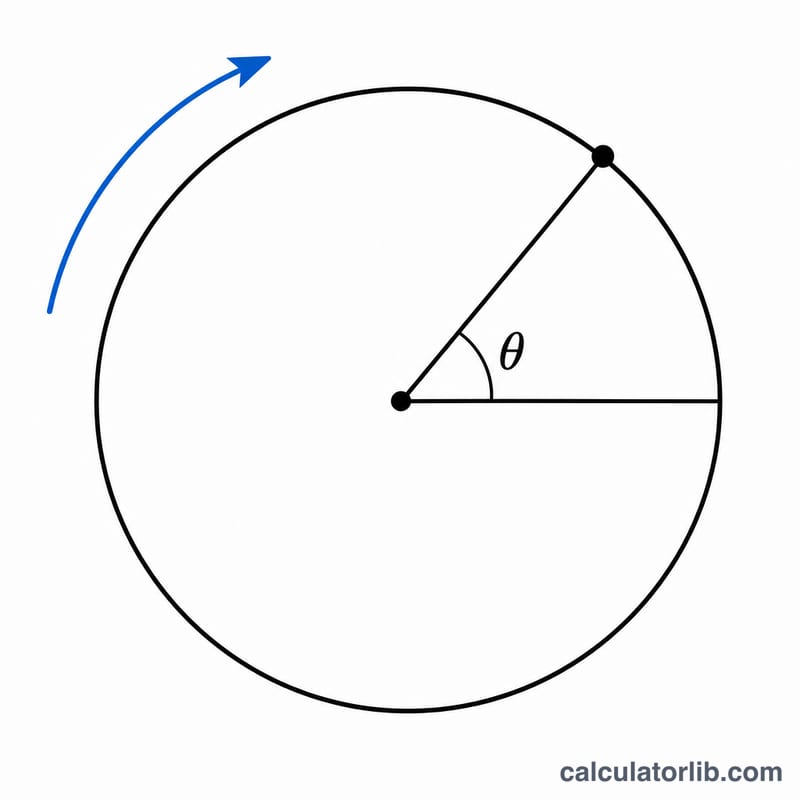
Angular frequency (symbol ω, "omega") measures how fast something oscillates or rotates, expressed in radians per second (rad/s). While ordinary frequency f counts how many full cycles occur per second (hertz), angular frequency expresses the same motion in terms of the angle swept per second. Since one complete cycle corresponds to 2π radians, the two are linked by a factor of 2π.
How to Use This Calculator
Choose whether you know the frequency f (in hertz) or the period T (in seconds), enter the value, and the calculator instantly returns the angular frequency ω in rad/s, along with the corresponding frequency and period for reference.
The Formula Explained
The angular frequency is defined as:
$$\omega = 2\pi f = \frac{2\pi}{T}$$
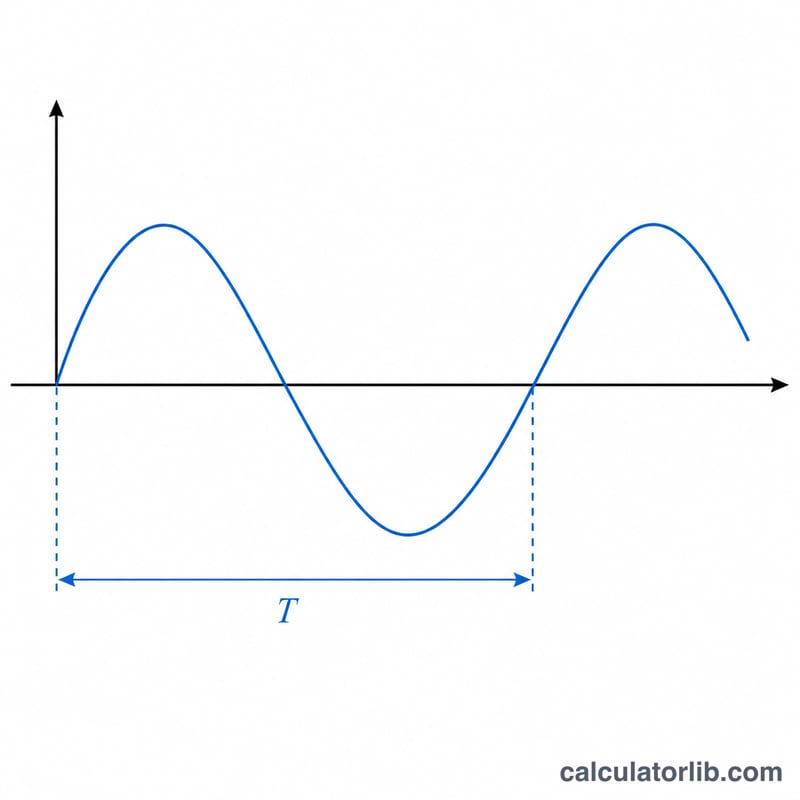
Here, f is the frequency in hertz (cycles per second) and T is the period in seconds (time for one cycle). Because period and frequency are reciprocals (\(T = 1/f\)), both forms of the equation give the same result.
Worked Example
Suppose a wave has a frequency of 50 Hz. Then:
$$\omega = 2\pi \times 50 = 314.159 \text{ rad/s}.$$
Its period is \(T = 1/50 = 0.02\) s, and checking the period form: \(\omega = 2\pi / 0.02 = 314.159\) rad/s — the same answer.
Constants & Units Used
Angular frequency converts an ordinary frequency (cycles per second) into an angular rate (radians per second). Because one full cycle corresponds to one complete revolution of \(2\pi\) radians, the conversion factor between cycles and radians is the constant \(2\pi\).
Key Constants
| Constant | Symbol | Value | Meaning |
|---|---|---|---|
| Pi | \(\pi\) | 3.14159265 | Ratio of a circle's circumference to its diameter |
| Two pi (radians per cycle) | \(2\pi\) | 6.28318531 | Number of radians in one full cycle (revolution) |
Units
| Quantity | Symbol | Unit | Description |
|---|---|---|---|
| Frequency | \(f\) | Hz (cycles per second) | How many full cycles occur each second |
| Period | \(T\) | s (seconds) | Time for one complete cycle |
| Angular frequency | \(\omega\) | rad/s (radians per second) | Angular rate of oscillation or rotation |
Core Relationships
Frequency and period are reciprocals of each other:
$$T = \frac{1}{f} \qquad f = \frac{1}{T}$$Angular frequency follows directly from either quantity:
$$\omega = 2\pi f = \frac{2\pi}{T}$$For example, a signal at \(f = 50\ \text{Hz}\) has a period of \(T = 1/50 = 0.02\ \text{s}\) and an angular frequency of \(\omega = 2\pi \times 50 \approx\) 314.159265 rad/s.
FAQ
What units does angular frequency use? Radians per second (rad/s).
How is ω different from f? Frequency f counts cycles per second; angular frequency ω measures radians per second. They differ by a factor of 2π.
Can I find period from angular frequency? Yes — rearrange to \(T = 2\pi / \omega\).