
What Is the Angular Velocity to RPM Calculator?
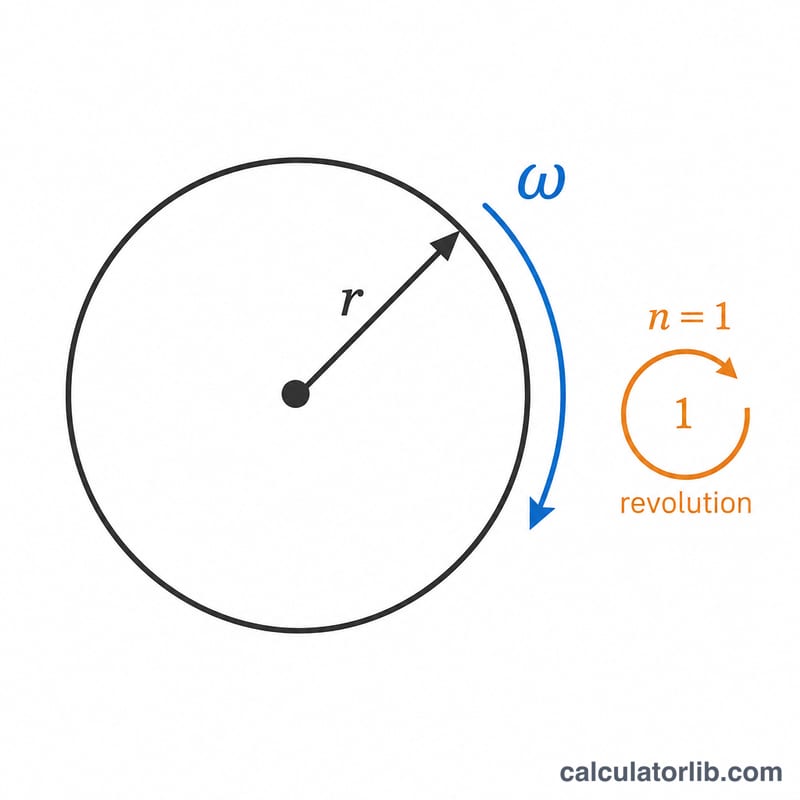
This calculator converts angular velocity, measured in radians per second (rad/s), into rotational speed, measured in revolutions per minute (RPM). Angular velocity (denoted \(\omega\), the Greek letter omega) describes how fast an object rotates in terms of the angle swept per unit of time, while RPM is the everyday unit used for motors, engines, turbines, and rotating machinery.
How to Use It
Enter the angular velocity in radians per second and the calculator returns the equivalent RPM instantly. The conversion is exact and works for any positive or negative value (a negative result simply indicates the opposite direction of rotation).
The Formula Explained
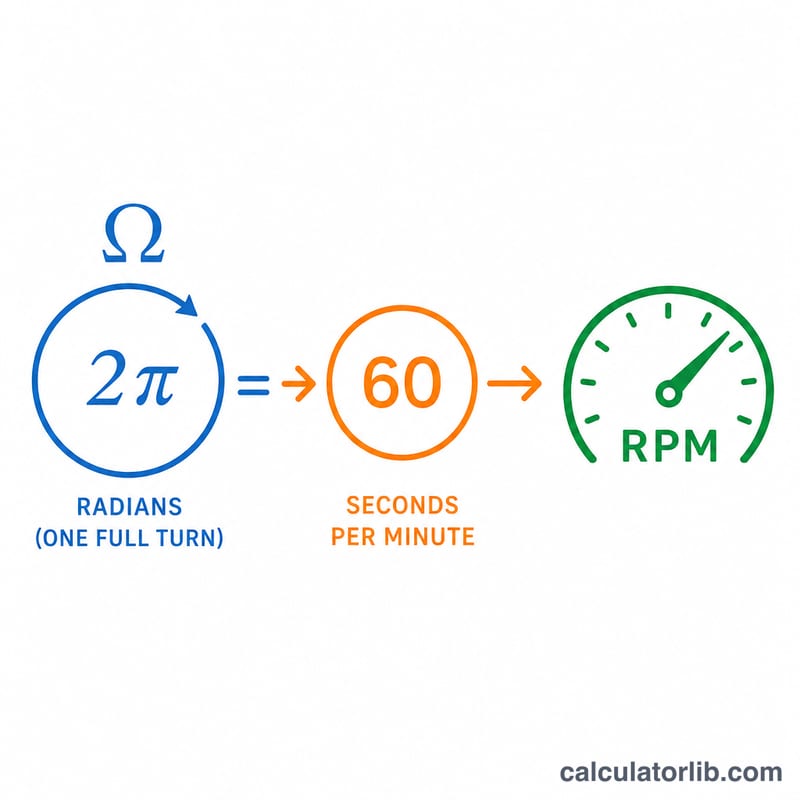
One full revolution equals \(2\pi\) radians, and one minute equals 60 seconds. To convert \(\omega\) in rad/s to revolutions per minute we multiply by 60 (to go from per-second to per-minute) and divide by \(2\pi\) (to go from radians to revolutions):
$$\text{RPM} = \frac{\omega \times 60}{2\pi}$$
Equivalently, \(\text{RPM} \approx \omega \times 9.5493\), since \(60 / (2\pi) \approx 9.5493\).
Worked Example
Suppose a shaft spins at an angular velocity of \(\omega = 10\) rad/s. Then $$\text{RPM} = \frac{10 \times 60}{2 \times 3.14159} = \frac{600}{6.28319} \approx 95.49 \text{ RPM}$$ So a 10 rad/s rotation corresponds to roughly 95.5 revolutions every minute.
Rad/s to RPM Conversion Table
To convert angular velocity \(\omega\) in radians per second to rotational speed in revolutions per minute (RPM), multiply by the constant factor \(\frac{60}{2\pi} \approx 9.5493\). To reverse the conversion (RPM back to rad/s), multiply by \(\frac{2\pi}{60} \approx 0.10472\).
The two factors are reciprocals: \(9.5493 \times 0.10472 \approx 1\). The table below lists several common angular velocities and their RPM equivalents.
| Angular Velocity (rad/s) | RPM (= ω × 9.5493) | Reverse check (RPM × 0.10472 = rad/s) |
|---|---|---|
| 1 | 9.55 | 1.00 |
| 5 | 47.75 | 5.00 |
| 10 | 95.49 | 10.00 |
| 50 | 477.46 | 50.00 |
| 100 | 954.93 | 100.00 |
| 314.16 | 3000.01 | 314.16 |
Note that \(314.16 \approx 100\pi\) rad/s corresponds neatly to 3000 RPM, a common motor speed at 50 Hz with two pole pairs.
Real-World Rotation Scenarios
The table below shows typical rotating devices, their approximate operating speed in RPM, and the equivalent angular velocity in rad/s computed with \(\omega = \text{RPM} \times 0.10472\). Actual speeds vary by model and operating condition; these are representative figures.
| Device / Scenario | Typical RPM | Angular Velocity (rad/s) |
|---|---|---|
| Clock second hand | 1 | 0.105 |
| Vinyl record (33⅓ LP) | 33.3 | 3.49 |
| Ceiling fan (medium) | 150 | 15.71 |
| Car engine at idle | 800 | 800 RPM ↔ 83.78 |
| Washing machine (spin cycle) | 1200 | 125.66 |
| Electric motor (4-pole, 60 Hz) | 1800 | 188.50 |
| Car engine (highway cruise) | 2500 | 261.80 |
| Gas turbine (power generation) | 3600 | 376.99 |
For example, a car engine idling at 800 RPM has an angular velocity of \(800 \times 0.10472 = 83.78\) rad/s. Feeding that angular velocity back into the converter returns the original 800 RPM, confirming the reciprocal relationship between the two factors.
FAQ
What is angular velocity? It is the rate of change of angular position, typically expressed in radians per second. It tells you how quickly something rotates.
How do I convert RPM back to rad/s? Reverse the formula: \(\omega = \text{RPM} \times 2\pi / 60\), or approximately \(\text{RPM} \times 0.10472\).
Why does 2π appear? Because a complete revolution corresponds to an angle of \(2\pi\) radians, so dividing by \(2\pi\) converts the radian count into a revolution count.