
What is the Arch Calculator?
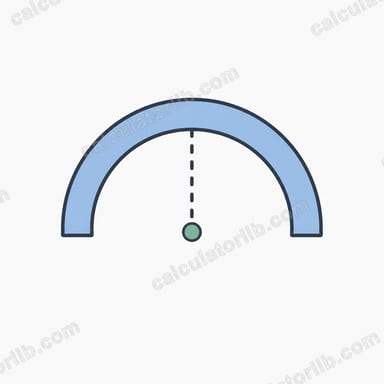
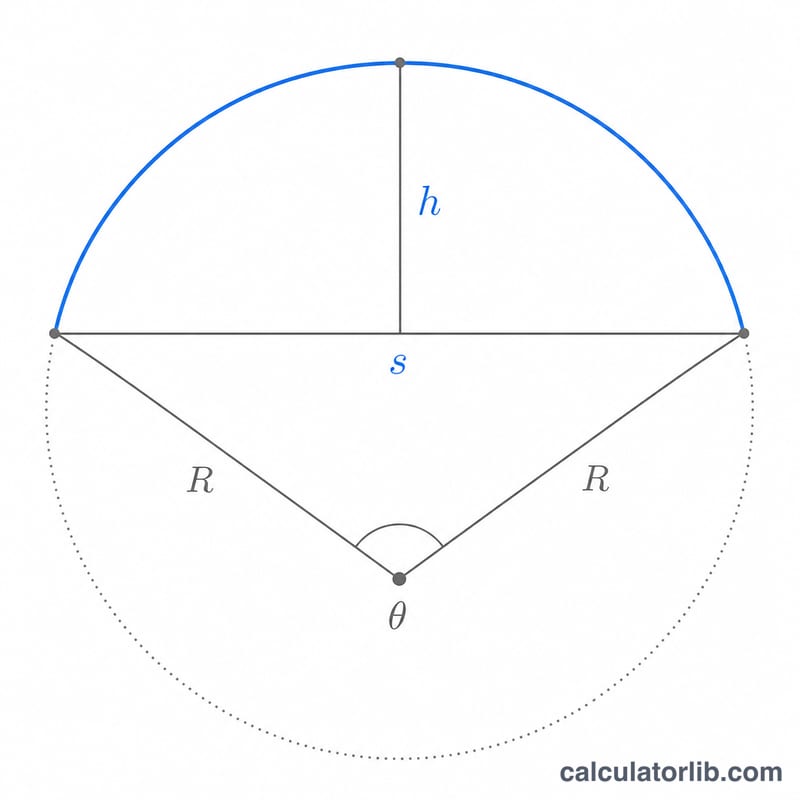
The Arch Calculator works out the geometry of a circular (segmental) arch from two simple measurements: the span (the horizontal chord across the opening) and the rise (the vertical height from the chord to the top of the curve). From these it derives the radius of the circle the arch is part of, the diameter, the length of the curved line, and the angle that the arc subtends at the centre of the circle. It is a universal geometry tool useful to masons, carpenters, woodworkers, set builders and anyone laying out a curved opening or template.
How to use it
Enter the span and the rise in the same units (centimetres, inches, metres — the result comes back in those same units). Press calculate. The hero box shows the radius; the table shows arc length, diameter and the included angle in degrees. To mark out the curve on site, pin a string of the calculated radius length at the centre point (which sits rise − radius below the apex, i.e. the centre may be below the springing line) and sweep the arc.
The formula explained
For a chord of length s (span) and a rise h, the radius of the containing circle is:
$$R = \frac{s^{2}}{8 \cdot h} + \frac{h}{2}$$
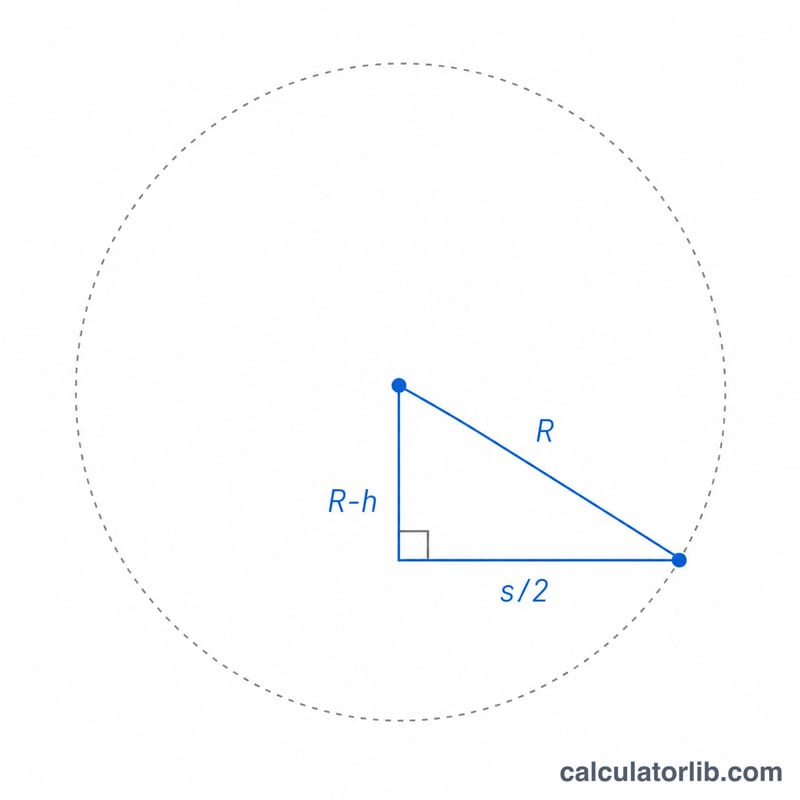
The perpendicular distance from the circle's centre to the chord is \(d = R - h\). The half-angle subtended by the chord is \(\theta/2 = \operatorname{atan2}(s/2,\, d)\), so the full central angle is $$\theta = 2 \cdot \operatorname{atan2}(s/2,\, R - h),$$ and the arc length is \(L = R \cdot \theta\) (with θ in radians). Using atan2 keeps the result correct even when the arc is more than a semicircle.
Worked example
A perfect semicircle has span 10 and rise 5. Then $$R = \frac{100}{40} + 2.5 = 2.5 + 2.5 = 5.$$ The centre lies on the chord (\(d = R - h = 0\)), so \(\theta = 2 \cdot \operatorname{atan2}(5, 0) = 2 \cdot 90° = 180°\). Arc length \(= R \cdot \theta = 5 \times \pi = 15.708\). Each half is 7.854.
Arch Geometry Across Common Span/Rise Scenarios
For a circular (segmental) arch the span \(S\) (the horizontal chord across the opening) and the rise \(H\) (the height from the springing line to the crown) fully determine its geometry. The radius follows from \(R = \tfrac{S^2}{8H} + \tfrac{H}{2}\); from there the central angle is \(\theta = 2\arctan\!\left(\tfrac{S/2}{\,R-H\,}\right)\) and the arc length is \(L = R\theta\) (with \(\theta\) in radians).
The table below holds the span fixed at 1000 mm and increases the rise, so you can see how a flatter arch demands a much larger radius and a smaller central angle, while a deep arch approaches and then exceeds a semicircle.
| Arch type | Span S (mm) | Rise H (mm) | Radius R (mm) | Diameter (mm) | Central angle θ | Arc length L (mm) |
|---|---|---|---|---|---|---|
| Shallow segmental | 1000 | 150 | 908.3 | 1816.7 | 67.4° | 1068.6 |
| Flatter segmental | 1000 | 250 | 625.0 | 1250.0 | 106.3° | 1159.3 |
| Semicircular | 1000 | 500 | 500.0 | 1000.0 | 180.0° | 1570.8 |
| Horseshoe | 1000 | 600 | 508.3 | 1016.7 | 241.9° | 2146.4 |
Note that at \(H = S/2\) the arch is exactly semicircular (\(R = S/2\), \(\theta = 180^\circ\)). When the rise exceeds half the span the curve passes through the widest point of the circle, producing the inward-curving horseshoe form with a central angle greater than \(180^\circ\).
Key Terms and Variables
- Span (S)
- The horizontal clear distance across the arch opening, measured between the two springing points. In circle geometry it is the chord of the arc.
- Rise (H)
- The vertical height from the springing line up to the highest point of the arch (the crown). The ratio \(H/S\) describes how shallow or deep the arch is.
- Radius (R)
- The radius of the circle that the arch's curve is part of, given by \(R = S^2/(8H) + H/2\). The arc is drawn by swinging this radius from the centre point.
- Diameter
- Twice the radius, \(d = 2R\) — the full width of the underlying circle.
- Chord
- A straight line joining two points on the circle. For a segmental arch the span is the chord subtending the arc.
- Arc length (L)
- The length measured along the curved intrados (or any concentric arc), equal to \(L = R\theta\) with the central angle \(\theta\) in radians.
- Central angle (θ)
- The angle subtended at the circle's centre by the arc, \(\theta = 2\arctan\!\big(\tfrac{S/2}{R-H}\big)\). It is 180° for a semicircle and more than 180° for a horseshoe arch.
- Springing line
- The horizontal level at which the arch begins to curve away from its vertical supports; the span is measured along this line.
- Apex / Crown
- The topmost point of the arch, where the rise is measured to. The crown lies directly above the midpoint of the span.
- Segmental arch
- An arch whose curve is a circular segment less than a semicircle (\(H < S/2\)), giving a flatter profile and a radius larger than half the span.
- Semicircular arch
- An arch that is exactly half a circle, occurring when the rise equals half the span (\(H = S/2\)), so \(R = S/2\) and \(\theta = 180^\circ\).
- Horseshoe arch
- An arch that continues past the widest point of the circle (\(H > S/2\)), curving back inward at the springing so the opening is narrower than the circle's diameter; its central angle exceeds 180°.
FAQ
What if the rise equals half the span? The arch is a true semicircle; the radius equals the rise and the angle is 180°.
Can the rise be larger than half the span? Yes — the arc becomes more than a semicircle (a "horseshoe" arch) and the centre sits above the chord; atan2 still returns the correct angle.
What units should I use? Any, as long as span and rise share the same unit; all outputs use that unit.