
What Is the Area of a Square?
A square is a four-sided polygon (quadrilateral) where all sides are equal in length and every interior angle is 90°. The area of a square is the amount of two-dimensional space it covers, measured in square units. Because all sides are equal, the area is found simply by squaring one side length.
How to Use This Calculator
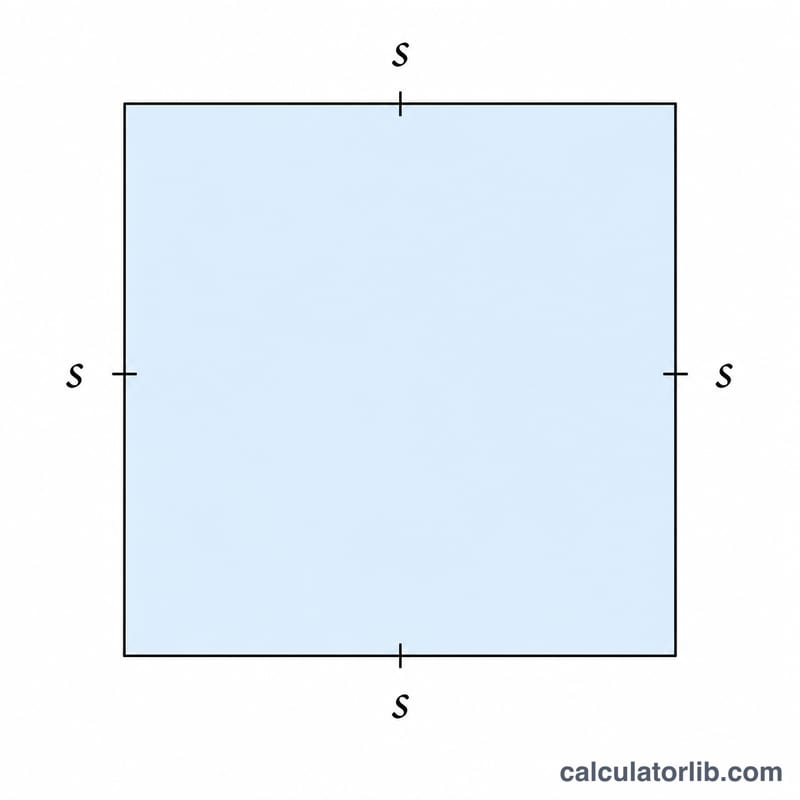
Enter the length of one side of the square (s) into the input field and the calculator instantly returns the area, along with the perimeter and diagonal. The units are generic — if you enter the side in centimeters, the area will be in square centimeters, the perimeter in centimeters, and the diagonal in centimeters.
The Formula Explained
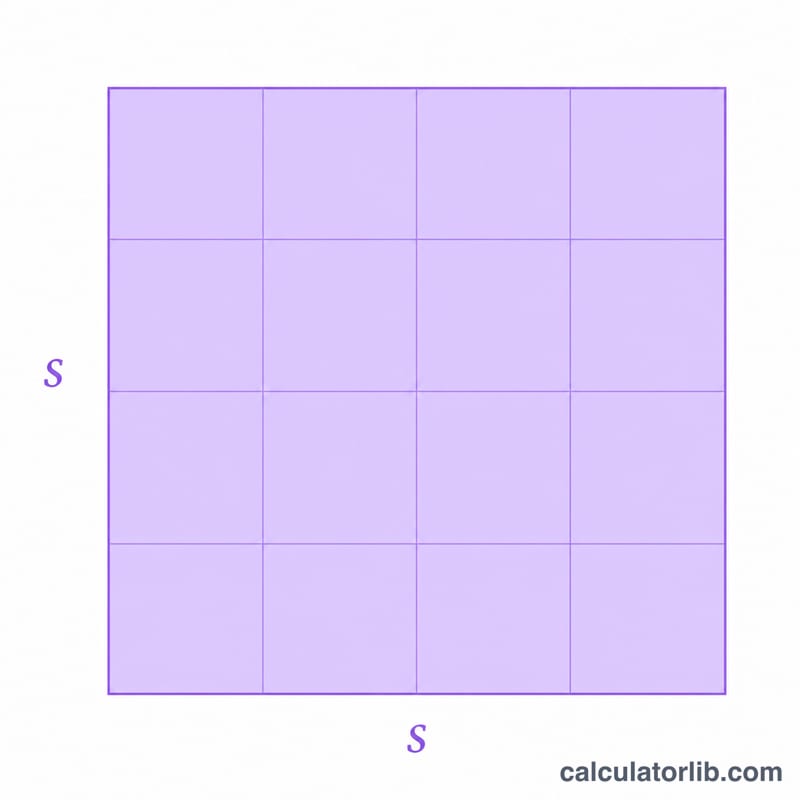
The core formula is $$A = s^{2}$$ meaning the area equals the side length multiplied by itself. This calculator also computes the perimeter, \(P = 4s\) (the total distance around the square), and the diagonal, \(d = s\sqrt{2}\) (the straight line connecting opposite corners), which follows from the Pythagorean theorem applied to the two equal sides.
Worked Example
Suppose a square has a side length of 5 units. The area is $$A = 5^{2} = 25 \text{ square units}.$$ The perimeter is $$P = 4 \times 5 = 20 \text{ units},$$ and the diagonal is $$d = 5 \times \sqrt{2} \approx 7.0711 \text{ units}.$$
Square Area Reference Table
Because every side of a square is equal, all three key measurements follow directly from the side length \(s\): area \(A=s^2\), perimeter \(P=4s\), and diagonal \(d=s\sqrt{2}\). The table below lists these values for common side lengths (diagonals are rounded to three decimals). Values are unit-independent — if \(s\) is in metres, the area is in square metres; if \(s\) is in feet, the area is in square feet.
| Side (s) | Area (s²) | Perimeter (4s) | Diagonal (s√2) |
|---|---|---|---|
| 1 | 1 | 4 | 1.414 |
| 2 | 4 | 8 | 2.828 |
| 5 | 25 | 20 | 7.071 |
| 10 | 100 | 40 | 14.142 |
| 20 | 400 | 80 | 28.284 |
| 50 | 2,500 | 200 | 70.711 |
| 100 | 10,000 | 400 | 141.421 |
How to Calculate the Area of a Square by Hand
Calculating a square's area takes a single multiplication once you know the side length. Follow these steps:
- Measure one side (s) in consistent units. Because a square has four equal sides, you only need one. Use a single unit throughout — for instance, metres, centimetres, or inches — and convert first if your measurement mixes units.
- Square the side length. Multiply the side by itself: \(A = s \times s = s^2\). For a side of 6 m: \(A = 6 \times 6 = 36\).
- Label the result in square units. The answer carries squared units matching your measurement — square metres (m²), square feet (ft²), and so on. So \(A = 36\ \text{m}^2\).
Optional — perimeter. Add up all four equal sides: \(P = 4s\). For \(s = 6\): \(P = 4 \times 6 = 24\ \text{m}\).
Optional — diagonal. The diagonal cuts the square into two right triangles, so by the Pythagorean theorem \(d = s\sqrt{2}\). For \(s = 6\): \(d = 6 \times 1.41421 = \)8.485 m. The completed worked example therefore gives an area of 36 m², a perimeter of 24 m, and a diagonal of about 8.485 m.
FAQ
How do I find the side length if I only know the area? Take the square root of the area: \(s = \sqrt{A}\).
What units does this use? Any consistent unit works. Whatever unit you use for the side, the area comes out in that unit squared.
Is the area the same as the perimeter? No. Area measures the surface inside the square (square units), while perimeter measures the distance around its edge (linear units).