
What the Arithmetic Sequence Calculator Does
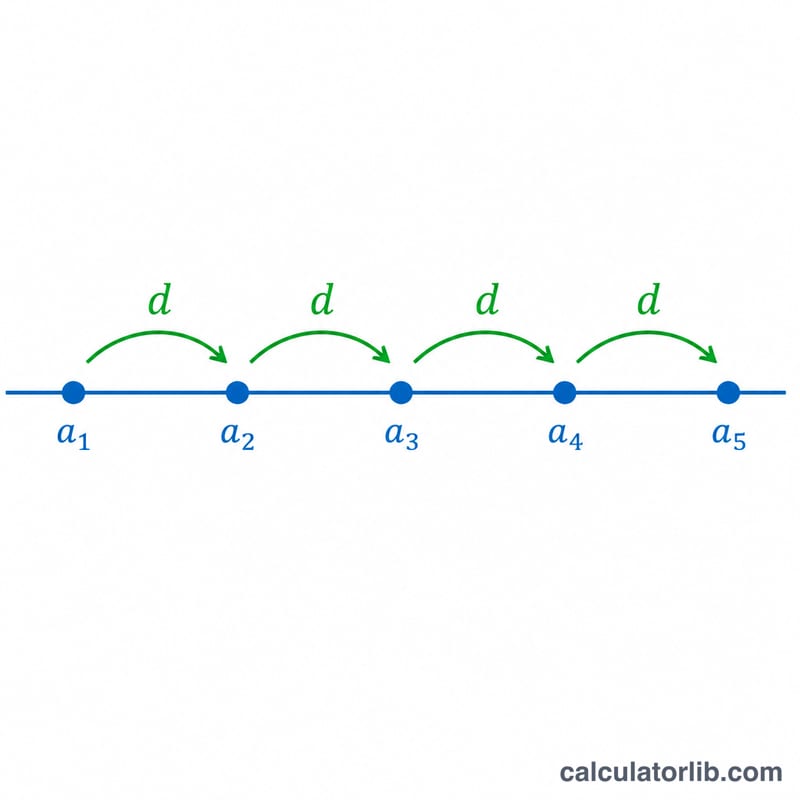
An arithmetic sequence is a list of numbers where each term increases (or decreases) by the same fixed amount, called the common difference. This calculator takes three inputs and instantly returns the last term, the sum of all terms, and a colour-coded visual of the full sequence so you can see the progression at a glance.
The Inputs You Provide
- First Term (a₁): the starting value of the sequence.
- Common Difference (d): the amount added to each term to get the next one. A positive value makes the sequence rise; a negative value makes it fall.
- Number of Terms (n): how many terms you want to generate, listed and summed.
The Formulas Used
The calculator applies the two standard arithmetic-progression formulas:
- nth (last) term: $$a_n = \text{a}_1 + \left(\text{n} - 1\right)\times\text{d}$$
- Sum of n terms: $$S_n = \frac{\text{n}}{2}\times\left(2\,\text{a}_1 + \left(\text{n} - 1\right)\times\text{d}\right)$$
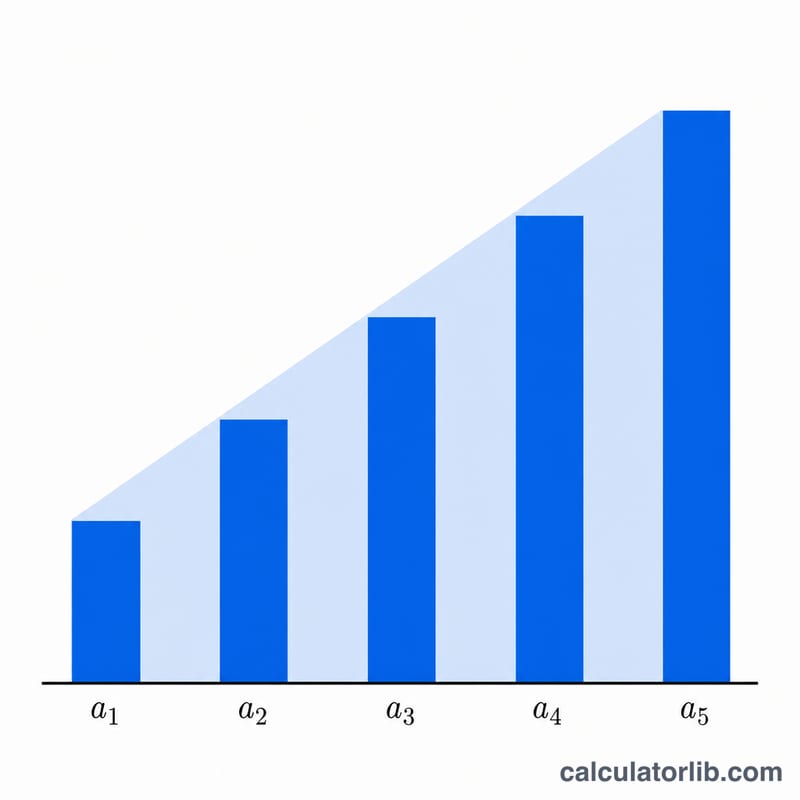
It also builds every individual term from \(\text{a}_1\) up to \(a_n\). In the visual display, each term is shaded on a green-to-red gradient and slightly resized — the smallest value appears green and small, the largest appears red and large — so the trend is easy to follow.
Worked Example
Suppose you enter First Term = 3, Common Difference = 5, and Number of Terms = 6.
- Last term: $$a_6 = 3 + \left(6 - 1\right)\times 5 = 3 + 25 = \textbf{28}$$
- Sum: $$S_6 = \frac{6}{2}\times\left(2\times 3 + \left(6 - 1\right)\times 5\right) = 3\times\left(6 + 25\right) = 3\times 31 = \textbf{93}$$
- Sequence: 3, 8, 13, 18, 23, 28
The calculator returns 28 as the last term, 93 as the sum, and displays all six terms with their colour gradient.
Comparing Different Sequence Inputs
An arithmetic sequence is defined by three inputs: the first term \(a_1\), the common difference \(d\), and the number of terms \(n\). From these you can compute the last (nth) term and the sum of all terms using:
$$a_n = a_1 + (n-1)\,d \qquad S_n = \frac{n}{2}\,(a_1 + a_n)$$
The table below shows how the last term and sum change across several realistic input sets. Notice how a negative common difference produces a decreasing sequence, and a fractional difference produces non-integer terms.
| First term \(a_1\) | Common difference \(d\) | Number of terms \(n\) | Last term \(a_n\) | Sum \(S_n\) |
|---|---|---|---|---|
| 2 | 3 | 5 | 14 | 40 |
| 10 | -2 | 8 | -4 | 24 |
| 1 | 0.5 | 10 | 5.5 | 32.5 |
| 5 | 5 | 20 | 100 | 1050 |
| 100 | -10 | 11 | 0 | 550 |
| 0 | 1 | 100 | 99 | 4950 |
For example, the last row sums the integers \(0+1+2+\cdots+99\). Using \(S_n = \tfrac{n}{2}(a_1 + a_n) = \tfrac{100}{2}(0 + 99) = 4950\). This same total can be confirmed with the arithmetic series formula, and equivalently as the summation \(\sum_{i=1}^{100}(i-1)\).
Frequently Asked Questions
Can the common difference be negative or a decimal? Yes. The inputs are read as decimal numbers, so a difference of −2 produces a decreasing sequence and 0.5 produces fractional steps. Only the number of terms must be a whole number.
What happens if I enter 1 for the number of terms? The sequence will contain only the first term, the last term will equal the first term, and the sum will simply be that value.
Does the calculator work for an arithmetic series too? Yes — the "sum" output is exactly the value of the arithmetic series (the total of all terms), calculated with the \(S_n\) formula above.