
What is the Healthy Weight Range Calculator?
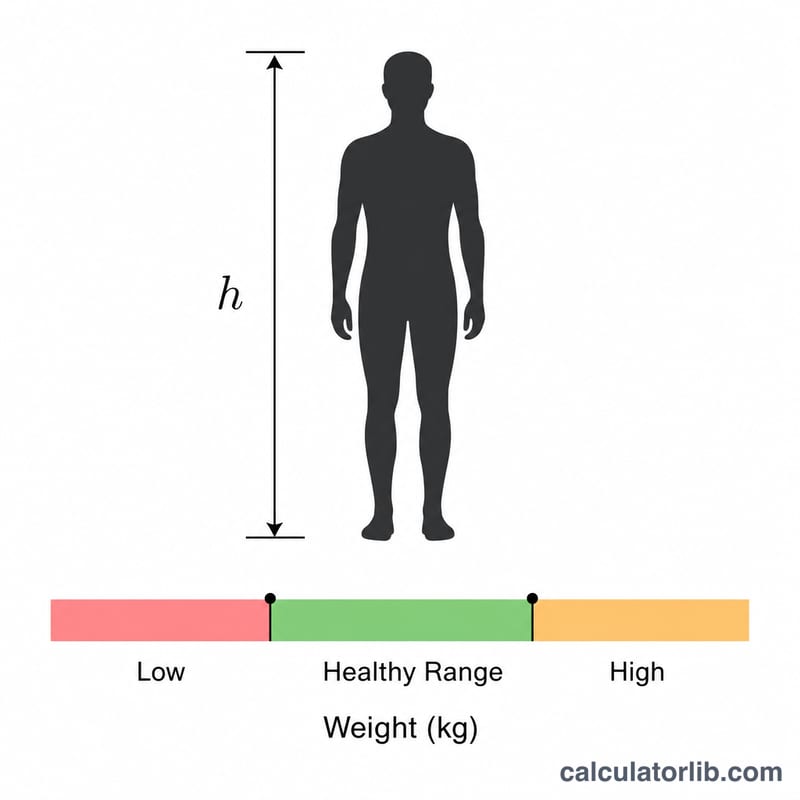
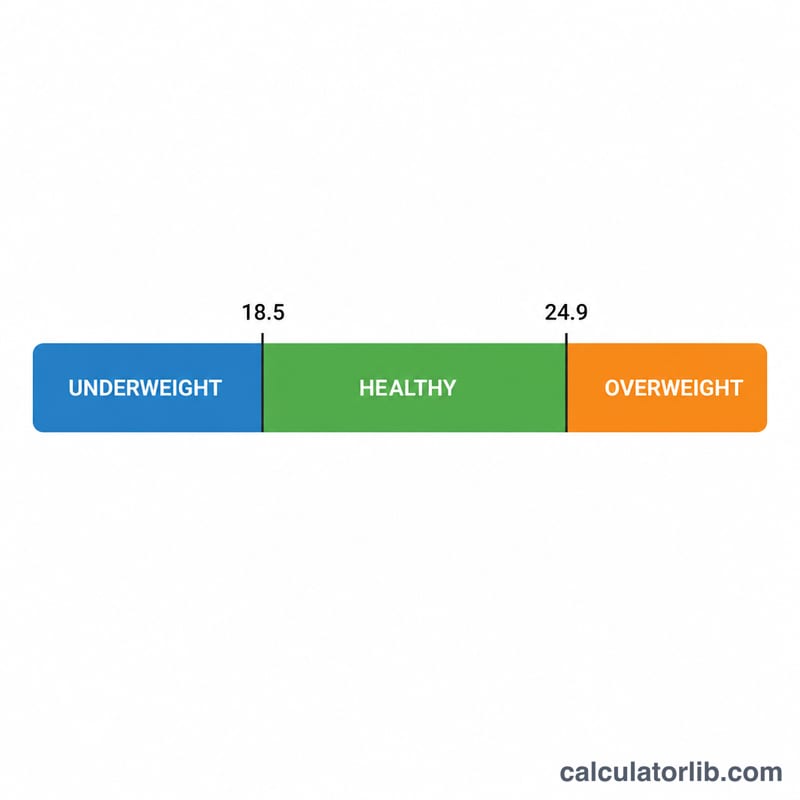
This calculator tells you the range of body weights considered healthy for your height, based on the World Health Organization's "normal" Body Mass Index (BMI) category of 18.5 to 24.9. Below 18.5 is generally classed as underweight, and 25 or above as overweight. Because BMI depends only on height and weight, you can reverse it: enter your height and the tool returns the lowest and highest weight that still keep you inside the healthy band.
How to use it
Enter your height in centimetres and press calculate. The result shows two weights in kilograms — the lower limit (BMI 18.5) and the upper limit (BMI 24.9). Any weight between these two values falls in the healthy range for your height. This tool is a general guide and does not account for muscle mass, age, or body composition; athletes and the elderly may sit naturally outside these limits.
The formula explained
BMI is defined as weight in kilograms divided by height in metres squared: \(\text{BMI} = \text{kg} / \text{m}^2\). Rearranging for weight gives \(\text{weight} = \text{BMI} \times \text{height}^2\). To find the boundaries of the healthy zone we plug in the two edge values of the normal BMI band:
$$\text{Lower weight} = 18.5 \times \text{height}^2$$
$$\text{Upper weight} = 24.9 \times \text{height}^2$$
Height is first converted from centimetres to metres by dividing by 100.
Worked example
Suppose your height is 170 cm. Convert to metres: 1.70 m, so \(\text{height}^2 = 2.89 \text{ m}^2\). $$\text{Lower limit} = 18.5 \times 2.89 = 53.465 \text{ kg}$$ $$\text{Upper limit} = 24.9 \times 2.89 = 71.961 \text{ kg}$$ So a healthy weight for someone 170 cm tall is roughly 53.5 kg to 72.0 kg.
Interpreting Your Result
The calculator returns the lowest and highest body weights that fall within the WHO healthy BMI band (18.5–24.9) for your height. Here is how to read where you sit relative to that range:
- Below the range: Your weight corresponds to a BMI under 18.5 (underweight). This can reflect low energy reserves, recent weight loss, or simply a naturally light build, and is worth discussing with a clinician if unexplained.
- Within the range: Your weight maps to a BMI of 18.5–24.9, the band the WHO associates with the lowest average health risk for adults.
- Above the range: Your weight gives a BMI of 25 or more (overweight or obese). This is a flag for further assessment, not a diagnosis on its own.
BMI is a screening tool, not a measure of health or body composition. Because it uses only height and weight, it cannot distinguish muscle from fat. Very muscular people (for example athletes) may register as "overweight" despite low body fat, while others within the normal band may carry excess fat with reduced muscle. It also does not capture fat distribution, age-related changes in body composition, bone density, sex, or ethnicity-specific risk thresholds.
For a fuller picture, body fat estimates such as the BMI-method body fat calculator or fat-distribution measures like the waist-to-hip ratio can complement BMI.
These categories follow the WHO international classification for adults. This page provides general information only and is not medical advice; for guidance specific to your circumstances, consult a qualified healthcare professional.
FAQ
Why 24.9 instead of 25? A BMI of exactly 25.0 is the start of the overweight category, so 24.9 is the highest value still inside the healthy band.
Does this work for children? No. Children and teenagers use age- and sex-specific BMI percentile charts, not the fixed 18.5–24.9 adult cut-offs.
Is BMI accurate for everyone? BMI is a screening tool, not a diagnosis. It can overestimate fat in muscular people and underestimate it in others. Use it as a rough guide alongside professional advice.